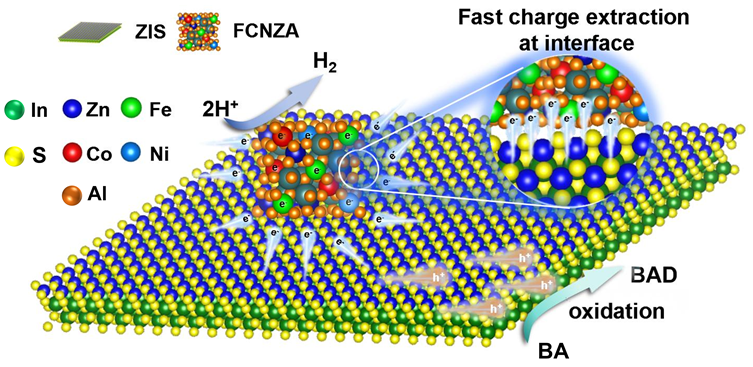
Photocatalytic hydrogen production provides a promising route for converting solar energy into green hydrogen fuels. However, the practical application is often limited by its rapid carrier recombination and sluggish redox dynamics. Coupling hydrogen evolution with the selective oxidation of organic chemicals offers an attractive strategy to simultaneously utilize photogenerated electrons and photogenerated holes, thereby improving solar-energy utilization while producing value-added chemicals. Herein, medium-entropy (FeCoNiZn)Al2O4 (FCNZA) cocatalysts were introduced onto ZIS nanosheets to construct Schottky-type FCNZA/ZIS junctions for enhanced photocatalytic hydrogen reduction coupled with benzyl alcohol oxidation. Comprehensive structural characterization confirmed the successful coupling of FCNZA with ZIS while retaining the original crystal structures of the two components. More importantly, Fe-S, Co-S, and Ni-S bonds formed at the FCNZA/ZIS interface, which was favorable for the interfacial charge migration. Consequently, under visible-light irradiation, the optimal FCNZA-2.0/ZIS delivered a hydrogen evolution rate of 18.43 mmol·g-1·h-1, representing a 13.96-fold enhancement compared with pure ZIS. Meanwhile, the benzaldehyde production rate reached 12.35 mmol·g-1·h-1, which was 10.74 times that of pure ZIS. Such results demonstrated the simultaneous enhancement of the reduction-side and oxidation-side reactions. The apparent quantum efficiency (AQE) of FCNZA-2.0/ZIS reached 62.10% at 350 nm and 11.90% at 420 nm. In addition, the composite retained 92.16% of its initial photocatalytic activity after four consecutive cycles, confirming its good photostability. Photoelectrochemical measurements, spectroscopic characterization and band-structure analyses revealed that the enhanced photocatalytic performance originated from the synergistic effects of the medium-entropy cocatalyst, Schottky contact, and chemically-bonded interface. Upon contact, interfacial charge redistribution between ZIS and FCNZA established a Schottky contact that facilitated the directional migration and rapid electron extraction from ZIS to FCNZA. Meanwhile, the chemically-coupled interface provided efficient charge-transfer pathways, thereby suppressing electron-hole recombination. The transferred electrons participated in subsequent proton reduction for H2 evolution, whereas the holes remaining in ZIS drived the selective oxidation of benzyl alcohol to benzaldehyde. This work demonstrates an effective strategy of medium-entropy cocatalysts to enhance the solar-energy utilization and provides an insight into the rational construction of Schottky-type contact for efficient photocatalytic hydrogen production coupled with value-added chemicals generation.
[1] Lee W. H.; Lee C. W.; Cha G. D.; Lee B. H.; Jeong J. H.; Park H.; Heo J.; Bootharaju M. S.; Sunwoo S. H.; Kim J. H.; Ahn K. H.; Kim D. H.; Hyeon T. Nat. Nanotechnol.,2023, 18, 754-762.
[2] Luo Y. L.; Zhuang Z. Y.; Fan F. T.; Li, C. Acta Chim. Sinica2025, 83, 608-615 (in Chinese).
(罗雅玲, 庄展洋, 范峰滔, 李灿. 化学学报, 2025, 83, 608-615.)
[3] Le Y. T. H.; Wu J. C. S.; Yu W.-Y.; Yeh C.-L.; Kržmanc, M. M. Int. J. Hydrogen Energ. 2025, 130, 390-401.
[4] Duan W.; Li W.; Cui R. X.; Ma T. H.; Su Y.; Hou C. P.; Wang, C. Y. Angew. Chem. Int. Ed. 2026, 65, e4629546.
[5] He J. Y.; Zhang W. S.; Liu Z. G.; Wang Z. M.; Lu K. Q.; Yang, K. J. Liaocheng Univ. (Nat. Sci. Ed.)2025, 38, 421-429 (in Chinese).
(何静怡, 张文森, 刘曾光, 王泽蒙, 卢康强, 杨凯. 聊城大学学报(自然科学版), 2025, 38, 421-429.)
[6] Duan W.; Li W.; Liao G. C.; Zhang Z. Q.; Su Y.; Ali N.; Wang Y. S.; Cui R. X.; Tong, J. B. ACS Appl. Mater. Interfaces2026, 18, 35427-35438.
[7] Wang B.; Liu M.; Zhou Z.; Guo L. Adv. Sci.2015, 2, 1500153.
[8] Zhang L.; Shi X.; Xu A.; Zhong W.; Zhang J.; Shen S. Nano Res.2024, 17, 3693-3699.
[9] Liu D.; Dai L.; Lin X.; Chen J.; Zhang J.; Feng X.; Müllen K.; Zhu X.; Dai S. Adv. Mater.2019, 31, e1804863.
[10] Wang S. H.; Chen B. D.; Cao F. F.; Wu Q. J.; Qian C. B.; Xu F. X.; Li, Z. P. Nonferrous Met. Sci. Eng.2024, 15, 877-889 (in Chinese).
(王书红, 陈步东, 曹飞飞, 吴启军, 钱纯波, 徐飞星, 李中平. 有色金属科学与工程, 2024, 15, 877-889.)
[11] Chong W.; Ng B.; Lee Y.; Tan L.; Putri L.; Low J.; Mohamed A.; Chai S. Nat. Commun. 2023, 14, 7676.
[12] Su P.; Yu J. H.; Deng P. X.; Qu D. L.; Liang T. T.; Zhao H. H.; Yang N.; Zhang D. F.; Ge B.; Pu X. P.J. Liaocheng Univ.(Nat. Sci. Ed.) 2024, 37, 1230-131 (in Chinese).
(苏平, 于佳慧, 邓培新, 曲德亮, 梁腾腾, 赵怀浩, 杨楠, 张大凤, 葛博, 蒲锡鹏.聊城大学学报(自然科学版), 2024, 37, 123-131.)
[13] Albukhari, S. M. J. Mol. Liq. 2024, 398, 124248.
[14] Tan H.; Liu Y.; Wu H.; Zhao Y.; Zhang Y.; Liu Z.; Liu Y.; Meng S.; Peng, S. ACS Appl. Mater. Interfaces2026, 18, 8125-8132.
[15] Katzbaer R. R.; Vieira F. M. D.; Dabo I.; Mao Z.; Schaak, R. E. J. Am. Chem. Soc.2023, 145, 6753-6761.
[16] An W.; Niu Y.; Yan X.; Deng C.; Zheng C.; Li B.; Yang X.; Li N.; Yang Y.; Fan, W. J. Colloid Interface Sci. 2026, 713, 140183.
[17] Guo M.; Han Y.; Gao H.; Xu Z.; Wang D.; Peng Z.; Hou, H. Sep. Purif. Technol. 2024, 328, 125078.
[18] Chen K.; Shi Y.; Shu P.; Luo Z.; Shi W.; Guo, F. Chem. Eng. J.2022, 454, 140053.
[19] Hao X.; Deng W.; Fan Y.; Jin, Z. J. Mater. Chem. A2024, 12, 8543-8560.
[20] Kumar A.; Kanchan D. R.; Banerjee A.; Singh B. P.; Srivastava R. ACS Catal. 2025, 15, 8239-8258.
[21] Wako A. H.; Dejene F. B.; Swart, H. C. J. Rare Earth. 2014, 32, 806-811.
[22] Tu K.; Lin H.; Chou J.; Wu, J. Adv. Funct. Mater. 2025, 35, 2424279.
[23] Fan M.; Li X.; Liu L.; Wu M.; Wang S.; Ji W.; Gao Y. Water Res. 2026, 289, 125001.
[24] Nadeem S.; Khushi H. H.; Javed M.; Iqbal S.; Alsaab H. O.; Awwad N. S.; Ibrahium H. A.; Akhter T.; Rauf A.; Raza, H. J. Mol. Struct.2022, 1252, 132191.
[25] Li N.; Ding Y.; Wu J.; Zhao Z.; Li X.; Zheng Y.; Huang M.; Tao, X. ACS Appl. Mater. Interfaces2019, 11, 22297-22306.
[26] Zhou B.; Fan K.; Chong Y.; Xu S.; Wei J.; Wei J.; Sergeev A. A.; Wong K. S.; Li T.; Chen G.; Ye D.; Yan, K. ACS Energy Lett. 2024, 9, 1743-1752.
[27] Liu Y., Xue W., Ye J., Zhang R., Rangappa A. P., Zhao J., Small, 2025, 21, 2409005.
[28] Chen R.; Fan F.; Dittrich T.; Li, C. Chem. Soc. Rev.2018, 47, 8238-8262.
[29] Andreou E. K.; Vamvasakis I.; Armatas, G. S. ACS Appl. Energy Mater. 2024, 7, 4891-4903.
[30] Ma R. D.; Guo X.; Shi K. X.; An S. L.; Wang R. F.; Guo, R. H. J. Inorg. Mater. 2023, 38, 1176-1182 (in Chinese).
(马润东, 郭雄, 施凯旋, 安胜利, 王瑞芬, 郭瑞华. 无机材料学报, 2023, 38, 1176-1182.)
[31] Ge M.; Cao C.; Li S.; Tang Y.; Wang L.; Qi N.; Huang J.; Zhang K.; Al-Deyab S. S.; Lai Y. Nanoscale2016, 8, 5226-5234.
[32] Xiao H.; Qian Q.; Zang, Z. Sci. China Mater. 2023, 66, 1810-1819.
[33] Wang W.; Bai X.; Ci Q.; Du L.; Ren X.; Phillips, D. Adv. Funct. Mater. 2021, 31, 2103978.
[34] Wang H.; Jing L.; Zhang H.; Varamesh A.; Yan Y.; Gao Q.; Li Z.; Hu, J. J. Energy Chem. 2025, 105, 373-384.
[35] Liu C.; Yu H.; Li J. M.; Yu Q.; Song Y. X.; Zhang F.; Zhang Q. F.; Zou, Z. G. Acta Phys.-Chim. Sin.2025, 41, 10-23 (in Chinese).
(刘超, 余欢, 李佳明, 余茜, 宋玉玺, 张峰, 张勤芳, 邹志刚. 物理化学学报, 2025, 41, 10-23.)
[36] Tuo X. W.; Li W.; Duan W.; Ma T. H.; Su Y.; Hou, C. P. Appl. Catal. B-Environ. Energy 2027, 402, 127461.
[37] Hao H.; Zhang L.; Wang W.; Qiao S.; Liu, X. ACS Sustainable Chem. Eng. 2019, 7, 10501-10508.
[38] Tan C.-L.; Qi M.-Y.; Tang Z.-R.; Xu, Y.-J. Appl. Catal. B-Environ. 2021, 298, 120541.