

Acta Chimica Sinica ›› 2025, Vol. 83 ›› Issue (7): 667-673.DOI: 10.6023/A25050172 Previous Articles Next Articles
Article
张杰豪a, 徐明金a, 古满珍a,b, 马浩文b, 蔡倩b,*( )
)
投稿日期:2025-05-15
发布日期:2025-07-28
基金资助:
Jiehao Zhanga, Mingjin Xua, Manzhen Gua,b, Haowen Mab, Qian Caib,*()
Received:2025-05-15
Published:2025-07-28
Contact:
*E-mail: caiqian@zjnu.edu.cn
Supported by:Share
Jiehao Zhang, Mingjin Xu, Manzhen Gu, Haowen Ma, Qian Cai. Copper(I)-Catalyzed Asymmetric Kinugasa/Aldol Reactions for the Construction of Chiral Spiro β-Lactams[J]. Acta Chimica Sinica, 2025, 83(7): 667-673.


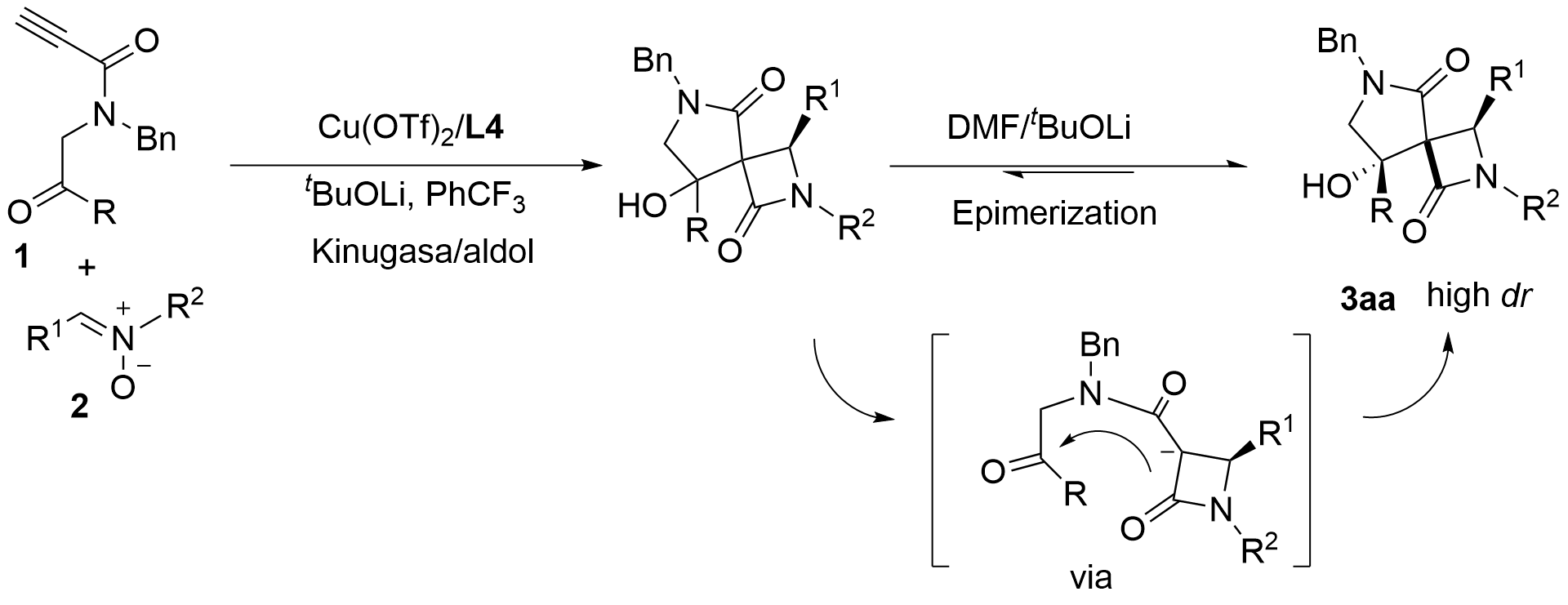
| Entry | L* | Solvent | Base | Yieldb/% | drc (3aa/3aa') | erd (3aa) |
|---|---|---|---|---|---|---|
| 1 | L1 | PhCF3 | tBuOLi | 41 | 4∶1 | 62∶38 |
| 2 | L2 | PhCF3 | tBuOLi | 39 | 10∶1 | 53∶47 |
| 3 | L3 | PhCF3 | tBuOLi | 58 | 8∶1 | 55∶45 |
| 4 | L4 | PhCF3 | tBuOLi | 66 | 3∶1 | 90∶10 |
| 5 | L5 | PhCF3 | tBuOLi | 58 | 7∶1 | 55∶45 |
| 6 | L4 | MeCN | tBuOLi | 51 | 1∶1 | 53∶47 |
| 7 | L4 | DCE | tBuOLi | 36 | 6∶1 | 64∶36 |
| 8 | L4 | 1,4-dioxane | tBuOLi | 47 | 2∶1 | 86∶14 |
| 9 | L4 | THF | tBuOLi | 41 | 3∶1 | 88∶12 |
| 10 | L4 | DMF | tBuOLi | n.d. | — | — |
| 11 | L4 | PhCF3 | K2CO3 | 46 | 3∶1 | 80∶20 |
| 12 | L4 | PhCF3 | Cs2CO3 | 44 | 2∶1 | 85∶15 |
| 13 | L4 | PhCF3 | NaH | 35 | 3∶1 | 75∶25 |
| Entry | L* | Solvent | Base | Yieldb/% | drc (3aa/3aa') | erd (3aa) |
|---|---|---|---|---|---|---|
| 1 | L1 | PhCF3 | tBuOLi | 41 | 4∶1 | 62∶38 |
| 2 | L2 | PhCF3 | tBuOLi | 39 | 10∶1 | 53∶47 |
| 3 | L3 | PhCF3 | tBuOLi | 58 | 8∶1 | 55∶45 |
| 4 | L4 | PhCF3 | tBuOLi | 66 | 3∶1 | 90∶10 |
| 5 | L5 | PhCF3 | tBuOLi | 58 | 7∶1 | 55∶45 |
| 6 | L4 | MeCN | tBuOLi | 51 | 1∶1 | 53∶47 |
| 7 | L4 | DCE | tBuOLi | 36 | 6∶1 | 64∶36 |
| 8 | L4 | 1,4-dioxane | tBuOLi | 47 | 2∶1 | 86∶14 |
| 9 | L4 | THF | tBuOLi | 41 | 3∶1 | 88∶12 |
| 10 | L4 | DMF | tBuOLi | n.d. | — | — |
| 11 | L4 | PhCF3 | K2CO3 | 46 | 3∶1 | 80∶20 |
| 12 | L4 | PhCF3 | Cs2CO3 | 44 | 2∶1 | 85∶15 |
| 13 | L4 | PhCF3 | NaH | 35 | 3∶1 | 75∶25 |
| Entry | Solvent 2 | Yieldb/% | drc (3aa/3aa') |
|---|---|---|---|
| 1 | PhCF3 | 46 | 3∶1 |
| 2 | DCE | 36 | 4∶1 |
| 3 | THF | 38 | 3∶1 |
| 4 | MeCN | 41 | 6∶1 |
| 5 | 1,4-dioxane | 46 | 3∶1 |
| 6 | DMF | 51 | 9∶1 |
| Entry | Solvent 2 | Yieldb/% | drc (3aa/3aa') |
|---|---|---|---|
| 1 | PhCF3 | 46 | 3∶1 |
| 2 | DCE | 36 | 4∶1 |
| 3 | THF | 38 | 3∶1 |
| 4 | MeCN | 41 | 6∶1 |
| 5 | 1,4-dioxane | 46 | 3∶1 |
| 6 | DMF | 51 | 9∶1 |



| [1] |
(a)
pmid: 21861821 |
|
(b)
pmid: 21861821 |
|
|
(c)
pmid: 21861821 |
|
|
(d)
pmid: 21861821 |
|
|
(e)
pmid: 21861821 |
|
|
(f)
pmid: 21861821 |
|
| [2] |
For reviews and examples about synthesis of β-lactams and spiro β-lactams, see: (a)
pmid: 25003801 |
|
(b)
doi: 10.1021/cr500127b pmid: 25003801 |
|
|
(c)
pmid: 25003801 |
|
|
(d)
pmid: 25003801 |
|
|
(e)
pmid: 25003801 |
|
|
(f)
pmid: 25003801 |
|
|
(g)
pmid: 25003801 |
|
|
(h)
pmid: 25003801 |
|
| [3] |
For reviews about Staudinger cycloaddition, see: (a)
doi: 10.1021/cr0307300 pmid: 17649981 |
|
(b)
pmid: 17649981 |
|
|
(c)
pmid: 17649981 |
|
|
(d)
pmid: 17649981 |
|
| [4] |
For a book and selected examples, see: (a)
|
|
(b)
|
|
|
(c)
|
|
|
(d)
|
|
| [5] |
For reviews about the Kinugasa reaction, see: (a)
|
|
(b)
|
|
|
(c)
|
|
|
(邱孔茜, 李杰, 马浩文, 周伟, 蔡倩, 化学学报, 2023, 81, 42.)
doi: 10.6023/A22100419 |
|
|
(d)
|
|
| [6] |
|
| [7] |
|
| [8] |
For selected examples of racemic Kinugasa reactions, see: (a)
|
|
(b)
|
|
|
(c)
|
|
|
(d)
|
|
|
(e)
|
|
| [9] |
For selected examples of asymmetric Kinugasa reactions, see: (a)
pmid: 21744801 |
|
(b)
pmid: 21744801 |
|
|
(c)
pmid: 21744801 |
|
|
(d)
pmid: 21744801 |
|
|
(e)
doi: 10.1002/chem.201702070 pmid: 21744801 |
|
|
(f)
doi: 10.1021/jo2010846 pmid: 21744801 |
|
|
(g)
pmid: 21744801 |
|
|
(h)
pmid: 21744801 |
|
|
(i)
pmid: 21744801 |
|
|
(王琳璇, 徐政虎, 有机化学, 2022, 42, 3912.)
doi: 10.6023/cjoc202200067 pmid: 21744801 |
|
| [10] |
(a)
|
|
(b)
|
|
|
(c)
|
|
|
(d)
|
|
| [11] |
|
| [12] |
|
| [13] |
(a)
|
|
(b)
|
|
| [14] |
|
| [15] |
(a)
|
|
(b)
|
|
|
(c)
|
|
|
(d)
|
|
| [16] |
For the crystal structures of 3aa and 3aa′, see CCDC (2426984, 2458837) and Supporting Information.
|
| [1] | Xiaochen Wang, Zeyao Ji, Jian Liu, Bingfu Wang, Hui Jin, Lixin Zhang. Advances in Organocatalytic Asymmetric Reactions Involving Thioesters [J]. Acta Chimica Sinica, 2023, 81(1): 64-83. |
| [2] | Cai Qian, Ma Haowen. Recent Advances of Chiral Hypervalent Iodine Reagents [J]. Acta Chim. Sinica, 2019, 77(3): 213-230. |
| [3] | Liu Yunlin, Zhou Jian. Highly Enantioselective Organocatalytic Asymmetric Mukaiyama-aldol Reaction of Difluoroenoxysilanes with β,γ-Unsaturated α-Ketoesters [J]. Acta Chimica Sinica, 2012, 70(13): 1451-1456. |
| [4] | ZHENG Ji-Fu; LI Yao-Xian; ZHANG Suo-Qin*; WANG Xiao-Ming; YANG Song-Tao; BAI Jie; WANG Fang; ZHANG Guang-Liang; LIU Fu-An. Studies on Synthesis of Novel Chiral Organocatalysts and Its Evaluations for Asymmetric Direct Aldol Reactions [J]. Acta Chimica Sinica, 2007, 65(6): 553-556. |
| [5] | ZHANG Chao-Xin; DA Shi-Jun; ZHANG Hua-Bing; SUN Bin; LI Ying. Asymmetric Total Synthesis of (+)-Disparlure: (+)-(7R,8S)-cis-7,8- ep-oxy-2-methyloctadecane [J]. Acta Chimica Sinica, 2007, 65(21): 2433-2436. |
| [6] | WANG Jian-Ping, CHENG Xi-Xing2, CHEN Qing-Hua*,1. Synthesis and Structure of Some Functionalized Chiral Aziridine Derivatives [J]. Acta Chimica Sinica, 2006, 64(7): 686-690. |
| [7] | GUO Jin-Bo; ZHANG Xi-Yun2; CHEN Qing-Hua*,1,2. Study of the Synthetic Method of Cyclopropane Derivatives Based on 3-Bromo-2,5-dihydro-5-menthyloxyfuran-2-one: Asymmetric Tandem Reaction Starting by Carbon Nucleophile [J]. Acta Chimica Sinica, 2006, 64(19): 2008-2014. |
| [8] | FAN Jian-Fen*, WU Li-Fen. Transition State Study on the S-Proline-catalyzed Direct Aldol Reaction between Acetone and 2,2-Dimethyl-propionaldehyde [J]. Acta Chimica Sinica, 2005, 63(8): 677-680. |
| Viewed | ||||||
|
Full text |
|
|||||
|
Abstract |
|
|||||
