

Acta Chimica Sinica ›› 2026, Vol. 84 ›› Issue (2): 196-207.DOI: 10.6023/A25100334 Previous Articles Next Articles
Article
刘庆a, 陈双龙a, 王秋实a,*( ), 王雪娇b, 刘才龙c
投稿日期:2025-10-11
发布日期:2025-12-10
基金资助:
Qing Liua, Shuanglong Chena, Qiushi Wanga,*(), Xuejiao Wangb, Cailong Liuc
Received:2025-10-11
Published:2025-12-10
Contact:
*E-mail: wang_jiu_jiu@foxmail.com
Supported by:Share
Qing Liu, Shuanglong Chen, Qiushi Wang, Xuejiao Wang, Cailong Liu. Plasma-assisted Synthesis of ZnO:Er3+/Yb3+ Hierarchical Nanorods and Their Upconversion Luminescence-based Trimodal Optical Thermometry Properties[J]. Acta Chimica Sinica, 2026, 84(2): 196-207.


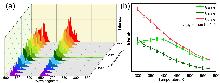

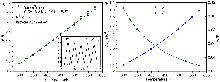
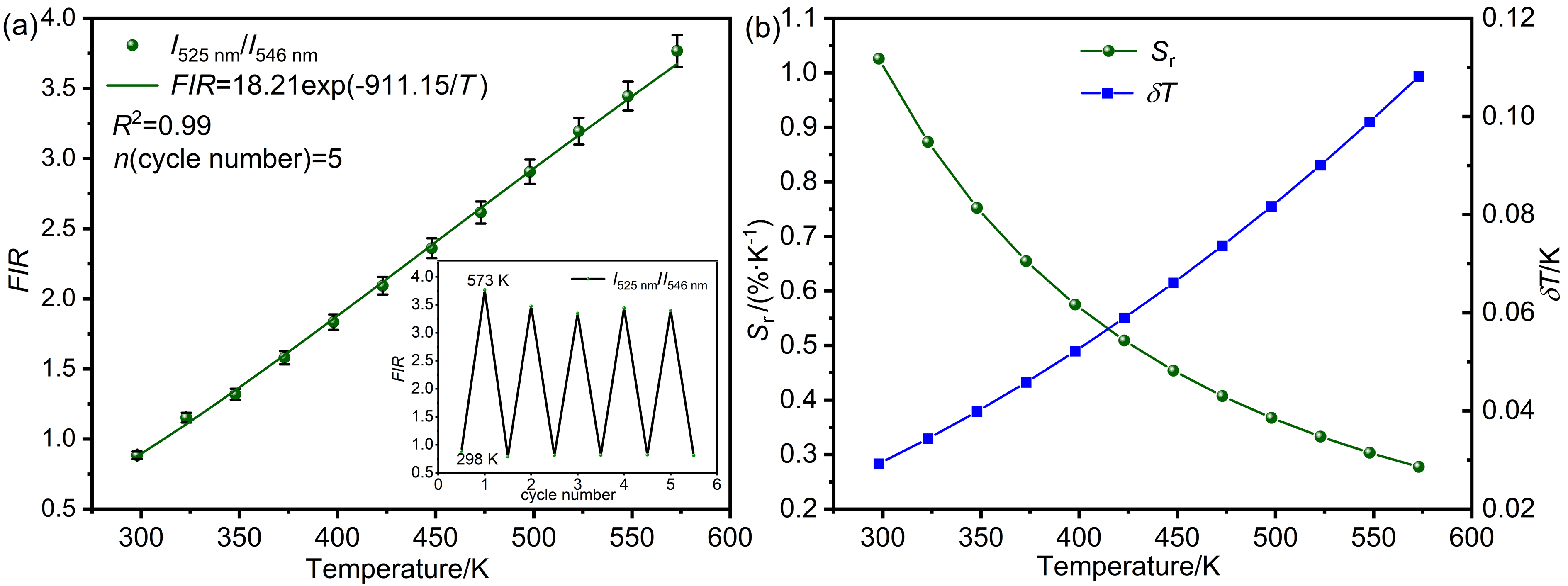
| Er3+/Yb3+掺杂不同基质材料 | 跃迁能级 | 温度范围/K | 最大相对灵敏度/(%•K−1) | 参考文献 |
|---|---|---|---|---|
| NaYF4 | 2H11/2, 4S3/2 | 198~498 | 0.46 | [ |
| β-NaGdF4 | 2H11/2, 4S3/2 | 303~563 | 0.37 | [ |
| NaLnTiO4 | 2H11/2, 4S3/2 | 300~510 | 0.45 | [ |
| LiGa5O8 | 2H11/2, 4S3/2 | 300~480 | 0.35 | [ |
| Ba2SrLu4O9 | 2H11/2, 4S3/2 2H11/2, 4F9/2 | 303~573 | 0.99 0.88 | [ |
| Ca3Y2Ge3O12 | 2H11/2, 4S3/2 2H11/2, 4F9/2 | 293~473 | 1.29 1.09 | [ |
| ZnO | 2H11/2, 4S3/2 2H11/2, 4F9/2 | 298~573 | 1.03 2.20 | 本文 |
| Er3+/Yb3+掺杂不同基质材料 | 跃迁能级 | 温度范围/K | 最大相对灵敏度/(%•K−1) | 参考文献 |
|---|---|---|---|---|
| NaYF4 | 2H11/2, 4S3/2 | 198~498 | 0.46 | [ |
| β-NaGdF4 | 2H11/2, 4S3/2 | 303~563 | 0.37 | [ |
| NaLnTiO4 | 2H11/2, 4S3/2 | 300~510 | 0.45 | [ |
| LiGa5O8 | 2H11/2, 4S3/2 | 300~480 | 0.35 | [ |
| Ba2SrLu4O9 | 2H11/2, 4S3/2 2H11/2, 4F9/2 | 303~573 | 0.99 0.88 | [ |
| Ca3Y2Ge3O12 | 2H11/2, 4S3/2 2H11/2, 4F9/2 | 293~473 | 1.29 1.09 | [ |
| ZnO | 2H11/2, 4S3/2 2H11/2, 4F9/2 | 298~573 | 1.03 2.20 | 本文 |
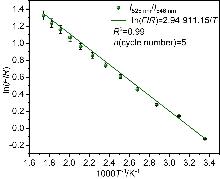


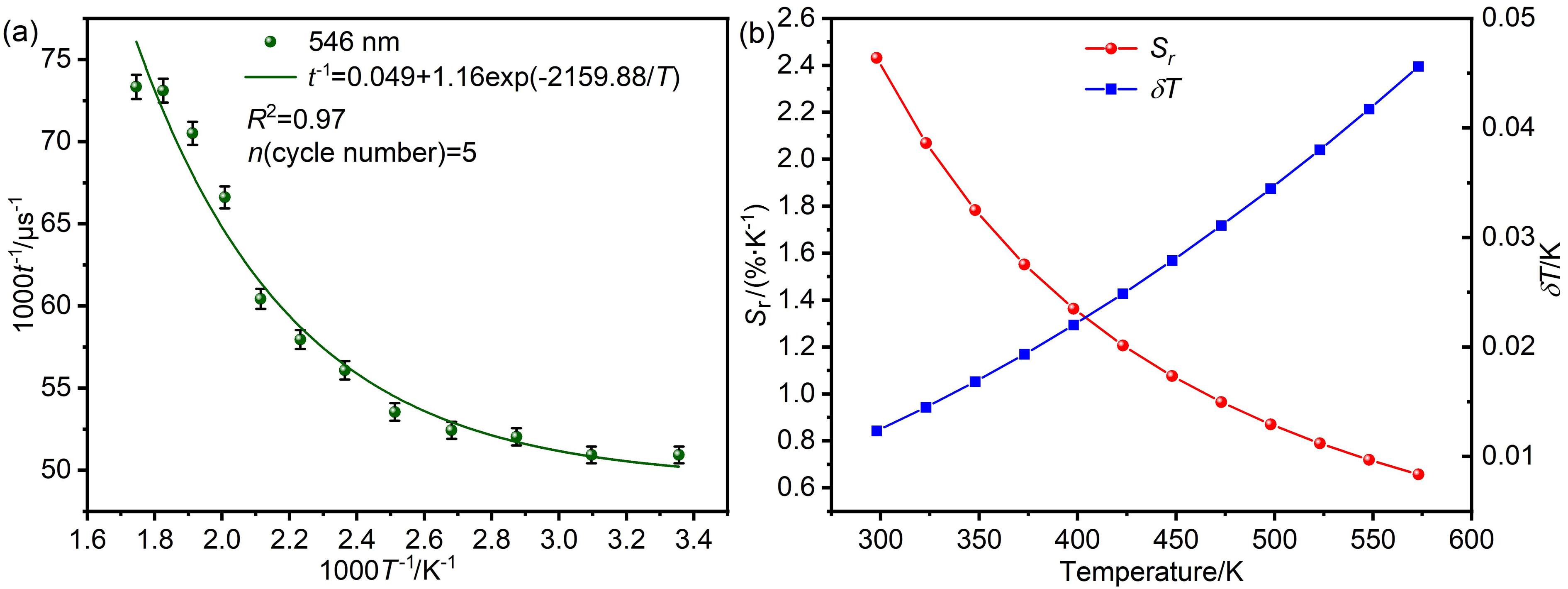
| Er3+/Yb3+掺杂不同基质材料 | 跃迁能级 | 温度范围/K | 最大相对灵敏度/(%•K−1) | 参考文献 |
|---|---|---|---|---|
| Ca2MgWO6 | 4S3/2 | 303~573 | 0.11 | [ |
| Ba9Y2Si6O24 | 4S3/2 | 303~483 | 0.14 | [ |
| Na2YMg2(VO4)3 | 4S3/2 | 323~573 | 0.09 | [ |
| Ba2SrLu4O9 | 4S3/2 | 303~573 | 0.36 | [ |
| Y1. 88WO6 | 4S3/2 | 303~543 | 0.10 | [ |
| Ca3Y2Ge3O12 | 4S3/2 | 293~473 | 1.03 | [ |
| ZnO | 4S3/2 | 298~573 | 2.43 | 本文 |
| Er3+/Yb3+掺杂不同基质材料 | 跃迁能级 | 温度范围/K | 最大相对灵敏度/(%•K−1) | 参考文献 |
|---|---|---|---|---|
| Ca2MgWO6 | 4S3/2 | 303~573 | 0.11 | [ |
| Ba9Y2Si6O24 | 4S3/2 | 303~483 | 0.14 | [ |
| Na2YMg2(VO4)3 | 4S3/2 | 323~573 | 0.09 | [ |
| Ba2SrLu4O9 | 4S3/2 | 303~573 | 0.36 | [ |
| Y1. 88WO6 | 4S3/2 | 303~543 | 0.10 | [ |
| Ca3Y2Ge3O12 | 4S3/2 | 293~473 | 1.03 | [ |
| ZnO | 4S3/2 | 298~573 | 2.43 | 本文 |
| [1] |
doi: 10.1021/acs.inorgchem.9b01229 |
| [2] |
doi: 10.6023/A13050490 |
|
(魏忠杰, 刘桂霞, 董相廷, 王进贤, 于文生, 化学学报, 2014, 72, 257.)
doi: 10.6023/A13050490 |
|
| [3] |
doi: 10.6023/A20050154 |
|
(黄清明, 化学学报, 2020, 78, 968.)
doi: 10.6023/A20050154 |
|
| [4] |
doi: 10.6023/A21120618 |
|
(胡晓柯, 商晓颖, 黄萍, 郑伟, 陈学元, 化学学报, 2022, 80, 244.)
doi: 10.6023/A21120618 |
|
| [5] |
doi: 10.1002/adom.v6.17 |
| [6] |
doi: 10.1016/j.cej.2019.06.015 |
| [7] |
doi: 10.1016/j.jlumin.2020.117145 |
| [8] |
doi: 10.1016/j.jnoncrysol.2021.121055 |
| [9] |
doi: 10.1039/C8TC02401D |
| [10] |
doi: 10.1016/j.cej.2020.125178 |
| [11] |
doi: 10.1021/acs.jpclett.1c04000 |
| [12] |
doi: 10.1021/jp0686689 |
| [13] |
doi: 10.1016/j.ceramint.2021.10.080 |
| [14] |
doi: 10.1039/C8TC03642J |
| [15] |
doi: 10.1111/jace.v107.7 |
| [16] |
doi: 10.1016/j.cej.2020.127470 |
| [17] |
doi: 10.1039/D3NR00893B |
| [18] |
doi: 10.1007/s12034-025-03432-3 |
| [19] |
doi: 10.1021/acs.inorgchem.0c02118 |
| [20] |
doi: 10.1016/j.cej.2021.128977 |
| [21] |
doi: 10.1021/acsami.5b06036 |
| [22] |
doi: 10.1016/j.ceramint.2020.09.106 |
| [23] |
doi: 10.1039/C8TC03851A |
| [24] |
doi: 10.1016/j.jallcom.2018.07.012 |
| [25] |
|
|
(李敬远, 刘欣, 刘胜杰, 中国材料进展, 2024, 43, 1118.)
|
|
| [26] |
doi: 10.1016/j.jcis.2011.03.036 |
| [27] |
doi: 10.1016/j.tsf.2014.03.078 |
| [28] |
doi: 10.1016/j.saa.2015.05.081 pmid: 26092606 |
| [29] |
doi: 10.1063/1.2980326 |
| [30] |
doi: 10.1166/jnn.2021.19489 pmid: 33980385 |
| [31] |
doi: 10.6023/A19070268 |
|
(孟双艳, 王明明, 吕柏霖, 薛群基, 杨志旺, 化学学报, 2019, 77, 1184.)
doi: 10.6023/A19070268 |
|
| [32] |
doi: 10.6023/A24110358 |
|
(佟浩, 邓玉雪, 李磊, 陶铮, 申来法, 张校刚, 化学学报, 2025, 83, 110.)
doi: 10.6023/A24110358 |
|
| [33] |
doi: 10.1007/s10854-018-9645-4 |
| [34] |
doi: 10.1016/j.sna.2017.11.033 |
| [35] |
doi: 10.1016/j.sna.2018.11.043 |
| [36] |
doi: 10.1088/2050-6120/aa9c13 |
| [37] |
doi: 10.1063/1.4906976 |
| [38] |
doi: 10.5185/amlett.2015.5801 |
| [39] |
doi: 10.1016/j.solidstatesciences.2008.10.016 |
| [40] |
doi: 10.1088/0022-3727/42/21/215007 |
| [41] |
doi: 10.1016/j.seppur.2019.115726 |
| [42] |
doi: 10.1039/C6TC04296A |
| [43] |
|
| [44] |
|
| [45] |
doi: 10.1039/c2nr31316b |
| [46] |
doi: 10.1039/C5RA08325G |
| [47] |
doi: 10.1016/j.jallcom.2022.164461 |
| [48] |
doi: 10.1039/c2ce26757h |
| [49] |
doi: 10.1016/j.jlumin.2015.06.017 |
| [50] |
doi: 10.1039/c1ce05159h |
| [51] |
doi: 10.6023/A13020187 |
|
(黄清明, 俞瀚, 张新奇, 俞建长, 化学学报, 2013, 71, 1071.)
doi: 10.6023/A13020187 |
|
| [52] |
doi: 10.1021/acs.jpcc.5b11786 |
| [53] |
doi: 10.1021/acs.inorgchem.0c01543 |
| [54] |
doi: 10.1016/j.saa.2007.02.017 |
| [55] |
doi: 10.1088/1742-6596/1695/1/012041 |
| [56] |
doi: 10.1016/j.jlumin.2023.119907 |
| [57] |
|
|
(李玉强, 杨健, 王帅, 郑基源, 赵炎, 周恒为, 刘玉学, 人工晶体学报, 2024, 53, 649.)
|
|
| [58] |
doi: 10.1039/c3ra47264g |
| [59] |
|
|
(于晓晨, 李华健, 高博扬, 蒋银林, 李小杰, 郑荣芳, 吴涵, 宋泽钰, 樊继斌, 赵鹏, 材料导报, 2022, 36, 21050128.)
|
|
| [60] |
doi: 10.1016/j.molstruc.2019.127665 |
| [61] |
doi: 10.1039/D1CE01651B |
| [62] |
doi: 10.1016/j.jlumin.2022.119121 |
| [63] |
doi: 10.1016/j.jlumin.2023.120331 |
| [64] |
doi: 10.1016/j.jlumin.2019.116632 |
| [65] |
doi: 10.1016/j.jallcom.2015.02.170 |
| [66] |
doi: 10.1039/C4RA11771A |
| [67] |
doi: 10.1039/C7TC04410K |
| [68] |
doi: 10.1016/j.matchemphys.2017.12.007 |
| [69] |
doi: 10.1021/acs.inorgchem.8b00102 pmid: 29664625 |
| [1] | Meng-Xin Xu, Zhi-Jian Yang, Jing Sun, Wen-Qiang Zou, Zhong-Ning Xu, Guo-Cong Guo. Oxygen Vacancies in Pd/Pr-CeO2 Catalyst Regulate the Selectivity of CO Esterification to Dimethyl Carbonate [J]. Acta Chimica Sinica, 2025, 83(7): 655-660. |
| [2] | Jian Kang, Zixuan Shi, Jingmei Li. Preparation of Highly Antimicrobial Composites and Study of Photocatalytic Antimicrobial Properties Driven by LED Light [J]. Acta Chimica Sinica, 2024, 82(9): 962-970. |
| [3] | Xiaoke Hu, Xiaoying Shang, Ping Huang, Wei Zheng, Xueyuan Chen. Polarized Upconversion Luminescence from a Single NaYF4:Yb3+/Er3+ Microrod for Orientation Tracking※ [J]. Acta Chimica Sinica, 2022, 80(3): 244-248. |
| [4] | Huang Qingming. Study on the Upconversion Luminescence Mechanism of Tegtragonal LiYF4: RE with Sublattice Energy Cluster Construction and Crystal Field Manipulation [J]. Acta Chimica Sinica, 2020, 78(9): 968-979. |
| [5] | Xiong Jingfang, Xiao Pei, Wu Qiang, Wang Xizhang, Hu Zheng. Synthesis and Gas-Sensing Properties of ZnO Porous Microflowers [J]. Acta Chimica Sinica, 2014, 72(4): 433-439. |
| [6] | Guo Chang, Li Maoguo. Synthesis and Cell Imaging of LaF3 Nanocrystals with Small Particle Size and Novel Upconversion Luminescence [J]. Acta Chimica Sinica, 2014, 72(2): 215-219. |
| [7] | Hao Rui, Deng Xiao, Yang Yibiao, Chen Deyong. Research Progress in Preparation and Applications of ZnO Nanowire/rod Arrays by Hydrothermal Method [J]. Acta Chimica Sinica, 2014, 72(12): 1199-1208. |
| [8] | SHAO Chun-Hong, LI Fen, WANG Lu, PANG Jing, WANG Wei. Effect of Multi-cycle Desulfurization and Regeneration on Surface Structure and Regeneration Performance of Desulfurizer Ce-Fe/ZnO [J]. Acta Chimica Sinica, 2011, 69(24): 3037-3042. |
| [9] | MI Ri-Gu-Li-?Mo-He-Mai-Ti, A Si-Ya-?Ke-Li-Mu, PA Ti-Man-?Ni-Zha-Mu-Ding, A Bu-Li-Zi-?Yi-Mi-Ti. Preparation of Zinc Oxide Thin Film/Tin-Diffused Optical Waveguide Sensor and Gas-sensing Detection [J]. Acta Chimica Sinica, 2011, 69(15): 1840-1844. |
| [10] | SUN Jian-Ping, WENG Jia-Bao, LIN Ting, MA Lin-Pu. Preparation and Photophysical Properties of Poly(2-methoxy-5- octyloxy)-p-phenylene Vinylene/Tb4O7 Nanocomposites [J]. Acta Chimica Sinica, 2010, 68(13): 1337-1342. |
| [11] | Guo Min;Diao Peng;Cai Shengmin. Novel Approach to Preparing Well-oriented ZnO Nanorods on Substrates [J]. Acta Chimica Sinica, 2003, 61(8): 1165-1168. |
| [12] | Zhang Shaoyan;Ding Shiwen;Liu Shujuan;Kang Quanying;Liu Yanchao;Ding Yu. Synthesis and Phtocatalytic Property of Nano-ZnO [J]. Acta Chimica Sinica, 2002, 60(7): 1225-1229. |
| [13] | Shi Shouheng;Shi Chuan;Yu Jiayou;Gao Tiehan;Wang Menglin;Wang Shaojun;Zhang Shaoyin;Dai Hongyi. Ab initio Study of the Adsorption of CO on a Zn_4O_4 Cluster [J]. Acta Chimica Sinica, 2002, 60(4): 639-642. |
| [14] | Xi Jingyu;Wang Weiping;Lu Gongxuan. Mechanism of Cu/ZnO Based Catalysis for Methanol Decomposition Promoted by Nickel [J]. Acta Chimica Sinica, 2002, 60(3): 419-426. |
| [15] | Ding Shiwen;Wang Jing;Kang Quanying;Liu Yanchao;Liu Shujuan;Ding Yu. Microwave Synthesis, Structure and Dielectric Property of Ba_(1-x) Zn_xTi_(1-y)Sn_yO_3 [J]. Acta Chimica Sinica, 2002, 60(12): 2141-2144. |
| Viewed | ||||||
|
Full text |
|
|||||
|
Abstract |
|
|||||
