Acta Chimica Sinica ›› 2026, Vol. 84 ›› Issue (8): 1305-1311.DOI: 10.6023/A26050176 Previous Articles Next Articles
Article
唐允浩a, 周齐治b, 王韬a, 邱智恒a, 乐效靖a, 张燕b,*( ), 余金生a,*()
投稿日期:2026-05-26
发布日期:2026-07-08
基金资助:
Yunhao Tanga, Qizhi Zhoub, Tao Wanga, Zhiheng Qiua, Xiaojing Lea, Yan Zhangb,*(), Jinsheng Yua,*()
Received:2026-05-26
Published:2026-07-08
Contact:
E-mail: Supported by:Share
Yunhao Tang, Qizhi Zhou, Tao Wang, Zhiheng Qiu, Xiaojing Le, Yan Zhang, Jinsheng Yu. Asymmetric Reduction of Fluorinated Aromatic Ketones Mediated by Daucus carota and Coriandrum sativum[J]. Acta Chimica Sinica, 2026, 84(8): 1305-1311.
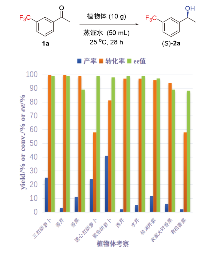
| Entry | pH | T/℃ | Y/mL | X/g | Yield a/% | eea/% |
|---|---|---|---|---|---|---|
| 1 | 7.0 | 25 | 50 | 10 | 25 | >99 |
| 2 | 6.5 | 25 | 50 | 10 | 21 | >99 |
| 3 | 7.5 | 25 | 50 | 10 | 7 | >99 |
| 4 | 7.0 | 25 | 25 | 10 | 20 | >99 |
| 5 | 7.0 | 25 | 100 | 10 | 19 | >99 |
| 6 | 7.0 | 28 | 50 | 10 | 36 | >99 |
| 7 | 7.0 | 30 | 50 | 10 | 28 | >99 |
| 8 | 7.0 | 33 | 50 | 10 | 17 | >99 |
| 9 | 7.0 | 28 | 50 | 20 | 71 | >99 |
| 10 | 7.0 | 28 | 50 | 30 | 73 | >99 |
| Entry | pH | T/℃ | Y/mL | X/g | Yield a/% | eea/% |
|---|---|---|---|---|---|---|
| 1 | 7.0 | 25 | 50 | 10 | 25 | >99 |
| 2 | 6.5 | 25 | 50 | 10 | 21 | >99 |
| 3 | 7.5 | 25 | 50 | 10 | 7 | >99 |
| 4 | 7.0 | 25 | 25 | 10 | 20 | >99 |
| 5 | 7.0 | 25 | 100 | 10 | 19 | >99 |
| 6 | 7.0 | 28 | 50 | 10 | 36 | >99 |
| 7 | 7.0 | 30 | 50 | 10 | 28 | >99 |
| 8 | 7.0 | 33 | 50 | 10 | 17 | >99 |
| 9 | 7.0 | 28 | 50 | 20 | 71 | >99 |
| 10 | 7.0 | 28 | 50 | 30 | 73 | >99 |
| Entry | 香菜部位 | T/℃ | X/g | pH | Yield a/% | eea/% |
|---|---|---|---|---|---|---|
| 1 | 茎 | 25 | 10 | 7.0 | 3 | 80 |
| 2 | 叶 | 25 | 10 | 7.0 | 12 | 88 |
| 3 | 根 | 25 | 10 | 7.0 | 7 | 91 |
| 4 | 根 | 28 | 10 | 7.0 | 8 | 91 |
| 5 | 根 | 30 | 10 | 7.0 | 5 | 88 |
| 6 | 根 | 25 | 10 | 6.5 | 3 | 91 |
| 7 | 根 | 25 | 10 | 7.5 | 4 | 91 |
| 8 | 根 | 25 | 20 | 7.0 | 11 | 91 |
| Entry | 香菜部位 | T/℃ | X/g | pH | Yield a/% | eea/% |
|---|---|---|---|---|---|---|
| 1 | 茎 | 25 | 10 | 7.0 | 3 | 80 |
| 2 | 叶 | 25 | 10 | 7.0 | 12 | 88 |
| 3 | 根 | 25 | 10 | 7.0 | 7 | 91 |
| 4 | 根 | 28 | 10 | 7.0 | 8 | 91 |
| 5 | 根 | 30 | 10 | 7.0 | 5 | 88 |
| 6 | 根 | 25 | 10 | 6.5 | 3 | 91 |
| 7 | 根 | 25 | 10 | 7.5 | 4 | 91 |
| 8 | 根 | 25 | 20 | 7.0 | 11 | 91 |
| [1] |
(a)
doi: 10.1021/acsorginorgau.2c00019 |
|
(b)
doi: 10.6023/A12070447 |
|
|
(郑柯, 林丽丽, 冯小明, 化学学报, 2012, 70, 1785.)
doi: 10.6023/A12070447 |
|
|
(c)
doi: 10.1039/D5OB00330J |
|
| [2] |
(a)
doi: 10.1021/jo0203793 pmid: 12590540 |
|
(b)
pmid: 12590540 |
|
|
(c)
pmid: 12590540 |
|
|
(王亮, 徐刚, 杨立荣, 化工进展, 2013, 32, 2691.)
pmid: 12590540 |
|
| [3] |
(a)
doi: 10.1002/anie.v50.13 |
|
(b)
doi: 10.1021/acs.orglett.6b02807 |
|
|
(c)
|
|
| [4] |
(a)
doi: 10.1021/acs.orglett.9b04253 |
|
(b)
doi: 10.1021/acs.oprd.5b00267 |
|
| [5] |
(a)
|
|
(b)
doi: 10.1080/00397910802663378 |
|
| [6] |
(a)
doi: 10.1039/b610738a |
|
(b)
doi: 10.1021/jacsau.3c00481 |
|
|
(c)
doi: 10.1002/anie.v63.24 |
|
| [7] |
(a)
doi: 10.1021/cr4002879 |
|
(b)
doi: 10.1021/acs.orglett.0c02565 |
|
|
(c)
doi: 10.1039/D3OB00193H |
|
| [8] |
(a)
|
|
(杨思娅, 孙成科, 林雪飞, 马思渝, 李宗和, 化学学报, 2003, 61, 192.)
|
|
|
(b)
doi: 10.1002/chem.v25.46 |
|
|
(c)
doi: 10.6023/A25030092 |
|
|
(李斌, 张静枫, 聂慧芳, 卢泽星, 杨贵东, 张生勇, 化学学报, 2025, 83, 661.)
doi: 10.6023/A25030092 |
|
| [9] |
(a)
|
|
(b)
doi: 10.1021/acs.orglett.5b00085 |
|
|
(c)
doi: 10.3390/molecules23102408 |
|
| [10] |
(a)
doi: 10.1016/j.biotechadv.2010.09.001 pmid: 20837129 |
|
(b)
doi: 10.1016/j.bioorg.2013.09.003 pmid: 20837129 |
|
|
(c)
doi: 10.1039/D3OB00193H pmid: 20837129 |
|
| [11] |
(a)
doi: 10.1016/j.tet.2023.133781 |
|
(b)
doi: 10.1021/acs.orglett.6c00812 |
|
| [12] |
(a)
doi: 10.1007/s10295-008-0381-2 |
|
(b)
doi: 10.1080/10242422.2021.1879795 |
|
|
(c)
doi: 10.1016/j.rechem.2024.101564 |
|
| [13] |
doi: 10.1016/j.procbio.2020.03.020 |
| [14] |
(a)
pmid: 12027710 |
|
(b)
pmid: 12027710 |
|
|
(c)
pmid: 12027710 |
|
|
(d)
doi: 10.1021/acsmedchemlett.3c00114 pmid: 12027710 |
|
| [15] |
(a)
|
|
(刘湘, 张宝立, 夏咏梅, 许建和, 化学学报, 2009, 67, 1492.)
|
|
|
(b)
doi: 10.3390/app8122605 |
|
| [16] |
(a)
doi: 10.1007/s12257-009-0207-8 |
|
(b)
doi: 10.3109/10242422.2011.635302 |
|
| [17] |
doi: 10.3109/10242422.2014.976634 |
| [18] |
|
| [19] |
doi: 10.1016/j.jics.2023.101111 |
| [20] |
doi: 10.1039/D5RA00901D |
| [21] |
|
|
(乌雅罕, 吴晶晶, 吴范宏, 生物化学与生物物理进展, 2023, 50, 1614.)
|
|
| [22] |
(a)
doi: 10.1039/D4CS01269K pmid: 38020394 |
|
(b)
doi: 10.1039/D4CS00417E pmid: 38020394 |
|
|
(c)
doi: 10.1039/D4CC03788J pmid: 38020394 |
|
|
(d)
doi: 10.1002/ajoc.201900071 pmid: 38020394 |
|
|
(e)
doi: 10.1039/C9CC07677H pmid: 38020394 |
|
|
(f)
doi: 10.1002/anie.v61.38 pmid: 38020394 |
|
|
(g)
doi: 10.1039/D2SC03958C pmid: 38020394 |
|
|
(h)
doi: 10.1021/acs.orglett.2c03393 pmid: 38020394 |
|
|
(i)
doi: 10.1002/anie.v62.9 pmid: 38020394 |
|
|
(j)
doi: 10.1039/d3sc04474b pmid: 38020394 |
|
|
(k)
doi: 10.1002/cjoc.v44.9 pmid: 38020394 |
|
|
(l)
doi: 10.1007/s11426-025-2720-1 pmid: 38020394 |
|
|
(m)
pmid: 38020394 |
|
| [23] |
doi: 10.1016/j.molcatb.2007.10.003 |
| [24] |
According to the suggestion of one reviewer, we have provided the specific yields of the reactions catalyzed by different plant tissues in Section 2 of the Supporting Information, to better evaluate the catalytic efficiency.
|
| [25] |
|
| [26] |
doi: 10.3923/pjbs.2000.250.256 |
| [27] |
doi: 10.1016/j.cbi.2010.12.005 |
| [1] | . On the Absolute Configuration of Phomallenic Acid C [J]. Acta Chimica Sinica, 2008, 66(17): 1991-1994. |
| Viewed | ||||||
|
Full text |
|
|||||
|
Abstract |
|
|||||