Special Topic

Synthesis, Characterization and Performance Study of Borosilazane as UV-Curable Borazine-Type Single Source Precursors for SiBNC Ceramic

  • Zhang Jianke ,
  • Chen Lixin ,
  • Zhang Hongxiang ,
  • He Weiqi
Expand
  • Department of Applied Chemistry, School of Science, Northwestern Polytechnical University, Xi'an 710129

Received date: 2011-09-25

  Revised date: 2011-12-06

  Online published: 2011-12-22

Supported by

Supported by Graduate Starting Seed Fund of Northwestern Polytechnical University (No. Z2011014).

Abstract

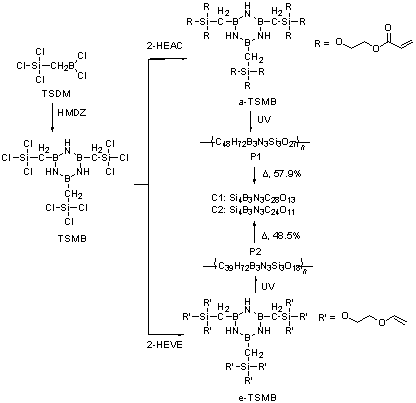
A novel borosilazane monomer terminated with Si-Cl groups: B,B',B"-tris[(trichlorosilyl)- methyl] borazine (TSMB) was synthesized through one-step route by reacting boron trichloride (BCl3), chloromethyl trichlorosilane (CH2ClSiCl3) with hexamethyldisilazane (HMDZ) as the starting materials. From functionalizing TSMB by 2-hydroxethyl acrylate and 2-hydroxyethyl vinyl ether, two UV-curable single source precursors a-TSMB and e-TSMB were obtained, respectively. Then ceramic materials C1 and C2 can be prepared with a-TSMB and e-TSMB through UV-curing and cracking under 1400 ℃ for 2 h. The chemical composition, structure, photo-curing performance and ceramic yield of the TSMB, a-TSMB and e-TSMB were investigated using infrared spectroscopy (FT-IR), nuclear magnetic resonance spectroscopy (NMR), differential photocalorimetry (DPC), real time infrared spectroscopy (RT-IR) and thermo gravimetric analyzer (TGA). The content and high temperature performance of the ceramic C1 and C2 were studied by element analysis, X-ray photoelectron spectroscopy analysis (XPS) and X-ray diffraction (XRD). Results show that both the two ceramic precursors molecules, a-TSMB and e-TSMB, contain the B-N six-member ring structure, and are terminated with acrylate or vinyl ether functional groups, which matches well with the theoretical design. The photo polymerization of the a-TSMB and e-TSMB can finish 82% and 67% in 25 s, the final conversion of the double bond can reach 90.0% and 74.0%, and the corresponding ceramic yield at 1300 ℃ is 57.9% and 48.5%, respectively. There are five elements, Si, B, C, N, and O in the C1 and C2 ceramic materials, and the contents of B are 4.4% and 4.9%, respectively, which can achieve the requirement for the high temperature ceramic material on the B element. Both the ceramic materials C1 and C2 can preserve amorphous states at 1400 ℃ and have excellent high-temperature resistance properties.

Cite this article

Zhang Jianke , Chen Lixin , Zhang Hongxiang , He Weiqi . Synthesis, Characterization and Performance Study of Borosilazane as UV-Curable Borazine-Type Single Source Precursors for SiBNC Ceramic[J]. Acta Chimica Sinica, 2012 , 70(08) : 1035 -1042 . DOI: 10.6023/A1109254

References

1 Riedel, R.; Mera, G.; Colombow, P. J. Am. Ceram. Soc.2010, 93, 1805.

2 Riedel, R.; Kienzle, A.; Dressler, W.; Ruwisch, L.; Bill, J. Nature 1996, 382, 796.  

3 Kunz, K. P.; Sarin, V. K.; Davis, R. F.; Bryan, R. F. Mater. Sci. Eng. A 1988, 105, 47.  

4 Wang, D.-H.; Jiang, L. The UV Curable Materials, Science Press, Beijing, 2001, pp. 3~7 (in Chinese). (王德海, 江棂, 紫外光固化材料, 科学出版社, 北京,2001, pp. 3~7.)

5 Reddy, S. K.; Cramer, N. B.; Cross, T.; Raj, R.; Bowman, C. N. Chem. Mater. 2003, 15, 4257.  

6 Cramer, N. B.; Reddy, S. K.; Lu, H.; Cross, T.; Raj, R.; Bowman, C. N. J. Polym. Sci. Part A: Polym. Chem. 2004,42, 1752.  

7 Li, Y.-H.; Li, X.-D.; Kim, D. P. J. Organomet. Chem. 2007,692, 5303.  

8 Li, Y.-H.; Li, X.-D.; Kim, D. P. J. Electroceram. 2009, 23,133.  

9 Zhang, G.-B.; Kong, J.; Fan, X.-D.; Li, X.-G.; Tian, W.; Huang, M.-R. Appl. Organomet. Chem. 2009, 23, 277.  

10 Zhang, G.-B.; Fan, X.-D.; Kong, J.; Liu, Y.-Y.; Wang, M.-C.; Qi, Z.-C. Macromol. Chem. Phys. 2007, 208, 541.  

11 Haberecht, J.; Krumeich, F.; Grützmacher, H.; Nesper, R. Chem. Mater. 2004, 16, 418.  

12 Gervais, C.; Maquet, J.; Babonneau, F.; Duriez, C.; Framery, E.; Vaultier, M.; Florian, P.; Massiot, D. Chem. Mater. 2001,13, 1700.  

13 Toury, B.; Miele, P. J. Mater. Chem. 2004, 14, 2609.  

14 Miele, P.; Toury, B.; Cornu, D.; Bernar, S. J. Org. Chem.2005, 690, 2809.  

15 Noth, H.; Vahrenkamp, H. Chem. Ber. 1966, 99, 1049.  

16 Jäschke, T.; Jansen, M. C. R. Chimie 2004, 7, 471.  

17 Jäschke, T.; Jansen, M. Z. Anorg. Allg. Chem. 2004, 630,239.  

18 Jäschke, T.; Jansen, M. J. Eur. Ceram. Soc. 2005, 25, 211.  

19 Jäschke, T.; Jansen, M. J. Mater. Chem. 2006, 16, 2792.  

20 Gerardin, C.; Henry, M.; Taulelle, F. Mater. Res. Soc. Symp. Proc. 1992, 271, 777.  

21 Nie, J.; Linden, L. A.; Rabek, J. F. Angew. Makromol. Chem.1998, 257, 47.  

22 Decher, C. Prog. Polym. Sci. 1996, 21, 593.  

23 Decker, C. J. Macromol. Sci., Pure Appl. Chem. 1997, 34,605.  

24 Seyferth, D.; Köjler, H. P. J. Inorg. Nucl. Chem. 1960, 15,99.  

25 Wideman, T.; Cortez, E.; Remsen, E. E.; Zank, G. A.; Carroll, P. J.; Sneddon, L. G. Chem. Mater. 1997, 9, 2218.  

26 Trassel, S.; Motz, G.; Rossler, E. J. Non-Cryst. Solids 2001,293/295, 261.  
Outlines

/