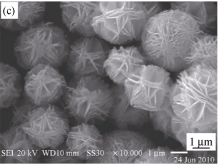
Flower-like copper sulfide (CuS) microsphere superstructures with diameters of 2.2~4.8 µm comprising nanoflakes were successfully synthesized by a facile solvothermal process at 140 ℃ for 90 min, employing copper chloride (CuCl2•2H2O) and thiourea (CH4N2S, Tu) as starting materials, ethylene glycol (C2H6O2) as the solvent. The products were characterized by means of XRD, SEM, TEM, SAED, HRTEM and UV-Vis techniques. The xenon lamp and high-pressure mercury lamp were used as light source to investigate the photocatalytic activity of CuS microspheres for the degradation of methylene blue. The result shows that the prepared products belong to hexagonal phase CuS with calculated cell parameters of a=0.3813 nm, c=1.6774 nm. It is also demonstrated that the morphology of the products is greatly influenced by solvents, different sources of sulfur and copper salt, reaction temperature and reaction time. UV-Vis analysis exhibits that the band gap energy of CuS microsphere superstructures is 2.0 eV. Photocatalytic tests indicate that the as-prepared CuS microspheres have high photocatalytic degradation rate for methylene blue under ultraviolet or visible regions, but the photocatalytic activity is higher in the visible region. The degradation rate of methylene blue is up to 98.7% and 82.9% after 30 min degradation under the irradiation of 35 W xenon lamp and 450 W high-pressure mercury lamp, respectively. In addition, the possible formation mechanism of CuS microsphere superstructures was also discussed.
TAN Zhi-Gang
,
ZHU Qi-An
,
GUO Xun-Zhi
,
ZHANG Jin-Fu
,
WU Wen-Yong
,
LIU Ai-Ping
. Synthesis of Flower-Shaped CuS Microsphere Superstructures by a Solvothermal Route and Its Photocatalytic Properties[J]. Acta Chimica Sinica, 2011
, 69(23)
: 2812
-2820
.
DOI: 10.6023/A1105043


