Full Papers

Preparation of Polypyrrole-Carbon Black Supported Pd Catalyst for Formic Acid Electrooxidation

  • Liu Jiajia ,
  • Wu Bing ,
  • Gao Ying
Expand
  • a College of Chemistry and Chemical Engineering, Harbin Normal University, Harbin 150025;
    b Key Laboratory of Design and Synthesis of Functional Materials and Green Catalysis, Harbin 150025

Received date: 2012-01-09

  Online published: 2012-06-14

Supported by

Project supported by the Natural Science Foundation of Heilongjiang Province (Nos. B200905, B201002), the Youth Fund of Harbin Science and Technology Bureau (No. 2010RFXXG018) and Program for Scientific and Technological Innovation Team Construction in Universities of Heilongjiang (No. 2011TD010).

Abstract

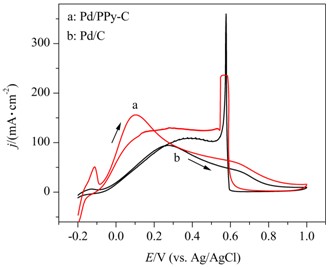
Direct formic acid fuel cells are environmentally friendly technologies and have attracted more and more attention as a new generation of power source. Pd is an important noble metal that is widely used in heterogeneous catalysis. In order to disperse Pd nanoparticles and to improve their catalytic efficiency and stability, polypyrrole are generally used as supporting materials due to their structures and electrical properties. In this work, polypyrrole composite (PPy-C) encompassed of carbon black are synthesized by low temperature oxidation of pyrrole on carbon black and the nanosized Pd catalyst supported by PPy-C is prepared. The support PPy-C and the catalyst Pd/PPy-C are characterized by X-ray diffraction, scanning electron microscopy and transmission electron microscopy. The TEM results show that the morphology of Pd/PPy-C and Pd/PPy-C is not the same. Pd deposited on PPy-C are nanoparticle clusters. The average particle size of metal Pd in Pd/C and Pd/PPy-C catalysts are 4.2 and 3.8 nm obtained from XRD diffraction peak. The results from formic acid oxidation show that the Pd/PPy-C catalyst exhibits better activity and stability in contrary to Pd/C. After 160 potential cycles, the formic acid oxidation current reduced to 8% of the first lap on Pd/C, but 50% on Pd/PPy-C. Therefore, the Pd/PPy-C catalyst is a promising anode catalyst in direct formic acid fuel cells. By analyzing formic acid oxidation current in the experiment of multi-step potential, it shows that the main reasons of the decrease of the oxidation current are the unstabitily of the support and the strong adsorption species on the electrode surface.

Cite this article

Liu Jiajia , Wu Bing , Gao Ying . Preparation of Polypyrrole-Carbon Black Supported Pd Catalyst for Formic Acid Electrooxidation[J]. Acta Chimica Sinica, 2012 , 70(16) : 1743 -1747 . DOI: 10.6023/A1201091

References

[1] Uhm, S.; Lee, H. J.; Lee, J. PCCP 2009, 11, 9326.   
[2] Ma, Y. J.; Yang, M. X.; Wang, W. F.; Zhou, M.; Liu, J.; Li, T. T.; Chen, H. Acta Chim. Sinica 2011, 69, 262. (马永钧, 杨梅霞, 王伟峰, 周敏, 刘婧, 李婷婷, 陈慧, 化学学报, 2011, 69, 262.)
[3] Serov, A.; Kwak, C. Appl. Catal. B: Environ. 2009, 91, 1.   
[4] Antolini, E. Energy Environ. Sci. 2009, 2, 915.   
[5] Liu, Y.; Wang, L. W.; Wang, G.; Deng, C.; Wu, B.; Gao, Y. J. Phys. Chem. C 2010, 114, 21417.
[6] Pan, Y. H.; Zhang, R. M.; Blair, S. L. Electrochem. Solid-State Lett. 2009, 12, B23.   
[7] Zhang, S. X.; Qing, M.; Zhang, H.; Tian, Y. N. Electrochem. Commun. 2009, 11, 2249.   
[8] Zhang, L.; Li, F. Electrochim. Acta 2010, 55, 6695.   
[9] Zhao, Y. C.; Wang, F. Y.; Tian, J. N.; Yang, X. L.; Zhan, L. Electrochim. Acta 2010, 55, 8998.   
[10] Sun, Z. P.; Zhang, X. G.; Tong, H.; Liang, Y. Y.; Li, H. L. J. Colloid Interface Sci. 2009, 337, 614.   
[11] Ji, X. L.; Lee, K. T.; Holden, R.; Zhang, L.; Zhang, J. J.; Botton, G. A.; Couillard, M.; Nazar, L. F. Nat. Chem. 2010, 2, 286.   
[12] Tu, D. D.; Wu, B.; Wang, B. X.; Deng, C.; Gao, Y. Appl. Catal. B: Environ. 2011, 103, 163.   
[13] Liu, Z. L.; Zhang, X. H.; Hong, L. Electrochem. Commun. 2009, 11, 925.   
[14] Dhaoui, W.; Hasik, M.; Djurado, D.; Bernasik, A.; Pron, A. Synth. Met. 2010, 160, 2546.   
[15] Liao, C.; Wei, Z. D.; Chen, S. G.; Li, L.; Ji, M. B.; Tan, Y.; Liao, M. J. J. Phys. Chem. C 2009, 113, 5705.   
[16] Wang, Z.; Zhu, Z. Z.; Li, H. L. Acta Chim. Sinica 2007, 65, 1149. (王喆, 朱赞赞, 力虎林, 化学学报, 2007, 65, 1149.)
[17] Selvaraj, V.; Alagar, M.; Kumar, K. S. Appl. Catal. B: Environ. 2007, 75, 129.   
[18] Ding, K. Q.; Jia, H. T.; Wei, S. Y.; Guo, Z. H. Ind. Eng. Chem. Res. 2011, 50, 7077.   
[19] Qu, B.; Xu, Y. T.; Lin, S. J.; Zheng, Y. F.; Dai, L. Z. Synth. Met. 2010, 160, 732.   
[20] Yang, S.; Shen, C.; Liang, Y.; Tong, H.; He, W.; Shi, X.; Zhang, X.; Gao, H.-J. Nanoscale 2011, 3, 3277.   
[21] Ding, K.; Jia, H.; Wei, S.; Guo, Z. Ind. Eng. Chem. Res. 2011, 50, 7077.   
[22] Radmilovic, V.; Gasteiger, H. A.; Ross, P. N. J. Catal. 1995, 154, 98.   
[23] Zhou, Y.; Liu, J. G.; Ye, J. L.; Zou, Z. G.; Ye, J. H.; Gu, J.; Yu, T.; Yang, A. D. Electrochim. Acta 2010, 55, 5024. Yu, X. W.; Pickup, P. G. Electrochem. Commun. 2009, 11, 2012.   
Outlines

/