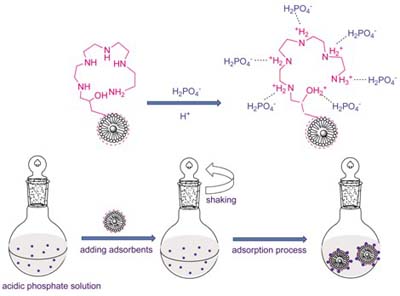
Four kinds of amino-functionalized nano-size composite materials (NH2-NCMs) were prepared firstly by radical co-polymerization, of which methylmethacrylate (MMA) and glycidylmethacrylate (GMA) acted as monomers and benzoyl peroxide (BPO) acted as initiator, to obtain epoxyl-functionalized polymers and then modified by ethanediamine (EDA), diethylenetriamine (DETA), triethylenetetramine (TETA), or tetraethylenepentamine (TEPA), named as EDA-NCMs, DETA-NCMs, TETA-NCMs and TEPA-NCMs, respectively. They were fully characterized by Fourier-transformed infrared spectroscopy (FTIR), thermogravimetry and differential analyses (TG/DTG), and X-ray photoelectron spectroscopy analysis (XPS). The NH2-NCMs were used as phosphate adsorbents to remove phosphate in water. Effects of pH values, initial concentration of phosphate, adsorption time, adsorption temperature and type of functional amines were studied. To investigate the effects of pH value of solutions on adsorption, 40 mL of 200 mg/L phosphate solutions with pH ranging from 1.5 to 7.0 were mixed with 0.05 g NH2-NCMs for 12 h. The adsorption capacities were investigated at pH 2.5, with 0.05 g NH2-NCMs by varying the initial phosphate concentration from 50 to 800 mg/L at 308 K. Adsorption kinetic studies were investigated at pH 2.5, by adding 0.05 g NH2-NCMs into 40 mL 200 mg/L phosphate solutions at 308 K with contacting time ranging from 1 min to 180 min. Results indicated that the adsorptive properties of the four kinds of NH2-NCMs were highly pH dependent and reached optimum at pH 2.5. Adsorption processes reached 90% of the equilibrium within 5 min. The adsorption data of the NH2-NCMs were well fitted with the Langmuir isotherm. The maximum adsorption capacity calculated from Langmuir isotherm was 142.85, 156.25, 172.41 and 188.67 mg/g for EDA-NCMs, DETA-NCMs, TETA-NCMs and TEPA-NCMs, respectively. Thermodynamic studies suggested that the adsorption processes of phosphate were exothermic (ΔH<0), entropy disfavored (ΔS<0), and spontaneous (ΔG<0) in nature. The adsorption mechanism of phosphate could be mainly related with electrostatic interaction. By using the present NH2-NCMs to treat phosphate contained wastewater at concentration of 50 mg/L, the adsorption efficiencies for phosphate can be reached to more than 97% with the residue concentration of phosphate less than 1.16 mg/L, which reached the national criterion of drainage (≤1.53 mg/L,PO43-).
Zhang Yun
,
Xi Xiaoqing
,
Xu Shanni
,
Zhou Junchen
,
Zhou Jinjin
,
Xu Qihong
,
Shen Haoyu
. Adsorption Studies on Phosphate by Amino-functionalized Nano-size Composite Materials[J]. Acta Chimica Sinica, 2012
, 70(17)
: 1839
-1846
.
DOI: 10.6023/A12050171


