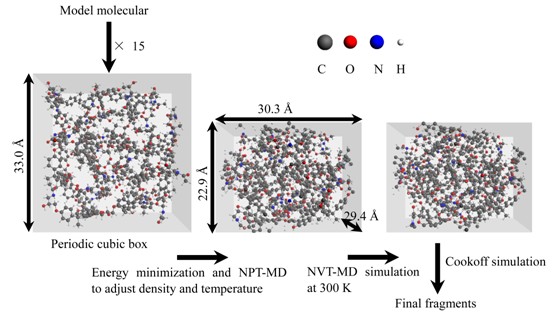
We have performed a series of molecular dynamics simulations to study the thermal decomposition characteristics of the non-cross linked cruing epoxy resin and the evolution of small molecules at different conditions using ReaxFF reactive force field, which bridges quantum mechanical and molecular mechanical methods. Reaction systems with 1620 atoms were simulated at various heating rates and temperatures from 2300 to 4300 K. We also discuss the relevance of our simulation results to previous experimental observations. The results show that the cleavages of nitrogen- and oxygen-bridge bonds are initiation reactions. Four primary formation pathways of H2O were observed, all of these reaction pathways involved hydroxyl-containing precursors. We found that at lower temperatures the primary product is H2O, whereas H2 is dominant one and the larger carbon cluster containing graphene-related structure prefers to formation at high temperatures. We also found multiple pathways leading to formation of H2, including intra- and inter-molecular dehydrogenation and hydrogen abstraction by hydrogen radical. Other small molecular products also found include CH4, HCN, NH3 and CO, but with an insignificant content of CO2. The formation of CH4 involves the demethylation of methyl group-containing precursor, which could evolve from methylene groups via hydrogen abstraction reaction. And the formation of CO involves the decarbonylation of carbonyl group-containing precursor, which could evolve from ether oxygen group-containing fragments and hydroxy group-containing fragments via dehydrogenation reactions. Furthermost, the primary reaction products and the observed carbon clusters containing graphene-related structure were in accordance with experimental results. In our simulations, we ?nd that these ReaxFF-MD simulations successfully reproduce thermal decomposition processes of depolymerization, chain reaction, defunctionalization, ring formation and polycondensation of the fragments observed in various experimental studies. The agreement of these results with available experimental observations demonstrates that ReaxFF can provide useful insights into the complicated bulk thermal decomposition of organic materials under extreme conditions at the atomistic level.
Diao Zhijun
,
Zhao Yuemin
,
Chen Bo
,
Duan Chenlong
. Thermal Decomposition of Epoxy Resin Contained in Printed Circuit Boards from Reactive Dynamics Using the ReaxFF Reactive Force Field[J]. Acta Chimica Sinica, 2012
, 70(19)
: 2037
-2044
.
DOI: 10.6023/A12070451


