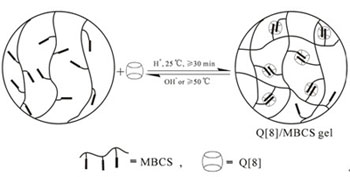
Chitosan (CS) which is a non-toxic, biocompatible, and biodegradable material and a good candidate for hydrogel formation was modified. A chitosan derivative, N-(4-dimethylaminobenzyl)chitosan (MBCS), was synthesized by the reaction of 4-(dimethylamino)benzaldehyde and chitosan to fabricate supramolecular gel system. The new family of macrocyclic host molecules, cucurbit[n]urils (Q[n], n=6~8) with its hydrophobic central cavity and negatively charged carbonyl portals, can bind to a variety of cationic organic guest molecules and neutral species to form the clathrate compounds with high affinity, and shows great potential applications in drug delivery system due to its low toxicity and good thermal stability. Cucurbit[8]uril (Q[8]) has a larger hydrophobic cavity volume of 479 ?3 and can include two aromatic rings. In this paper a novel supramolecular gel was prepared by utilizing the host-guest interaction between Q[8] and MBCS. The physical properties and structure of supramolecular gel and MBCS were characterized via IR, UV, 1H NMR, X-ray powder diffraction (XRD), thermogravimetric method (TG) and differential scanning calorimetry (DSC). The morphology of network structure of the xerogel was observed via an environmental scanning electron microscope (SEM). The spectrum of 1H NMR demonstrated that the host-guest interaction between Q[8] and guest units on the side chain of MBCS in the Q[8]/MBCS system resulted in the formation of the supramolecular gel. Q[8] acted as a cross-linker for supramolecular interactions (noncovalent crosslinking referring to electrostatic action, Van der Waals force and hydrophobic action, etc.). The Q[8]/MBCS supramolecular gel showed pH-sensitive and thermosensitive properties. 5-Fluorouracil (5-Fu) was taken as a model drug. The release characteristics of drug-loaded gels were studied in mediums with three different pH values. The results showed that the Q[8]/MBCS supramolecular gel system had obviously sustained-release for 5-Fu in acidic condition in vitro, suggesting that the Q[8]/MBCS supramolecular gel could be a new potential carrier for stimuli-responsive drug delivery system.
[1] Lehn, J. M. Angew. Chem., Int. Ed. Engl. 1988, 27, 89.
[2] Sangeetha, N.; Maitra, U. Chem. Soc. Rev. 2005, 34, 821.
[3] Charlot, A.; Auzly-Velty, R. Macromolecules 2007, 40,1147.
[4] Dong, S.; Luo, Y.; Yan, X.; Zheng, B.; Ding, X.; Yu, Y.; Ma, Z.; Zhao, Q.; Huang, F. Angew. Chem., Int. Ed. Engl. 2011, 50, 1905.
[5] Guo, M. Y.; Jiang, M.; Pispas, S.; Yu, W.; Zhou, C. X. Macromolecules 2008, 41, 9744.
[6] Ge, Z. S.; Hu, J. M.; Huang, F. H.; Liu, S. Y. Angew. Chem., Int. Ed. 2009, 48, 1798.
[7] Corma, A.; Garcia, H.; Montes-Navajas, P.; Primo, A.; Calvino, J. J.; Trasobares, S. Chem. Eur. J. 2007, 13, 6359.
[8] Yan, J.-L.; Liu, J.; Chen, X.; Fang, Y. Chem. J. Chin. Univ. 2008, 29, 124. (严军林, 刘静, 陈希, 房喻, 高等学校化学学报, 2008, 29, 124.)
[9] Zhao, J.; Kim, H. J.; Oh, J.; Kim, S. Y.; Lee, J. W.; Sakamoto, S.;Yamaguchi, K.; Kim, K. Angew. Chem., Int. Ed. 2001, 40, 4233.
[10] Hettiarachchi, G.; Nguyen, D.;Wu, J.; Lucas, D.; Ma, D.; Isaacs, L.; Briken, V. PLoS One 2010, 5, e10514.
[11] Dong, N.; Xue, S.-F.; Tao, Z.; Zhao, Y.; Cai, J.; Liu, H.-C. Acta Chim. Sinica 2008, 66, 1117. (董南, 薛赛凤, 陶朱, 赵昱, 蔡洁, 刘洪材, 化学学报, 2008, 66, 1117.)
[12] Hwang, I.; Jeon, W. S.; Kim, H. J.; Kim, D.; Kim, H.; Selvapalam, N.; Fujita, N.; Shinkai, S.; Kim, K. Angew. Chem., Int. Ed. 2007, 46, 210.
[13] Yang, H.; Tang, Y. B.; Wang, Y. X. Soft Matter 2009, 5, 3511.
[14] Appel, E. A.; Biedermann, F.; Rauwald, U.; Jones, S. T.; Zayed, J. M.; Scherman, O. A. J. Am. Chem. Soc. 2010, 132, 14251.
[15] Rinaudo, M. Prog. Polym. Sci. 2006, 31, 603.
[16] Lin, Y. W.; Chen, Q.; Luo, H. B. Carbohydr. Res. 2007, 73, 265.
[17] Teng, S. H.; Lee, E. J.; Wang, P.; Shin, D. S.; Kim, H. E. J. Biomed. Mater. Res. B 2008, 87, 132.
[18] Samuels, R. J. J. Polym. Sci. Polym. Phys. Ed. 1981, 19, 1081.
[19] Zhang, C.; Ding, Y.; Ping, Q.-N. Polym. Mater. Sci. Eng. 2006, 22, 200. (张灿, 丁娅, 平其能, 高分子材料科学与工程, 2006, 22, 200.)


