
Study on the Inhibition Effect of Carbon Quantum Dots on Luminol Electrochemiluminescence System and Its Application in DNA Analysis
Received date: 2012-11-15
Online published: 2013-01-16
Supported by
Project supported by the National Natural Science Foundation of China (No. 20905044) and the Natural Science Foundation of Shaanxi Province (No. 2012JQ2006).
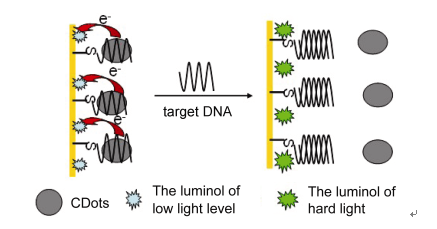
In this paper, the microwave synthesis method was adopted to prepare carbon quantum dots (CDots), in which glucose acted as carbon source, water as solvent and polyethylene glycol (PEG-200) as passivation agent. With the different heating time, CDots with different size were gotten. Then, it was found that Cdots had an obvious inhibition effect on luminol electrochemiluminescence (ECL) system. The possible mechanism of inhibition effect of CDots on luminol ECL was discussed, it may be due to the electron transfer between CDots and the excited luminol. It was also reported that single-stranded DNA (ssDNA) could be adsorbed on the CDots’s surface via π-π stacking interactions, while double-stranded DNA (dsDNA) did not possess this feature. In this work, it was found that the inhibited luminol ECL signal by CDots was further decreased at ssDNA modified gold electrode. This result could be attributed to the adsorption reaction between ssDNA and Cdots. That is to say, CDots in solution approached toward the electrode surface by adsorption of ssDNA and the ECL signal of luminol was inhibited greatly. However, with the addition of complementary DNA, the hybridization reaction took place and the electrostatic repulsion between dsDNA and CDots made CDots keep away from the surface of electrode, which resulted in the increase of the inhibited luminol ECL signal. So, there were different ECL signals between ssDNA and dsDNA because of the different adsorption ability of CDots to ssDNA and dsDNA. Based on those findings, a simple, rapidly and sensitive detection method for DNA was developed. The influence of the size of CDots and their concentration on the inhibited ECL behaviors was further investigated. Then, the ECL reaction conditions, including pH and luminol concentration have also been optimized. Under the optimal experimental conditions, the linear range of the proposed method for determination of DNA is 1.0×10⁻¹⁰~7.5×10⁻⁹ mol/L and the detection limits is 5.2×10⁻¹¹ mol/L.
Zhang Lihong , Guo Zhihui . Study on the Inhibition Effect of Carbon Quantum Dots on Luminol Electrochemiluminescence System and Its Application in DNA Analysis[J]. Acta Chimica Sinica, 2013 , 71(04) : 644 -648 . DOI: 10.6023/A12110867
/
| 〈 |
|
〉 |

