
Design, Synthesis and Gene Transfection Activity of Macrocyclic Polyamine-Imidazolium Based Cationic Lipids
Received date: 2012-12-08
Online published: 2013-02-06
Supported by
Project supported by the National Program on Key Basic Research Project of China (973 Program, 2012CB720603, 2013CB328900) and the National Natural Science Foundation of China (No. 21232005).
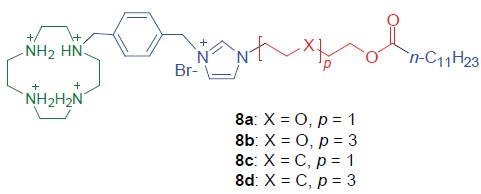
A major challenge in gene therapy is the development of effective gene delivery vectors with low toxicity. In this study, four cyclen-based amphiphilic molecules including lauric acid moieties were designed and synthesized, and their molecular structures were confirmed by NMR and ESI-MS. These molecules have a hydrophilic cyclen headgroup and a hydrophobic long chain linking by alkyl or glycol chain, leading to different hydropohobic properties. Cationic liposomes were prepared by mixing the molecules with DOPE at various mole ratios. Agarose gel electrophoresis demonstrated that the liposomes 8a could condense plasmid DNA at N /P molar ratio of 4, and the ratios was 6 for 8b~8d. Fluorescence quenching assay also suggested that lipids 8 have good DNA binding ability. The sizes of the formed lipoplexes were measured to be around 80~120 nm, while zeta-potentials of the liposomes were found to be +25~55 mV, and both of these values could remain with little change within 7 d. Among the four lipids, 8a showed moderate in vitro gene transfection efficiency toward A549 cells, and the best transfection could be observed at N/P of 4 with 8a/DOPE ratio of 1∶2.
Key words: cyclen; cationic lipid; spacer; gene vector
Fu Yun , Wang Haijiao , Zhang Ji , Yu Xiaoqi . Design, Synthesis and Gene Transfection Activity of Macrocyclic Polyamine-Imidazolium Based Cationic Lipids[J]. Acta Chimica Sinica, 2013 , 71(04) : 585 -592 . DOI: 10.6023/A12121016
/
| 〈 |
|
〉 |

