Article

Synthesis of Dendritic BINAP Ligands and Their Applications in the Asymmetric Hydrogenation: Exploring the Relationship between Catalyst Structure and Catalytic Performance

  • Ma Baode ,
  • Deng Guojun ,
  • Liu Ji ,
  • He Yanmei ,
  • Fan Qinghua
Expand
  • a Beijing National Laboratory for Molecular Sciences, CAS Key Laboratory of Molecular Recognition and Function, Institute of Chemistry, Chinese Academy of Sciences, Beijing 100190;
    b Key Laboratory for Environmentally Friendly Chemistry and Application of Ministry of Education, College of Chemistry, Xiangtan University, Xiangtan 411105

Received date: 2013-01-31

  Online published: 2013-02-20

Supported by

Project supported by the National Natural Science Foundation of China (No. 21232008), the National Basic Research Program of China (973 Program) (No. 2010CB833300).

Abstract

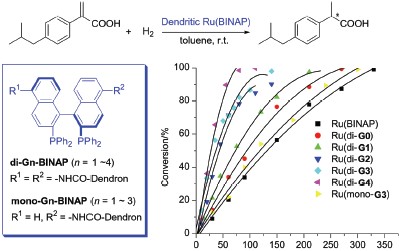
Series of chiral dendritic BINAP ligands of different generations and with varied structures have been designed and synthesized through incorporation of BINAP unit into the core (disubstituted ligand) or the focal point (monosubstituted ligand) of the Fréchet’s polyether dendrimers. The relationship between catalyst structure and catalytic behavior was explored by choosing the Ru-catalyzed asymmetric hydrogenation of 2-aryl acrylic acid and Rh-catalyzed asymmetric hydrogenation of acetamidocinnamic acid as model reactions together with CD spectra analysis. It was found that the disubstituted dendritic catalysts showed obvious higher activity than the small molecular catalyst, and the reaction rate increased with the increase of the generation. This rate enhancement became more significant when changing the solvent from toluene/methanol (1/1, V/V) to neat toluene. While the monosubstituted dendritic catalysts showed similar performance with the small molecular catalyst, which was due to that the catalytic center located away from the dendritic support. In addition, the disubstituted dendritic BINAP ligands showed different Cotton effect in CD spectra with regard to the monosubstituted dendritic BINAP ligands and BINAP itself, suggesting that the microenvironment inside the disubstituted BINAP-cored dendrimer might be influenced by the sterically demanding dendritic wedges. These results indicated that the microenvironment around the catalytic center created by the dendritic support played an important role in promoting catalytic activity. This positive dendritic effect was further observed in the Rh-catalyzed asymmetric hydrogenation of acetamidocinnamic acid. Finally, the dendritic catalyst could be easily recycled by solvent precipitation at least three times without any loss of activity and selectivity.
Cite this article

Ma Baode , Deng Guojun , Liu Ji , He Yanmei , Fan Qinghua . Synthesis of Dendritic BINAP Ligands and Their Applications in the Asymmetric Hydrogenation: Exploring the Relationship between Catalyst Structure and Catalytic Performance[J]. Acta Chimica Sinica, 2013 , 71(04) : 528 -534 . DOI: 10.6023/A13010156

References

[1] For selected reviews, see: (a) Oosterom, G. E.; Reek, J. N. H.; Kamer, P. C. J.; van Leeuwen, P. W. N. M. Angew. Chem., Int. Ed. 2001, 40, 1828; (b) Astruc, D.; Chardac, F. Chem. Rev. 2001, 101, 2991; (c) van Heerbeek, R.; Kamer, P. C. J.; van Leeuwen, P. W. N. M.; Reek, J. N. H. Chem. Rev. 2002, 102, 3717; (d) Fan, Q.-H.; Li, Y.-M.; Chan, A. S. C. Chem. Rev. 2002, 102, 3385.

[2] Knapen, J. W. J.; van der Made, A. W.; de Wilde, J. C.; van Leeuwen, P. W. N. M.; Wijkens, P.; Grove, D. M.; van Koten, G. Nature 1994, 372, 659.

[3] For selected reviews on chiral dendritic catalysts, see: (a) Seebach, D.; Rheiner, P. B.; Greiveldinger, G.; Butz, T.; Sellner, H. Top. Curr. Chem. 1998, 197, 125; (b) Kassube, J. K.; Gade, L. H. Top. Organomet. Chem. 2006, 20, 61; (c) Fan, Q.-H.; Deng, G.-J.; Feng, Y.; He, Y.-M. In Handbook of Asymmetric Heterogeneous Catalysis, Eds.: Ding, K.; Uozumi, Y., Wiley-VCH, Weinheim, 2008, p. 131; (d) Caminade, A. M.; Servin, P.; Laurent, R.; Majoral, J. P. Chem. Soc. Rev. 2008, 37, 56; (e) Ma, B.-D.; Fan, Q.-H. Sci. Sinica Chim. 2010, 40, 827.

[4] For reviews on dendritic effect in catalytic reactions, see: (a) Chow, H.-F.; Leung, C.-F.; Wang, G.; Yang, Y. Y. C. R. Chem. 2003, 6, 735; (b) Helms, B.; Fréchet, J. M. J. Adv. Synth. Catal. 2006, 348, 1125; (c) Fan, Q.-H.; Ding, K.-L. Top. Organomet. Chem. 2011, 36, 207.

[5] For selected examples of chiral dendrimer catalysts with positive dendritic effect, see: (a) Breinbauer, R.; Jacobsen, E. N. Angew. Chem., Int. Ed. 2000, 39, 3604; (b) Ribourdouille, Y.; Engel, G. D.;Richard-Plouet, M.; Gade, L. H. Chem. Commun. 2003, 1228; (c) Fan, Q.-H.; Chen, Y.-M.; Chen, X.-M.; Jiang, D.-Z.; Xi, F.; Chan, A. S. C. Chem. Commun. 2000, 789; (d) Wang, Z.-J.; Deng, G.-J.; Li, Y.; He, Y.-M.; Tang, W.-J.; Fan, Q.-H. Org. Lett. 2007, 9, 1243; (e) Zhang, F.; Li, Y.; Li, Z.-W.; He, Y.-M.; Zhu, S.-F.; Fan, Q.-H.; Zhou, Q.-L. Chem. Commun. 2008, 6048; (f) Mitsui, K.; Hyatt, S. A.; Turner, D. A.; Hadad, C. M.; Parquette, J. R. Chem. Commun. 2009, 3261; (g) Kehat, T.; Portnoy, M. Chem. Commun. 2007, 2823; (h) Kassube, J. K.; Wadepohl, H.; Gade, L. H. Adv. Synth. Catal. 2009, 351, 607; (i) Gissibl, A.; Padié, C.; Hager, M.; Jaroschik, F.; Rasappan, R.; Cuevas-Yaňez, E.; Turrin, C. O.; Caminade, A. M.; Majoral, J. P.; Reiser, O. Org. Lett. 2007, 9, 2895; (j) Garcia, L.;Roglans, A.; Laurent, R.; Majoral, J. P.; Pla-Quintana, A.; Caminade, A. M. Chem. Commun. 2012, 48, 9248.

[6] (a) Deng, G.-J.; Fan, Q.-H.; Chen, X.-M. Chin. J. Chem. 2002, 20, 1139; (b) Deng, G.-J.; Fan, Q.-H.; Chen, X.-M.; Liu, D.-S.; Chan, A. S. C. Chem. Commun. 2002, 1570; (c) Deng, G.-J.; Fan, Q.-H.; Chen, X.-M.; Liu, G.-H. J. Mol. Catal. A 2003, 193, 21; (d) Yi, B.; Fan, Q.-H.; Deng, G.-J.; Li, Y.-M.; Qiu, L.-Q.; Chan, A. S. C. Org. Lett. 2004, 6, 1361; (e) Huang, Y.-Y.; He, Y.-M.; Zhou, H.-F.; Wu, L.; Li, B.-L.; Fan, Q. H. J. Org. Chem. 2006, 71, 2874; (f) Tang, W.-J.; Huang, Y.-Y.; He, Y.-M.; Fan, Q.-H. Tetrahedron: Asymmetry 2006, 17, 536; (g) Deng, G.-J.; Li, G.-R.; Zhu, L.-Y.; Zhou, H.-F.; He, Y.-M.; Fan, Q.-H.; Shuai, Z.-G. J. Mol. Catal. A 2006, 244, 118; (h) Li, Y.; He, Y.-M.; Li, Z.-W.; Zhang, F.; Fan, Q.-H. Org. Biomol. Chem. 2009, 7, 1890; (i) Liu, J.; Feng, Y.; Ma, B.-D.; He, Y.-M.; Fan, Q.-H. Eur. J. Org. Chem. 2012, 6737.

[7] Fan, Q.-H.; Hu, W.-H.; Ren, C.-Y.; Yeung, C. H.; Chan, A. S. C. J. Am. Chem. Soc. 1999, 121, 7407.

[8] Hawker, C. J.; Fréchet, J. M. J. J. Am. Chem. Soc. 1990, 112, 7638.

[9] Harrington, P. J.; Lodewijk, E. Org. Process Res. Dev. 1997, 1, 72.

[10] Ohta, T.; Takaya, H.; Kitamura, M.; Nagai, K.; Noyori, R. J. Org. Chem. 1987, 52, 3174.

[11] Niu, Y.-H.; Yeung, L. K.; Crooks, R. M. J. Am. Chem. Soc. 2001, 123, 6840.

[12] (a) Dang, T.-P.; Kagan, H. B. J. Chem. Soc., Chem. Commun. 1971, 481; (b) Miyashita, A.; Yasuda, A.; Takaya, H.; Toriumi, K.; Ito, T.; Souchi, T.; Noyori, R. J. Am. Chem. Soc. 1980, 102, 7932.
Outlines

/

