
Application of Anisole, 2-Bromoanisole and 3-Bromoanisole as Overcharge Protection Additives in Lithium-Ion Batteries
Received date: 2012-11-23
Online published: 2013-03-01
Supported by
Project supported by the National Natural Science Foundation of China (No. 51204211) and the China Postdoctoral Science Foundation (No. M521543).
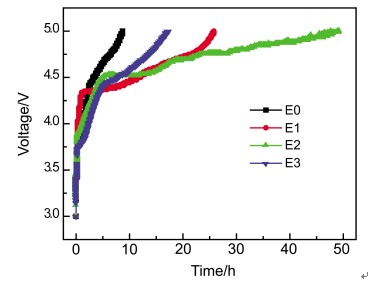
Anisole, 2-bromoanisole and 3-bromoanisole were studied as novel additives for overcharge protection in lithium-ion batteries. All the additives were added in the system of electrolyte 1 mol·L-1 LiPF6/EC(ethylene carbonate)+DEC(diethyl carbonate)+EMC(ethyl methyl carbonate) (1:1:1 in volume). The overcharge protection effect of the three additives on lithium-ion batteries and the compatibility of the additives with the LiNi1/3Co1/3Mn1/3O2 (NCM) electrode has been investigated by cyclic voltammetry (CV), overcharge tests, electrochemical impedance spectroscopy (EIS) and scanning electron microscope (SEM). CV tests was performed with stainless steel/electrolyte (with additives)/Li cells at a scan rate of 5 mV/s. The results suggested that all the additives worked at a potential range from 4.3 V to 5 V. Thus, they were all appropriate for overcharge protection of lithium-ion battery. Moreover they had good oxidation-reduction characters which were able to improve the overcharge protection tolerance. 5 V overcharge tests and 100% overcharge tests (charging the cell twice capacity of itself) had been used to examine the additives' overcharge performance. The battery with 2-bromoanisole exhibited the best overcharge protection capability, which took almost 50 h before charging to 5 V and can be bore 4 times of 100% overcharge, but it had negative effect on the cycle performance of NCM cathode. Anisole also has a good overcharge protection effect, meanwhile the NCM/Li battery with anisole hold capacity retention of 93.8% after 80 cycles at 0.2 C, showing favorable cycle stability in comparison with 78.5% of 2-bromoanisole. EIS measurements were taken before and after overcharge over the frequency from 100 kHz to 10 mHz with an AC oscillation of 5 mV. The result revealed a sharp increase in impedance of the batteries with additives. SEM was employed to investigate the morphology of NCM electrodes. Through SEM test, it is clear that after the batteries with above three additives (especially the 2-bromoanisole) overcharging, some oxidation-reduction byproducts generated and adhered on the surfaces of NCM electrodes, which enlarged the total impedance of batteries.
Key words: lithium-ion battery; electrolyte; overcharge protection; additives; anisole; bromide replace
Zhang Zhian , Peng Bo , Lu Hai , Ren Chunyan , Jia Ming , Lai Yanqing . Application of Anisole, 2-Bromoanisole and 3-Bromoanisole as Overcharge Protection Additives in Lithium-Ion Batteries[J]. Acta Chimica Sinica, 2013 , 71(05) : 798 -802 . DOI: 10.6023/A12110964
/
| 〈 |
|
〉 |

