Article

Replica Exchange Molecular Dynamics Simulations on the Folding of Trpzip4 β-Hairpin

  • Liao Chenyi ,
  • Zhou Jian
Expand
  • School of Chemistry and Chemical Engineering, Guangdong Provincial Key Lab for Green Chemical Product Technology, South China University of Technology, Guangzhou 510640

Received date: 2013-01-04

  Online published: 2013-03-01

Supported by

Project supported by the Program for New Century Excellent Talents in Universities, Ministry of Education, China (No. NCET-07-0313), the National Natural Science Foundation of China (No. 20876052) and the Natural Science Foundation of Guangdong Province(No. S2011010002078).

Abstract

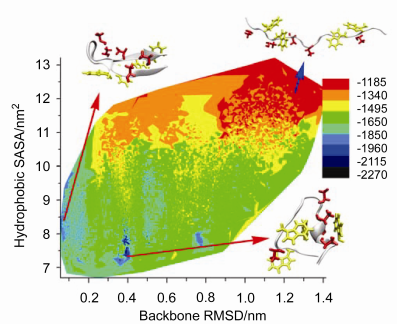
β-Hairpin is an essential secondary structure unit of protein. Understanding the formation mechanism of the β hairpin and kinetic stability helps to gain insight into the formation of protein secondary structure as well as the mechanism of protein folding. Replica exchange molecular dynamics (REMD) approach is applied to investigate the folding mechanism of Trpzip4 β-hairpin. The REMD method is more efficient than conventional MD in searching for a representative set of the low energy minima in the existence of a large energy gap between the native state and any of the other possible state. The potential energy, backbone RMSD and solvent-accessible surface area (SASA) present descending trends in the process of REMD at 288 K. Methyl groups (most in threonines) show hydrophobic interactions with SASA decrements. The hydrophobic interactions and intra hydrogen bond forming drive the folding and maintain the low energy structure. Two low energy structures, β-hairpin and helix-coil conformation, are sampled by REMD. In β-hairpin structure, the hydroxyl group (OH) of Thr49 at β turn is accessible to form hydrogen bonds with carboxyl group (COO-) or C=O group of Asp46; while the hydroxyl group (OH) of Thr51 is inclined to interact with water molecule with methyl orienting inwards. As a result, the strong interactions between Asp46 and Thr49 cause a bend at β turn. In helix-coil conformation, hydrophobic interactions play between indole ring and methyl group. One of the zip-in paths of Trpzip4 indicates that, the forming of hydrogen bonds at β turn affects the whole folding process of β hairpin. The forming of hydrogen bonds at β turn takes place first, since it has advantages of distance and strong interactions in both side chains and backbone. Total solvent-accessible surface area decreases significantly as it folds to the β hairpin structure. REMD method could sample large phase space for the low energy minima, and present scenarios of potential energy distribution on phase space with related variables as hydrophobic SASA, backbone RMSD, and hydrogen bonds for specific conformation. This work sheds some lights on the understanding of β hairpin folding.
Cite this article

Liao Chenyi , Zhou Jian . Replica Exchange Molecular Dynamics Simulations on the Folding of Trpzip4 β-Hairpin[J]. Acta Chimica Sinica, 2013 , 71(04) : 593 -601 . DOI: 10.6023/A13010015

References

[1] Bryngelson, J. D.; Onuchic, J. N.; Socci, N. D.; Wolynes, P. G. Proteins 1995, 21, 167.

[2] Karplus, M.; Šali, A. Curr. Opin. Struct. Biol. 1995, 5, 58.

[3] Bian, L.; Yang, X.; Liu, L. Acta Chim. Sinica 2005, 63, 1081. (边六交, 杨晓燕, 刘莉, 化学学报, 2005, 63, 1081.)

[4] Yang, F.; Liang, Y.; Yang, F. J. Acta Chim. Sinica 2003, 61, 803 (杨芳, 梁毅, 杨芳(小), 化学学报, 2003, 61, 803.)

[5] Zhou, J.; Thorpe, I. F.; Izvekov, S.; Voth, G. A. Biophys. J. 2007, 92, 4289.

[6] Thorpe, I. F.; Zhou, J.; Voth, G. A. J. Phys. Chem. B 2008, 112, 13079.

[7] Dobson, C. M. Nature 2003, 426, 884.

[8] Hansmann, U. H. E. Chem. Phys. Lett. 1997, 281, 140.

[9] Kinnear, B. S.; Jarrold, M. F.; Hansmann, U. H. E. J. Mol. Graphics Modell. 2004, 22, 397.

[10] Hansmann, U. H. E. J. Chem. Phys. 2004, 120, 417.

[11] Hansmann, U. H. E.; Wille, L. T. Phys. Rev. Lett. 2002, 88, 68105.

[12] Sugita, Y.; Okamoto, Y. Chem. Phys. Lett. 1999, 314, 141.

[13] Zhang, J.; Qin, M.; Wang, W. Proteins: Struct., Funct., Bioinf. 2006, 62, 672.

[14] Munoz, V.; Thompson, P. A.; Hofrichter, J.; Eaton, W. A. Nature 1997, 390, 196.

[15] Chen, C.; Xiao, Y. Bioinformatics 2008, 24, 659.

[16] Zhou, R. Methods Mol. Biol. 2006, 350, 205.

[17] Xie, Y.; Zhou, J.; Jiang, S. Y. J. Chem. Phys. 2010, 132, 065101.

[18] Earl, D. J.; Deem, M. W. Phys. Chem. Chem. Phys. 2005, 7, 3910.

[19] Zhou, R.; Berne, B. J.; Germain, R. Proc. Natl. Acad. Sci. U. S. A. 2001, 98, 14931.

[20] Zhou, R. Proc. Natl. Acad. Sci. U. S. A. 2003, 100, 13280.

[21] Zhou, R. J. Mol. Graphics Modell. 2004, 22, 451.

[22] Haliloglu, T.; Kolinski, A.; Skolnick, J. Biopolymers 2003, 70, 548.

[23] Chen, J.; Won, H. S.; Im, W.; Dyson, H. J.; Brooks, C. L. J. Biomol. NMR. 2005, 31, 59.

[24] La Penna, G.; Mitsutake, A.; Masuya, M.; Okamoto, Y. Chem. Phys. Lett. 2003, 380, 609.

[25] Vreede, J.; Crielaard, W.; Hellingwerf, K. J.; Bolhuis, P. G. Biophys. J. 2005, 88, 3525.

[26] Jas, G. S.; Kuczera, K. Biophys. J. 2004, 87, 3786.

[27] Gnanakaran, S.; Hochstrasser, R. M.; García, A. E. Proc. Natl. Acad. Sci. U. S. A. 2004, 101, 9229.

[28] Antoine, R.; Compagnon, I.; Rayane, D.; Broyer, M.; Dugourd, P.; Breaux, G.; Hagemeister, F. C.; Pippen, D.; Hudgins, R. R.; Jarrold, M. F. J. Am. Chem. Soc. 2002, 124, 6737.

[29] Chebaro, Y.; Mousseau, N.; Derreumaux, P. J. Phys. Chem. B 2009, 113, 7668.

[30] Cecchini, M.; Rao, F.; Seeber, M.; Caflisch, A. J. Chem. Phys. 2004, 121, 10748.

[31] Lu, Y.; Wei, G.; Derreumaux, P. J. Phys. Chem. B 2011, 115, 1282.

[32] Cochran, A. G.; Skelton, N. J.; Starovasnik, M. A. Proc. Natl. Acad. Sci. U. S. A. 2001, 98, 5578.

[33] Du, D.; Zhu, Y.; Huang, C. Y.; Gai, F. Proc. Natl. Acad. Sci. U. S. A. 2004, 101, 15915.

[34] Juraszek, J. Ph.D. Dissertation, University of Amsterdam, Amsterdam, 2008.

[35] Olsen, K. A.; Fesinmeyer, R. M.; Stewart, J. M.; Andersen, N. H. Proc. Natl. Acad. Sci. U. S. A. 2005, 102, 15483.

[36] Wei, H.; Shao, Q.; Gao, Y. Q. Phys. Chem. Chem. Phys. 2010, 12, 9292.

[37] Rathore, N.; Chopra, M.; De Pablo, J. J. J. Chem. Phys. 2005, 122, 024111.

[38] Rao, F.; Caflisch, A. J. Chem. Phys. 2003, 119, 4035.

[39] Zhang, W.; Wu, C.; Duan, Y. J. Chem. Phys. 2005, 123, 154105.

[40] Sindhikara, D.; Meng, Y.; Roitberg, A. E. J. Chem. Phys. 2008, 128, 024103.

[41] Sindhikara, D. J.; Emerson, D. J.; Roitberg, A. E. J. Chem. Theory Comput. 2010, 6, 2804.

[42] Katzgraber, H. G.; Trebst, S.; Huse, D. A.; Troyer, M. J. Stat. Mech.: Theory Exp. 2006, 2006, P03018.

[43] van der Spoel, D.; Lindahl, E.; Hess, B.; van Buuren, A. R.; Apol, E.; Meulenhoff, P. J.; Tieleman, D. P.; Sijbers, A. L. T. M.; Feenstra, K. A.; van Drunen, R.; Berendsen, H. J. C. Gromacs User Manual, version 4.5, 2010, www.gromacs.org.

[44] Darden, T.; York, D.; Pedersen, L. J. Chem. Phys. 1993, 98, 10089.

[45] Essmann, U.; Perera, L.; Berkowitz, M. L.; Darden, T.; Lee, H.; Pedersen, L. G. J. Chem. Phys. 1995, 103, 8577.

[46] Berendsen, H. J. C.; Postma, J. P. M.; Van Gunsteren, W. F.; DiNola, A.; Haak, J. J. Chem. Phys. 1984, 81, 3684.

[47] Shaytan, A. K.; Shaitan, K. V.; Khokhlov, A. R. Biomacromolecules 2009, 10, 1224.

[48] Marsh, J. A.; Teichmann, S. A. Structure 2011, 19, 859.

[49] Lins, L.; Thomas, A.; Brasseur, R. Protein Sci. 2003, 12, 1406.

[50] Periole, X.; Mark, A. E. J. Chem. Phys. 2007, 126, 014903.

[51] Jang, S.; Kim, E.; Pak, Y. Proteins 2007, 66, 53.

[52] Blanco, F. J.; Rivas, G.; Serrano, L. Nat. Struct. Mol. Biol. 1994, 1, 584. Zagrovic, B.; Sorin, E. J.; Pande, V. J. Mol. Biol. 2001, 313, 151.
Outlines

/

