Article

Preparation and Electrochemical Performance of Carbon Nanoballs from Petroleum Asphalt

  • Pan Hailing ,
  • Li Li ,
  • Liu Jianghua ,
  • Jia Dianzeng
Expand
  • a Key Laboratory of Material and Technology for Clean Energy, Ministry of Education, Key Laboratory of Advanced Functional Materials, Autonomous Region, Institute of Applied Chemistry, Xinjiang University, Urumqi 830046;
    b School of Chemistry and Chemical Engineering, Xinjiang University, Urumqi 830046;
    c Engineering Technology Research Institute of Xinjiang Oilfield Company, Karamay 834000

Received date: 2012-11-30

  Online published: 2013-03-21

Supported by

Project supported by the Xinjiang Autonomous Region of high-tech projects (No. 201016118) and the Xinjiang Autonomous Region of major projects: (No. 201130113-1).

Abstract

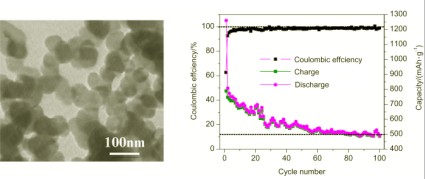
In this work, a simple low-temperature method has been employed to synthesize carbon nanoballs (CNBs). In a typical procedure, 1 g of petroleum asphalt in an alumina boat was directly heated to 450 ℃ at a rate of 10 ℃/min in air in a conventional box furnace to obtain the CNBs. Subsequently, the synthesized CNBs were treated in tubular furnace at 1500 ℃ under nitrogen atmosphere for 3 h and the obtained products were denoted as H-CNBs. The as-synthesized CNBs and H-CNBs were characterized by scanning electron microscopy, transmission electron microscopy, X-ray diffraction, Raman spectroscopy, and infrared spectroscopy. It was found that the diameters of CNBs and H-CNBs were in the range of 50~80 nm, and both of them showed a relatively low degree of graphitization. Compared with the CNBs, the H-CNBs showed a slightly higher degree of graphitization than the CNBs. A proposed formation mechanism of the CNBs is suggested to be as follows. Firstly, petroleum asphalt decomposed and formed a large amount of hydrocarbons at 220~500 ℃, such as benzene, methane, acetylene and so on. Carbon atoms from thermal cracking products of hydrocarbons deposited on the substrate in the absence of O2. Carbon atoms developed to CNBs as the temperature increased and the reaction time prolonged. The CNBs and H-CNBs were used as anode material in lithium ion batteries. The electrochemical performance was studied by galvanostatic charge/discharge at ambient temperature. The CNBs as anode materials exhibited a high initial capacity of 1260 mAh/g at a current of 1 C, which stabilized at around 500 mAh/g after 100 cycles. In contrast, the H-CNBs showed an initial capacity of 413 mAh/g under the same electrochemical conditions, which stabilized at 200 mAh/g after about 20 cycles with slight increase upon further cycling. Coulombic efficiency of as high as 98% was recorded after initial cycling for 10 cycles and 30 cycles for CNBs and H-CNBs, respectively. After cycling at different currents from 0.1 C, to 1 C, 5 C, and 10 C, the capacity of CNBs was almost fully recovered to the initial capacity at 0.1 C.
Cite this article

Pan Hailing , Li Li , Liu Jianghua , Jia Dianzeng . Preparation and Electrochemical Performance of Carbon Nanoballs from Petroleum Asphalt[J]. Acta Chimica Sinica, 2013 , 71(05) : 787 -792 . DOI: 10.6023/A12110989

References

[1] Iijima, S. Nature 1991, 354, 56.
[2] Alcántara, R.; Madrigal, F. J. F.; Lavela, P.; Tirado, J. L.; Mateos, J. M. J.; Salazar, C. G.; Stoyanova, R.; Zhecheva, E. Carbon 2000, 38, 1031.
[3] Horri, B. A.; Selomulya, C.; Wang, H.-T. Int. J. Hydrogen Energy 2012, 37, 15311.
[4] Li, Y.-H.; Huang, K.-L. Acta Chim. Sinica 2011, 69, 2185. (李艳华, 黄可龙, 化学学报, 2011, 69, 2185.)
[5] Ito, Y.; Venkatesan, N.; Hirako, N.; Sugioka, N.; Takada, K. Int. J. Pharm. 2007, 337, 357.
[6] Liu, Y.-C.; Qiu, X.-P.; Huang, Y.-Q.; Zhu, W.-T. Carbon 2002, 40, 2375.
[7] Uchida, M.; Aoyama, Y.; Tanabe, N.; Yanagihara, N.; Eda, N.; Ohta, A. J. Electrochem. Soc. 1995, 142, 2572.
[8] Dillon, A. C.; Jones, K. M.; Bekkedahl, T. A.; Kiang, C. H.; Bethune, D. S.; Heben, M. J. Nature 1997, 386, 377.
[9] Jiang, J.-H.; Gao, Q.-M.; Zheng, Z.-J.; Xia, K.-S.; Hu, J. Int. J. Hydrogen Energy 2010, 35, 210.
[10] Qiu, L.-B.; Sun, X.-M.; Yang, Z.-B.; Guo, W.-H.; Peng, H.-S. Acta Chim. Sinica 2012, 70, 1523. (丘龙斌, 孙雪梅, 仰志斌, 郭文瀚, 彭慧胜, 化学学报, 2012, 70, 1523.)
[11] Xia, W.; Jin, C.; Kundu, S.; Muhler, M. Carbon 2009, 47, 919.
[12] Qi, X.-S.; Zhong, W.; Yao, X.-J.; Zhang, H.; Ding, Q.; Wu, Q.; Deng, Y.; Au, C.; Du, Y. Carbon 2012, 50, 646.
[13] Mondal, K. C.; Strydom, A. M.; Tetana, Z.; Mhlanga, S. D.; Witcomb, M. J.; Havel, J.; Erasmus, R. M.; Coville, N. J. Mater. Chem. Phys. 2009, 114, 973.
[14] Yang, Y.-Z.; Liu, X.-G.; Xu, B.-S.; Li, T.-B. Carbon 2006, 44, 1661.
[15] Moothi, K.; Iyuke, S. E.; Meyyappa, M.; Falcon, R. Carbon 2012, 50, 2679.
[16] Corthals, S.; Noyen, J. V.; Geboers, J.; Vosch, T.; Liang, D.-D.; Ke, X.-X.; Hofkens, J.; Tendeloo, G. V.; Jacobs, P.; Sels, B. Carbon 2012, 50, 372.
[17] Jin, Y.-Z.; Gao, C.; Hsu, W. K.; Zhu, Y.-Q.; Huczko, A.; Bystrzejewski, M.; Roe, M.; Lee, C. Y.; Acquah, S.; Kroto, H.; Walton, D. R. M. Carbon 2005, 43, 1944.
[18] Moothi, K.; Iyuke, S. E.; Meyyappan, M.; Falcon, R. Carbon 2012, 50, 2679.
[19] Zhang, Y.-P. Ph.D. Dissertation, Dalian University of Technology, Dalian, 2004. (张云鹏, 博士论文, 大连理工大学, 大连, 2004.)
[20] Yang, Y.-Z.; Liu, X.-G.; Jia, H.-S.; Xu, B.-S. Mater. Chem. Phys. 2011, 126, 424.
[21] Liu, X.-G.; Yang, Y.-Z.; Lin, X.; Xu, B.-S.; Zhang, Y. Fuel Process. Technol. 2006, 87, 919.
[22] Yang, Y.-Z.; Liu, X.-G.; Luo, Q.-P.; Jin, L.; Xu, B.-S. New Carbon Mater. 2010, 25, 431.
[23] Li, F.-H.; Shen, Z.-M.; Xue, R.-S.; Chi, W.-D. New Carbon Mater. 2004, 19, 21. (李伏虎, 沈曾民, 薛锐生, 迟伟东, 新型碳材料, 2004, 19, 21.)
[24] Yang, Y.-Z.; Liu, X.-G.; Zhang, C.-Y.; Guo, M.-C.; Xu, B.-S. J. Phys. Chem. Solids 2010, 71, 235.
[25] Duan, L.-H.; Huang, Y.-D.; Jia, D.-Z.; Wang, X.-C.; Guo, Z.-P.Mater. Lett. 2012, 71, 151.
Outlines

/

