Article

Copper Complex Based Chemosensor which Could Colorimetrically Detect CN- in Water with Specific Selectivity and High Sensitivity

  • Lin Qi ,
  • Zhu Xin ,
  • Chen Pei ,
  • Fu Yongpeng ,
  • Zhang Youming ,
  • Wei Taibao
Expand
  • Key Laboratory of Polymer Materials of Gansu Province, Key Laboratory of Eco-Environment-Related Polymer Materials Ministry of Education, College of Chemistry and Chemical Engineering, Northwest Normal University, Lanzhou 730070

Received date: 2013-06-09

  Online published: 2013-07-22

Supported by

Project supported by the National Natural Science Foundation of China (Nos. 21064006, 21161018 and 21262032), the Natural Science Foundation of Gansu Province (No. 1010RJZA018) and the Program for Changjiang Scholars and Innovative Research Team in University of Ministry of Education of China (IRT1177).

Abstract

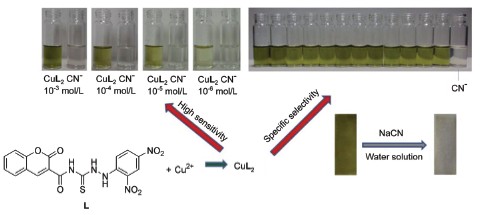
Owing to CN- could firmly bind copper(Ⅱ) via coordinate bonds, a competitive coordination mechanism based colorimetric chemosensor CuL2 was designed and synthesized. We carried out a series of CN- recognition research based on this work. As a result, chemosensor CuL2 could colorimetrically detect CN- in water solution with specific selectivity and high sensitivity. CuL2 can be utilized as a new colorimetric chemosensor for detection of cyanide at neutral pH in aqueous condition. Upon the addition of cyanide water solution to the DMSO/H2O (V:V=3:1) HEPES buffered solution (pH=7.0) of chemosensor CuL2, the green color of chemosensor CuL2 faded to colorless immediately, in the corresponding UV-vis spectra, the absorption at 446 nm disappeared. The detection limits were 8.0×10⁻⁶ and 4.0×10⁻⁷ mol/L of CN- using the visual color changes and UV-vis changes respectively, which is lower than the WHO guideline of 1.9 μmol·L-1. Other anions such as F-, Cl-, Br-, I-, AcO-, HSO4-, ClO4-, N3-, SO42-, NO3- and SCN- had no influence on the probing behavior of CuL2 toward cyanide. The CuL2 complex showed a highly selective and sensitive response toward cyanide by the complexation between the Cu2+ and CN-. The process can be monitored by UV-vis spectral changes as well as a visual color change. The good selectivity and high sensitivity of the complex CuL2 toward cyanide make CuL2 a promising candidate in practical applications as a good cyanide probe. Considering the simplicity of the analysis and low cost of the starting materials in the present system, this new method may be provided an useful potential candidate of colorimetric chemosensor for determination of cyanide in a variety of biological and environmental systems. Test strips based on CuL2 were fabricated, when different anion solutions were added to the test strips respectively, only the addition of CN- could induced an obviously color changes, the detection limits of the test strips for CN- is 8.0×10⁻⁵ mol/L. This test strips could act as a convenient and efficient CN- test kit.
Cite this article

Lin Qi , Zhu Xin , Chen Pei , Fu Yongpeng , Zhang Youming , Wei Taibao . Copper Complex Based Chemosensor which Could Colorimetrically Detect CN- in Water with Specific Selectivity and High Sensitivity[J]. Acta Chimica Sinica, 2013 , 71(11) : 1516 -1520 . DOI: 10.6023/A13060614

References

[1] Young, C.; Tidwell, L.; Anderson, C. Cyanide: Social, Industrial, and Economic Aspects, Minerals, Metals, and Materials Society, Warrendale, 2001.
[2] Baud, F. J.; Hum, E. Toxicol. 2007, 26, 191.
[3] Koening, R. Science 2000, 287, 1737.
[4] Anderson, R. A.; Harland, W. A. Med. Sci. Law 1982, 22, 35.
[5] Zamecnik, J.; Tam, J. J. Anal. Toxicol. 1987, 11, 47.
[6] Way, J. L. Annu. Rev. Pharmacol. 1984, 24, 451.
[7] Yen, S.; Wang, C. T.; Wang, J. S. Chem. Eng. Commun. 1991, 109, 167.
[8] Bhalla, V.; Singh, H.; Kumar, M. Dalton Trans. 2012, 41, 11413.
[9] Chattaraj, S.; Das, A. K. Analyst 1991, 116, 739.
[10] Bark, L. S.; Higson, H. G. Analyst 1963, 88, 751.
[11] Zhang, Y.-M.; Shi, B.-B.; Zang, P.; Huo, J. Q.; Chen, P.; Lin, Q.; Liu, J.; Wei, T.-B. Sci. China, Chem. 2013, 56, 612.
[12] Liu, S.-Y.; Wang, F.-J.; Wei, L.-H.; Xiao, W.; Meng, L.-Z.; He, Y.-B. Sci. China, Ser. B 2003, 33, 504. (刘顺英, 王法军, 隗兰花, 肖旺, 孟令芝, 何永炳, 中国科学B辑, 2003, 33, 504.)
[13] Zhang, Y.-M.; Lin, Q.; Wei, T.-B.; Wang, D.-D. Sens. Actuators, B 2009, 137, 447.
[14] Yang, Y.-M.; Zhao, Q.; Feng, W.; Li, F.-Y. Chem. Rev. 2013, 113, 192.
[15] Lin, Q.; Fu, Y.-P.; Chen, P.; Wei, T.-B.; Zhang, Y.-M. Dyes Pigm. 2013, 96, 1.
[16] Zhang, Y.-M.; Lin, Q.; Wei, T.-B.; Li, Y.; Qin, X.-P. Chem. Commun. 2009, 6074.
[17] Fang, X.-L.; Gao, B.-J.; Huang, X.-W.; Zhang, Y.-Q.; Gu, L.-Y. Acta Chim. Sinica 2012, 70, 2452. (房晓琳, 高保娇, 黄小卫, 张永奇, 顾来沅, 化学学报, 2012, 70, 2452.)
[18] Liu, Z.-Q.; Shi, M.; Li, F.-Y.; Fang, Q.; Chen, Z.-H.; Yi, T.; Huang, C.-H. Org. Lett. 2005, 7, 5481.
[19] Du, J.-M.; Gao, B.-J.; Huang, X.-W.; Zhang, Y.-Q.; Wang, M.-J. Acta Chim. Sinica 2012, 70, 1831. (杜俊玫, 高保娇, 黄小卫, 张永奇, 王明娟, 化学学报, 2012, 70, 1831.)
[20] Lin, Q.; Wei, T.-B.; Yao, H.; Zhang, Y.-M. Acta Chim. Sinica 2007, 65, 159. (林奇, 魏太保, 姚虹, 张有明, 化学学报, 2007, 65, 159.)
[21] Mao, J.; Wang, L.-N.; Dou, W.; Tang, X.-L.; Yan, Y.; Liu, W.-S. Org. Lett. 2007, 9, 4567.
[22] Tang, X.-L.; Peng, X.-H.; Dou, W.; Mao, J.; Zheng, J.-R.; Qin, W.-W.; Liu, W.-S.; Chang, J.; Yao, X.-J. Org. Lett. 2008, 10, 3653.
[23] Huang, X.-H.; Zhang, G.-X.; Zhang, D.-Q. Acta Chim. Sinica 2012, 70, 2133. (黄显虹, 张关心, 张德清, 化学学报, 2012, 70, 2133.)
[24] Ma, W.-H.; Xia, W.; Xu, Q.; Han, H.-Y.; Song, B.; Sun, L.-W.; Liang, C.-H. Acta Chim. Sinica 2012, 70, 917. (马文辉, 夏威, 徐群, 韩宏彦, 宋波, 孙丽微, 梁春花, 化学学报, 2012, 70, 917.)
[25] Liu, G.; Shao, J. Acta Chim. Sinica 2011, 69, 1070. (刘阁, 邵杰, 化学学报, 2011, 69, 1070.)
[26] Saha, S.; Ghosh, A.; Mahato, P.; Mishra, S.; Mishra, S. K.; Suresh, E.; Das, S.; Das, A. Org. Lett. 2010, 12, 3406.
[27] Kumar, V.; Kaushik, M. P.; Srivastava, A. K.; Pratap, A. Thiruvenkatam, V.; Row, T. N. Anal. Chim. Acta 2010, 663, 77.
[28] Odago, M. O.; Colabello, D. M.; Lees, A. J. Tetrahedron 2010, 66, 7465.
[29] Kumari, N.; Jha, S.; Bhattacharya, S. J. Org. Chem. 2011, 76, 8215.
[30] Yao, L.-M.; Zhou, J.; Liu, J.-L.; Feng, W.; Li, F.-Y. Adv. Funct. Mater. 2012, 22, 2667.
[31] Lin, Q.; Chen P.; Fu, Y.-P.; Zhang, Y.-M.; Shi, B.-B.; Zhang, P.; Wei, T.-B. Chin. Chem. Lett. 2013, 24, 699.
[32] Yang, L.; Li, X.; Yang, J.-B.; Qu, Y.; Hua, J.-L. Appl. Mater. Interfaces 2013, 5, 1317.
[33] Jo, J.; Olasz, A.; Chen, C. H.; Lee, D. J. Am. Chem. Soc. 2013, 135, 3620.
[34] Duan, Y.-L.; Zheng, Y.-S. Talanta 2013, 107, 332.
[35] Lee, J. H.; Jeong, A.; Shin, I. S.; Kim, H. J.; Hong, J. I. Org. Lett. 2010, 12, 764.
[36] Zelder, F. H. Inorg. Chem. 2008, 47, 1264.
[37] Guo, Y.-Y.; Tang, X.-L.; Hou, F.-P.; Wu, J.; Dou, W.; Qin, W.-W.; Ru, J.-X.; Zhang, G.-L.; Liu, W.-S.; Yao, X.-J. Sens. Actuators, B 2013, 181, 202.
[38] Kim, M. H.; Kim, S.; Jang, H. H.; Yi, S. J.; Seo, S. H.; Han, M. S. Tetrahedron Lett. 2010, 51, 4712.
[39] Lou, X.-D.; Zhang, Y.; Qin, J.-G.; Li, Z. Chem. Eur. J. 2011, 17, 9691.
[40] Lin, Q.; Chen, P.; Liu, J.; Fu, Y.-P.; Zhang, Y.-M.; Wei, T.-B. Dyes Pigm. 2013, 98, 100.
[41] Analytical Methods Committee, Analyst 1987, 112, 199.
Outlines

/

