
Research Progress of Non-Fullerene Small-Molecule Acceptor Materials for Organic Solar Cells
Received date: 2013-11-08
Online published: 2014-01-03
Supported by
Project supported by the National Key Basic Research Program of China (973 Program, Nos. 2014CB648300, 2009CB930601), the National Natural Science Foundation of China (Nos. 20904024, 51173081, 61136003, 61106036), the Natural Science Foundation of Jiangsu Province (Nos. BK20130037, BK2011760), the Nanjing University of Posts and Telecommunications (NUPT) Scientific Foundation (Nos. NY210016, NY212072), the Ministry of Education of China (Nos. 20133223110008, IRT1148), the Priority Academic Program Development of Jiangsu Higher Education Institutions (PAPD), the Six Talent Plan (No. 2012XCL035) and the Qing Lan Project of Jiangsu Province.
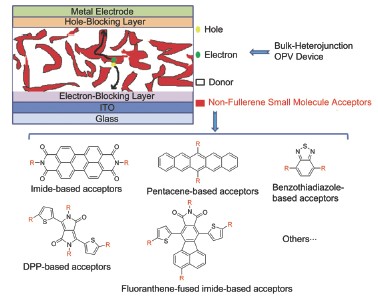
Bulk heterojunction organic photovoltaics have been the subject of intensive academic interest over the past two decades. Numerous recent efforts have been directed towards this area with the vision of developing next-generation low-cost solar cells. In the field of bulk heterojunction organic photovoltaics, fullerene and its derivatives are an important class of n-type electron acceptor materials. However, their disadvantages such as narrow wavelength absorption, high affinity, poor solubility, have severely limited their wide application as electron acceptors for organic solar cells and have largely hampered further improvement of the device performance. Recently, a number of research efforts have been focused on the development of novel non-fullerene n-type small-molecule acceptors. Various design rules and interesting new materials have been explored. The non-fullerene n-type small-molecule acceptors usually appear to possess lots of attractive advantages, such as adjustable energy levels, facile synthesis, good solubility, low processing cost. More important, when compared to the fullerene and its derivatives, this kind of small-molecule acceptors has wider spectral absorption that allows to absorb more sunlight to generate electricity. Recent breakthroughs rely mostly on the development of novel high-performance acceptor materials and optimization of the device structures. The up-to-date power conversion efficiencies exceeding 4% with using non-fullerene small-molecule acceptor materials in bulk heterojunction organic solar cells have been achieved. In this review, recent advances of non-fullerene small-molecule n-type acceptor materials for organic solar cells are reviewed, including rylene diimide-based acceptors, pentacene-based acceptors, benzothiadiazole-based acceptors, 1,4-diketopyrrolo-[3,4-c]-pyrrole (DPP)-based acceptors, fluorene-based acceptors, fluoranthene-fused imide-based acceptors and so on. Meanwhile, the future trends on material design and development have also been discussed. This review on illustrating the influence of the molecular structures and corresponding photovoltaic properties would thus be helpful to further unravel the role of electron acceptors and shed light on exploring efficient n-type electron acceptor materials for high performance organic photovoltaic devices.
Fu Yu , Wang Fang , Zhang Yan , Fang Xu , Lai Wenyong , Huang Wei . Research Progress of Non-Fullerene Small-Molecule Acceptor Materials for Organic Solar Cells[J]. Acta Chimica Sinica, 2014 , 72(2) : 158 -170 . DOI: 10.6023/A13111142
/
| 〈 |
|
〉 |

