
Viscoelastic Emulsions Stabilized by Salt-Free Catanionic Surfactants
Received date: 2015-03-28
Online published: 2015-07-07
Supported by
Project supported by the Hundred Talents Program of Chinese Academy of Sciences (No. Y20245YBR1) and the National Natural Science Foundation of China (Nos. 21402215, 61474124).
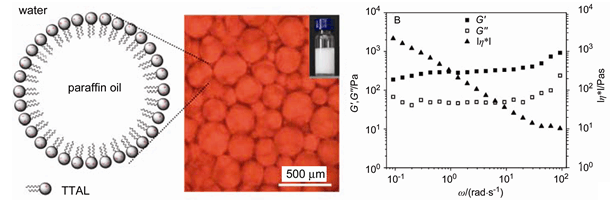
Salt-free cationic/anionic surfactant mixtures (catanionics) have received considerable attention in recent years due to their high surface activity and rich phase behavior. Although there have been extensive reports about their aggregation behavior, rheological properties and interaction with guest molecules in aqueous solutions, investigations in nonaqueous solutions and/or in solvent mixtures are rare. Typically, emulsions have enormous applications both in industry and daily life, and catanionics have long been predicted to be good emulsifiers. However, study in this direction is still in its infancy. Here, by acid-base neutralization we have prepared a catanionic surfactant, tetradecyltrimethyl ammonium laurate (TTAL), which was found to be able to effectively emulsify paraffin oil/water system. The emulsions can be obtained by simple hand-shaking, which is in sharp contrast to many of existing emulsions which can be only obtained through high-energy input. Optical microscopy observations revealed the presence of polydisperse, closely-packed emulsion droplets with diameters ranging from several micrometers to hundreds of micrometers. An increase in the amount of added TTAL at fixed water content induces a decrease of both the averaged size and polydispersity of the droplets. In contrast, the influence of the water content on the averaged size and polydispersity of the droplets is not obvious. Steady-state shear measurements indicated that the emulsions are shear-thinning, presumably due to the destruction of the close-packing of the emulsion droplets under shear. Oscillatory shear measurements revealed that the emulsions are viscoelastic with the elastic modulus higher than the viscous modulus over the whole investigated frequency range. At higher amount of added TTAL, the viscoelasticity of the emulsion also becomes higher and the emulsion begins to exhibit a yield stress. These observations are reminiscent of the characteristics of closely-packed vesicles formed by catanionics in water, and indicate that this unique class of surfactant can be potentially utilized for the construction of new generation of emulsions.
Key words: catanionic surfactant; emulsion; viscoelastic; closely packed
Zhang Na , Chen Guojun , Chen Kun , Li Hongguang , Hao Jingcheng . Viscoelastic Emulsions Stabilized by Salt-Free Catanionic Surfactants[J]. Acta Chimica Sinica, 2015 , 73(8) : 835 -839 . DOI: 10.6023/A15030212
[1] Zhao, G. X.; Zhu, B. Y. The Principle of Surface Active Agents, China Light Industry Press, Beijing, 2003. (赵国玺, 朱步瑶, 表面活性剂作用原理, 中国轻工业出版社, 北京, 2003.)
[2] Tang, Y. Q.; Zhu, L. Y.; Han, Y. C.; Wang, Y. L. Acta Chim. Sinica 2014, 72, 673. (唐永强, 朱琳一, 韩玉淳, 王毅琳, 化学学报, 2014, 72, 673.)
[3] Li, Y. P.; Lü, W. Q.; Cao, X. L.; Song, X. W.; Wang, Q. W.; Li, Y. Acta Chim. Sinica 2014, 72, 615. (李亚娉, 吕韦钦, 曹绪龙, 宋新旺, 王其伟, 李英, 化学学报, 2014, 72, 615.)
[4] Yatcilla, M. T.; Herrington, K. L.; Brasher, L. L.; Kaler, E. W.; Chiruvolu, S.; Zasadzinski, J. A. J. Phys. Chem. 1996, 100, 5874.
[5] Karukstis, K. K.; McCormack, S. A.; McQueen, T. M.; Goto, K. F. Langmuir 2004, 20, 64.
[6] Matos, M. R. A.; Silva, B. F. B.; Marques, E. F. J. Colloid Interface Sci. 2013, 405, 134.
[7] Jose, R.; Patel, T. J.; Cather, T. A.; Willhelm, D. J.; Grebowicz, J.; Han, H.; Bhowmik, P. K.; Sharpnack, L.; Agra-Kooijman, D. M.; Kumar, S. Colloid Surf. A 2014, 461, 40.
[8] Horbaschek, K.; Hoffmann, H.; Hao, J. J. Phys. Chem. B 2000, 104, 2781.
[9] Zemb, T.; Dubois, M.; Demé, B.; Gulik-Krzywicki, T. Science 1999, 283, 816.
[10] Dubois, M.; Demé, B.; Gulik-Krzywicki, T.; Dedieu, J.-C.; Vautrin, C.; Désert, S.; Perez, E.; Zemb, T. Nature 2001, 411, 672.
[11] Li, H.; Hao, J. J. Phys. Chem. B 2008, 112, 10497.
[12] Yang, M.; Hao, J.; Li, H. RSC Adv. 2014, 4, 40595.
[13] Varade, D.; Carriere, D.; Arriaga, L. R.; Fameau, A.-L.; Rio, E.; Langevin, D.; Drenckhan, W. Soft Matter 2011, 7, 6557.
[14] Li, H.; Hao, J.; Wu, Z. J. Phys. Chem. B 2008, 112, 3705.
[15] Li, H.; Xin, X.; Kalwarczyk, T.; Kalwarczyk, E.; Niton, P.; Holyst, R.; Hao, J. Langmuir 2010, 26, 15210.
[16] Li, H.; Xin, X.; Kalwarczyk, T.; Holyst, R.; Chen, J.; Hao, J. Colloids Surf. A 2013, 436, 49.
[17] Schelero, N.; Stocco, A.; Möhwald, H.; Zemb, T. Soft Matter. 2011, 7, 10694.
[18] Margulis-Goshen, K.; Silva, B. F. B.; Marques, E. F.; Magdassi, S. Soft Matter. 2011, 7, 9359.
[19] Sun, D. J.; Li, C.; Mei, Z.; Liu, W.; Su, C.; Yu, P.; Xu, J.; Liu, S. CN 200710113845 2007 [Chem. Abstr. 2008, 148, 588814].
[20] Cohen-Addad, S.; Höhler, R. Curr. Opin. Colloid Interface Sci. 2014, 19, 536.
[21] Wang, J.; Yang, F.; Li, C.; Liu, S.; Sun, D. Langmuir 2008, 24, 10054.
[22] Zhang, J.; Li, L.; Wang, J.; Sun, H.; Xu, J.; Sun, D. Langmuir 2012, 28, 6769.
[23] Zhang, J.; Li, L.; Wang, J.; Xu, J.; Sun, D. Langmuir 2013, 29, 3889.
[24] Vilasaua, J.; Solansa, C.; Gómezb, M. J.; Dabriob, J.; Mújika-Garaib, R.; Esquena, J. Colloid Surf. A 2011, 392, 38.
[25] Futamura, T.; Kawaguchi, M. J. Colloid Interface Sci. 2012, 367, 55.
[26] Nesterenko, A.; Drelich, A.; Lu, H.; Clausse, D.; Pezron, I. Colloids Surf. A 2014, 457, 49.
[27] Li, H.; Wieczorek, S. A.; Xin, X.; Kalwarczyk, T.; Ziebacz, N.; Szymborski, T.; Hozyst, R.; Hao, J.; Gorecka, E.; Damian Pociecha, D. Langmuir 2010, 26, 34.
/
| 〈 |
|
〉 |

