
Preparation of Polymer Nanotube Using Self-Assembled Metal Organic Nanotube as Template
Received date: 2015-10-13
Online published: 2015-11-13
Supported by
Project supported by the Natural Science Foundation of Liaoning Province of China (No. 2015020246).
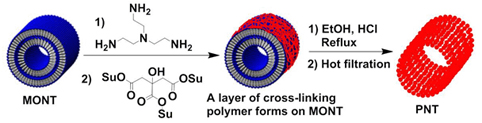
Hollow nano-material is one of the hot researches in recent years because of special optical, electrical, magnetic and catalytic properties. Polymer nanotube (PNT) is a polymer nano-material with tubular structure. Template method is an effective preparation method for tubular polymer nano-materials. In this study, we have developed a simple technique for the fabrication of polymer nanotubes by using self-assembled metal organic nanotube (MONT) as a template and multiple amine and acid as precursor molecules. An amphiphilic molecule (N-tetradecanoic glycylglycine, 1) was firstly synthesized by the coupling reaction of N-tetradecanoic acid and glycylglycine ethyl ester under the function of 1-ethyl-3-(3-dimethylamin-opropyl)carbodiimide hydrochloride (EDC·HCl), followed by a hydration process. The amphiphilic molecule 1 was successfully obtained in high yields. MONT was then prepared by the self-assembly of 1 with copper(Ⅱ) nitrate in methanol. A solution of copper(Ⅱ) nitrate in water was slowly added into a solution of 1 in methanol. The mixed solution was stirred for 24 h at room temperature and MONT was obtained by filtration, washing with water and freeze-dry. And finally, template reactions were carried out as follows: a certain amount of MONT was dispersed in tetrahydrofuran (THF), and then the multiple amine was added to complex with copper ions on the surface of MONT. The mixed solution was stirred for 3 h at room temperature and a coated layer formed on the surface of MONT. The coated layer on the nanotube surface was further cross-linked by an activated ester of citric acid. Finally, the self-assembled template was removed by hot filtration and the PNTs with good dispersibility in water were obtained. The surface topography, composition and structure of PNTs were characterized by scanning electron microscope (SEM), scanning transmission electron microscopy (STEM), differential scanning calorimetry (DSC), X-ray diffraction (XRD) and diffuse reflectance infrared Fourier transform spectroscopy (DRIFTS). The results showed that up to 80% cross-linked products form PNTs when the amount of multiple amines is 0.4 molar equivalent of MONT. The lengths of PNTs are about 500 nm~3 μm, inner diameters are 60~100 nm and outer diameters are 80~120 nm.
Key words: polymer nanotube; template; metal organic nanotube; self-assembly
Wang Lei , Li Xue , Zheng Fei , Guo Yuxin , Zhang Zhiqiang , Chi Haijun , Dong Yan , Wang Cuiping , Lu Gonghao . Preparation of Polymer Nanotube Using Self-Assembled Metal Organic Nanotube as Template[J]. Acta Chimica Sinica, 2016 , 74(3) : 259 -264 . DOI: 10.6023/A15100655
[1] Fu, G. D.; Li, G. L.; Neoh, K. G.; Kang, E. T. Prog. Polym. Sci. 2011, 36, 127.
[2] Yin, Z.; Zheng, Q. Adv. Energy Mater. 2012, 2, 179.
[3] Yang, L.; Tan, X.; Wang, Z.; Zhang, X. Chem. Rev. 2015, 115, 7196.
[4] Yao, Y.; Xue, M.; Chen, J.; Zhang, M.; Huang, F. J. Am. Chem. Soc. 2012, 134, 15712.
[5] Yu, G.; Ma, Y.; Han, C.; Yao, Y.; Tang, G.; Mao, Z.; Gao, C.; Huang, F. J. Am. Chem. Soc. 2013, 135, 10310.
[6] Dong, S.; Zheng, B.; Xu, D.; Yan, X.; Zhang, M.; Huang, F. Adv. Mater. 2012, 24, 3191.
[7] Dong, S.; Luo, Y.; Yan, X.; Zheng, B.; Ding, X.; Yu, Y.; Ma, Z.; Zhao, Q.; Huang, F. Angew. Chem. 2011, 123, 1945.
[8] Xue, M.; Hu, S.-Z.; Chen, C.-F. Acta Chim. Sinica 2012, 70, 1697. (薛敏, 胡树振, 陈传峰, 化学学报, 2012, 70, 1697.)
[9] Thorkelsson, K.; Bai, P.; Xu, T. Nano Today 2015, 10, 48.
[10] Stupp, S. I.; Palmer, L. C. Chem. Mater. 2014, 26, 507.
[11] Chapman, R.; Danial, M.; Koh, M. L.; Jolliffe, K. A.; Perrier, S. Chem. Soc. Rev. 2012, 41, 6023.
[12] Wu, D.; Xu, F.; Sun, B.; Fu, R.; He, H.; Matyjaszewski, K. Chem. Rev. 2012, 112, 3959.
[13] Liu, Y.; Goebl, J.; Yin, Y. Chem. Soc. Rev. 2013, 42, 2610.
[14] Yang, X.; Tang, H.; Cao, K.; Song, H.; Sheng, W.; Wu, Q. J. Mater. Chem. 2011, 21, 6122.
[15] Leenaars, A. F. M.; Keizer, K.; Burggraaf, A. J. J. Mater. Sci. 1984, 19, 1077.
[16] Meng, X.-X.; Yang, N.-T.; Tan, X.-Y.; Guo, H. Acta Chim. Sinica 2007, 65, 871. (孟秀霞, 杨乃涛, 谭小耀, 郭红, 化学学报, 2007, 65, 871.)
[17] Martin, C. R. Science 1994, 266, 1966.
[18] Steinhart, M.; Wendorff, J.; Greiner, A.; Wehrspohn, R.; Nielsch, K.; Schilling, J.; Choi, J.; Gosele, U. Science 2002, 296, 1997.
[19] Zhang, J.; Li, C. M. Chem. Soc. Rev. 2012, 41, 7016.
[20] Wei, Y.; Sun, D.; Yuan, D.; Liu, Y.; Zhao, Y.; Li, X.; Wang, S.; Dou, J. M.; Wang, X. P.; Hao, A. Y.; Sun, D. F. Chem. Sci. 2012, 3, 2282.
[21] Panda, T.; Kundu, T.; Banerjee, R. Chem. Commun. 2012, 48, 5464.
[22] Shimizu, T.; Masuda, M.; Minamikawa, H. Chem. Rev. 2005, 105, 1401.
[23] Shimizu, T. J. Polym. Sci., Part A: Polym. Chem. 2008, 46, 2601.
[24] Shimizu, T.; Minamikawa, H.; Kogiso, M.; Aoyagi, M.; Kameta, N.; Ding, W.; Masuda, M. Polym. J. 2014, 46, 858.
[25] Kameta, N. J. Inclusion Phenom. Macrocyclic Chem. 2014, 79, 1.
[26] Kogiso, M.; Zhou, Y.; Shimizu, T. Adv. Mater. 2007, 19, 242.
[27] Aida, T.; Meijer, E. W.; Stupp, S. I. Science 2012, 335, 813.
[28] Lee, J.; Kim, S. M.; Lee, I. S. Nano Today 2014, 9, 631.
[29] Gao, Z.-Z.; Tong, H.; Chen, J.-H.; Yue, S.-H.; Bai, W.-L.; Zhang, X.-G.; Pan, Y.-F.; Shi, M.; Song, Y.-X. Acta Chim. Sinica 2014, 72, 1175. (高珍珍, 佟浩, 陈建慧, 岳世鸿, 白文龙, 张校刚, 潘燕飞, 石明, 宋玉翔, 化学学报, 2014, 72, 1175.)
[30] Guix, M.; Mayorga-Martinez, C. C.; Merkoci, A. Chem. Rev. 2014, 114, 6285.
[31] Mathews, A. S.; Kim, I.; Ha, C. S. Macromol. Res. 2007, 15, 114.
/
| 〈 |
|
〉 |

