
Theoretical Investigation on Weak Interactions of HXeBr with Benzene and Its Derivatives
Received date: 2015-10-03
Online published: 2015-12-23
Supported by
Project supported by the National Natural Science Foundation of China (Nos. 21173020, 21473008).
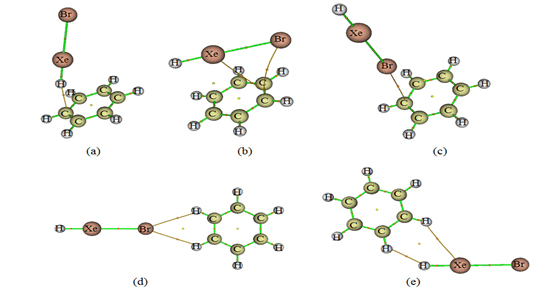
Geometries of complexes HXeBr…C6H5X (X=H, CH3, NH2, N(CH3)2, NHCH3, OH, OCH3, CN, F, Cl, Br, I, COOH, SO3H, CF3) and its monomers are optimized with MP2/aug-cc-pVDZ (aug-cc-pVDZ-PP for Xe and I). The aug-cc-pVDZ-PP is a small core pseudopotential basis set. It ignores 28 electrons for Xe and I atoms. Two types of weak interactions, π…H bond and bifurcated hydrogen bonds, are analyzed in detail. The effects of substituting group of the benzene ring on the weak interaction energies are investigated. Their effects on π…H bond are different from that on bifurcated hydrogen bonds. As for the complexes with π…H bond, electron withdrawing groups reduce the interaction energies while electron donating groups increase the interaction energies. However, for the complexes with bifurcated hydrogen bonds, electron withdrawing groups increase the interaction energies while electron-donating groups decrease the interaction energies. The effects of substituting groups on geometrical parameters of HXeBr are also analyzed. As for 14 complexes of HXeBr…C6H5X with bifurcated hydrogen bonds, it is found that their weak interaction energies have very good linear relationships with dipole moments of C6H5X, bond length changes of Xe—Br and H—Xe bonds, vibrational frequency changes of H—Xe bonds, and the sum of two interpenetration distances of Van der Waals surfaces of bromine and two hydrogen atoms which are connected to the bromine atom by hydrogen bonds. It is also found that the weak interaction energies of 14 complexes above have very good linear relationships with the sum of electron densities (ρ), the sum of ∇2ρ and the sum of electrostatic potentials at two critical points of bifurcated hydrogen bonds, and with the electron density, ∇2ρ and the electrostatic potential at the ring critical point which is inside a ring formed by the bifurcated hydrogen bonds and two carbon atoms of the benzene ring. As for the complexes with bifurcated hydrogen bonds, the weak interaction energies between the monomers can be understood approximately as dipole-dipole interaction.
Key words: rare gas; HXeBr; benzene; π…H bond; bifurcated hydrogen bonds
Zhao Qing , Qi Boyu , Wang Baojin , Chen Feiwu . Theoretical Investigation on Weak Interactions of HXeBr with Benzene and Its Derivatives[J]. Acta Chimica Sinica, 2016 , 74(3) : 285 -292 . DOI: 10.6023/A15100641
[1] Klemperer, W. Science 1992, 257, 887.
[2] Rozas, I.; Alkorta, I.; Elguero, J. J. Phys. Chem. A 1997, 101, 4236.
[3] Rozas, I.; Alkorta, I.; Elguero, J. J. Phys. Chem. A 1998, 102, 9925.
[4] Hobza, P.; Havlas, Z. Chem. Rev. 2000, 100, 4253.
[5] Tarakeshwar, P.; Choi, H. S.; Kim, K. S. J. Am. Chem. Soc. 2001, 123, 3323.
[6] Grabowski, S. J.; Sokalski, W. A.; Leszczynski, J. J. Phys. Chem. A 2004, 108, 5823.
[7] Yuan, K.; Liu, Y.-Z.; Zhu, Y.-C.; Zhang, J.; Zhang, J.-Y. Acta Chim. Sinica 2009, 67, 499 (in Chinese). (袁焜, 刘艳芝, 朱元成, 张继, 张俊彦, 化学学报, 2009, 67, 499.)
[8] Zhang, Q.-H.; Wang, Y.; Liu, C.; Yang, Z.-Z. Acta Chim. Sinica 2014, 72, 956 (in Chinese). (张千慧, 王阳, 刘翠, 杨忠志, 化学学报, 2014, 72, 956.)
[9] Liu, C.; Yu, G.; Huang, C.-Y.; Wang, C.-S. Acta Chim. Sinica 2015, 73, 357 (in Chinese). (刘畅, 于歌, 黄翠英, 王长生, 化学学报, 2015, 73, 357.)
[10] Bartlett, N. Proc. Chem. Soc. 1962, 218.
[11] Pettersson, M.; Lundell, J.; Räsänen, M. J. Chem. Phys. 1995, 102, 6423.
[12] Khriachtchev, L.; Pettersson, M.; Runeberg, N.; Lundell, J.; Räsänen, M. Nature 2000, 406, 874.
[13] Lignell, A.; Khriachtchev, L.; Pettersson, M.; Räsänen, M. J. Chem. Phys. 2003, 118, 11120.
[14] McDowell, S. A. C. J. Chem. Phys. 2004, 120, 3630.
[15] McDowell, S. A. C. Chem. Phys. Lett. 2005, 406, 228.
[16] Yen, S.-Y.; Mou, C.-H.; Hu, W.-P. Chem. Phys. Lett. 2004, 383, 606.
[17] Liu, X.-F.; Li, Q.-Z.; Li, R.; Li, W.-Z.; Cheng, J.-B. Spectrochim. Acta A 2011, 84, 68.
[18] Lignell, A.; Lundell, J.; Khriachtchev, L.; Räsänen, M. J. Phys. Chem. A 2008, 112, 5486.
[19] Tsuge, M.; Berski, S.; Stachowski, R.; Räsänen, M.; Latajka, Z.; Khriachtchev, L.J. Phys. Chem. A 2012, 116, 4510.
[20] Tsivion, E.; Räsänen, M.; Gerber, R. B. Phys. Chem. Chem. Phys. 2013, 15, 12610.
[21] Tsuge, M.; Berski, S.; Räsänen, M.; Latajka, Z.; Khriachtchev, L.J. Chem. Phys. 2014, 140, 044323.
[22] Peterson, K. A.; Figgen, D.; Goll, E.; Stoll, H.; Dolg, M. J. Chem. Phys. 2003, 119, 11113.
[23] (a) Feller, D. J. Comp. Chem. 1996, 17, 1571.
(b) Schuchardt, K. L.; Didier, B. T.; Elsethagen, T.; Sun, L.; Gurumoorthi, V.; Chase, J.; Li, J.; Windus, T. L. J. Chem. Inf. Model. 2007, 47, 1045.
[24] Boys, S. F.; Bernardi, F. Mol. Phys. 1970, 19, 553.
[25] Frisch, M. J.; Trucks, G. W.; Schlegel, H. B.; Scuseria, G. E.; Robb, M. A.; Cheeseman, J. R.; Scalmani, G.; Barone, V.; Mennucci, B.; Petersson, G. A.; Nakatsuji, H.; Caricato, M.; Li, X.; Hratchian, H. P.; Izmaylov, A. F.; Bloino, J.; Zheng, G.; Sonnenberg, J. L.; Hada, M.; Ehara, M.; Toyota, K.; Fukuda, R.; Hasegawa,J.; Ishida, M.; Nakajima, T.; Honda, Y.; Kitao, O.; Nakai, H.; Vreven, T.; Montgomery, J. A.; Jr., Peralta, J. E.; Ogliaro, F.; Bearpark, M.; Heyd, J. J.; Brothers, E.; Kudin, K. N.; Staroverov, V. N.;Keith, T.; Kobayashi, R.; Normand, J.; Raghavachari, K.; Rendell, A.; Burant, J. C.; Iyengar, S. S.; Tomasi, J.; Cossi,M.; Rega, N.; Millam, J. M.; Klene, M.; Knox, J. E.; Cross, J. B.; Bakken, V.; Adamo,C.; Jaramillo, J.; Gomperts, R.; Stratmann, R. E.; Yazyev, O.; Austin, A. J.; Cammi, R.; Pomelli,C.; Ochterski, J. W.; Martin, R. L.; Morokuma, K.; Zakrzewski, V. G.; Voth, G. A.; Salvador, P.; Dannenberg, J. J.; Dapprich, S.; Daniels, A. D.; Farkas, O.; Foresman, J. B.; Ortiz, J. V.; Cioslowski, J.; Fox, D. J. Gaussian 09, Revision D.01, Gaussian,Inc., Wallingford CT, 2009.
[26] (a) Lu, T.; Chen, F.-W. J. Comput. Chem. 2012, 33, 580.
(b) Multiwfn website:http://Multiwfn.codeplex.com.
[27] Humphrey, W.; Dalke, A.; Schulten, K. J. Mol. Graphics Modell. 1996, 14, 33.
[28] Bader, R. F. W. Chem. Rev. 1991, 91, 893.
[29] Bader, R. W. F. Acc. Chem. Res. 1985, 18, 9.
[30] Bader, R. F. W. Atoms in Molecules: A Quantum Theory, Oxford University Press, Oxford, 1990.
[31] Lu, T.; Chen, F.-W. J. Theor. Comput. Chem. 2012, 11, 163.
[32] Ammal, S. S. C.; Venuvanalingam, P. J. Chem. Phys. 1998, 109, 9820.
[33] Ji, L.-T.; Meng, L.-P.; Zheng, S.-J.; Zeng, Y.-L. Acta Chim. Sinica 2011, 69, 889 (in Chinese). (吉丽婷, 孟令鹏, 郑世钧, 曾艳丽, 化学学报, 2011, 69, 889.)
[34] Grimme, S. Angew. Chem., Int. Ed. 2008, 47, 3430.
[35] Joseph, J.; Jemmis, E. D. J. Am. Chem. Soc. 2007, 129, 4620.
/
| 〈 |
|
〉 |

