
Catalytic Asymmetric[4+2] Cycloaddition of o-Hydroxybenzyl Alcohols with o-Hydroxyl Styrenes: Diastereo- and Enantioselective Construction of Chiral Chroman Scaffold
Received date: 2016-02-05
Online published: 2016-06-07
Supported by
Project supported by the National Natural Science Foundation of China (Nos. 21372002 and 21232007), Priority Academic Program Development of Jiangsu Higher Education Institutions and QingLan project of Jiangsu Province.
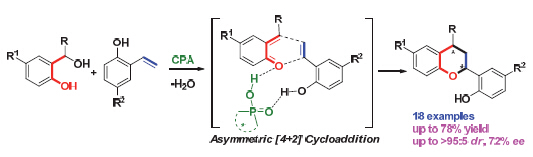
A chiral phosphoric acid-catalyzed asymmetric[4+2] cycloaddition of o-hydroxyl styrenes with o-quinone methides (o-QMs) generated in situ from o-hydroxybenzyl alcohols has been established. O-Hydroxybenzyl alcohols could transform into o-QM intermediates under the catalysis of chiral phosphoric acid (CPA), which are easily activated by CPA via hydrogen-bonding interaction. On the other hand, o-hydroxyl styrenes could also be activated by CPA via forming a hydrogen bond between the hydroxyl group of styrenes and the phosphoryl oxygen of CPA. So, by selecting o-hydroxybenzyl alcohols as precursors of dienes and o-hydroxyl styrenes as dienophiles under the catalysis of CPA, this catalytic asymmetric[4+2] cycloaddition provided an efficient strategy for constructing enantioenriched chroman framework with two stereogenic centers. A variety of substituted o-hydroxybenzyl alcohols and o-hydroxyl styrenes bearing either electron-donating or electron-withdrawing groups could be applicable to the reaction, delivering chiral chroman derivatives in high yields, considerable enantioselectivities and excellent diastereoselectivities (up to 78% yield, 72% ee, most of examples>95∶5 dr). The electronic nature of the substituents has some effect on the reaction. Namely, the electron-donating groups were beneficial to both the reactivity and the enantioselectivity. Based on the control experiments, it is suggested that the o-hydroxyl styrenes and the o-QM intermediates generated from o-hydroxybenzyl alcohols were simultaneously activated by CPA via forming double hydrogen bonds, thus facilitating the reaction in an enantioselective way. A representative procedure for the enantioselective[4+2] cycloaddition reaction is as following: 1,2-dichloroethane (1 mL) was added to the mixture of o-hydroxybenzyl alcohols (0.1 mmol), o-hydroxyl styrenes (0.12 mmol), the chiral phosphoric acid (0.005 mmol), and 3 Å molecular sieves (100 mg). After being stirred at 50 ℃ for 12 h, the reaction mixture was filtered to remove the molecular sieves, and the solid powder was washed with ethyl acetate. The resultant solution was concentrated under the reduced pressure to give the residue, which was purified through flash column chromatography on silica gel to afford the pure chiral chroman derivatives.
Wu Qiong , Zhao Jiajia , Sun Sibing , Tu Mansu , Shi Feng . Catalytic Asymmetric[4+2] Cycloaddition of o-Hydroxybenzyl Alcohols with o-Hydroxyl Styrenes: Diastereo- and Enantioselective Construction of Chiral Chroman Scaffold[J]. Acta Chimica Sinica, 2016 , 74(7) : 576 -581 . DOI: 10.6023/A16020080
[1] For some examples, see: (a) Ko, H.-H.; Jin, Y.-J.; Lu, T.-M.; Chen, I.-S. Chem. Biodiversity 2013, 10, 1269;
(b) Kumar, S.; Deshpande, S.; Chandra, V.; Kitchlu, S.; Dwivedi, A.; Nayak, V. L.; Konwar, R.; Prabhakar; Yenamandra, S.; Sahu, D. P. Bioorg. Med. Chem. 2009, 17, 6832;
(c) Hafez, H. N.; Hegab, M. I.; Ahmed-Farag, I. S.; El-Gazzar, A. B. A. Bioorg. Med. Chem. Lett. 2008, 18, 4538;
(d) Poupelin, J. P.; Saint-Ruf, G.; Foussard-Blanpin, O.; Narcisse, G.; Uchida-Ernouf, G.; Lacroix, R. Eur. J. Med. Chem. 1978, 13, 67.
[2] (a) Kumar, S.; Deshpande, S.; Chandra, V.; Kitchlu, S.; Dwivedi, A.; Nayak, V. L.; Konwar, R.; Prabhakar, Y. S.; Sahu, D. P. Bioorg. Med. Chem. 2009, 17, 6832;
(b) Sangita; Dwivedi, A.; Prathipati, P.; Ray, S. Med. Chem. Res. 2010, 19, 915.
[3] For some examples, see: (a) Tripathi, S.; Dwivedy, I.; Dhar, J. D.; Dwivedy, A.; Ray, S. Bioorg. Med. Chem. Lett. 1997, 7, 2131;
(b) Ferreira, S. B.; da Silva, F. de C.; Pinto, A. C.; Gonzaga, D. T. G.; Ferreira, V. F. J. Heterocycl. Chem. 2009, 46, 1080;
(c) Zhang, H.; Zhu, L.; Wang, S.; Yao, Z.-J. J. Org. Chem. 2014, 79, 7063;
(d) Yu, S.-Y.; Zhang, H.; Gao, Y.; Mo, L.; Wang, S.; Yao, Z.-J. J. Am. Chem. Soc. 2013, 135, 11402;
(e) Enders, D.; Urbanietz, G.; Hahn, R.; Raabe, G. Synthesis 2012, 44, 773.
[4] For some reviews, see: (a) van de Water, R. W.; Pettus, T. R. R. Tetrahedron 2002, 58, 5367;
(b) Pathak, T. P.; Sigman, M. S. J. Org. Chem. 2011, 76, 9210;
(c) Willis, N. J.; Bray, C. D. Chem.-Eur. J. 2012, 18, 9160;
(d) Wang, Z.; Sun, J. Synthesis 2015, 47, 3629; For some enantioselective examples, see:
(e) Alden-Danforth, E.; Scerba, M. T.; Lectka, T. Org. Lett. 2008, 10, 4951;
(f) Lv, H.; You, L.; Ye, S. Adv. Synth. Catal. 2009, 351, 2822;
(g) Pathak, T. P.; Gligorich, K. M.; Welm, B. E.; Sigman, M. S. J. Am. Chem. Soc. 2010,132, 7870;
(h) Luan, Y.; Schaus, S. E. J. Am. Chem. Soc. 2012, 134, 19965;
(i) Lv, H.; Jia, W. Q.; Sun, L. H.; Ye, S. Angew. Chem., Int. Ed. 2013, 52, 8607;
(j) Izquierdo, J.; Orue, A.; Scheidt, K. A. J. Am. Chem. Soc. 2013, 135, 10634;
(k) Wang, Z. B.; Ai, F. J.; Wang, Z.; Zhao, W. X.; Zhu, G. Y.; Lin, Z. Y.; Sun, J. W. J. Am. Chem. Soc. 2015, 137, 383.
[5] (a) Wilcke, D.; Herdtweck, E.; Bach, T. Synlett 2011, 2011, 1235;
(b) Zhao, W.; Wang, Z.; Chu, B.; Sun, J. Angew. Chem., Int. Ed. 2015, 54, 1910;
(c) Saha, S.; Alamsetti, S. K.; Schneider, C. Chem. Commun. 2015, 51, 1461.
[6] (a) El-Sepelgy, O.; Haseloff, S.; Alamsetti, S. K.; Schneider, C. Angew. Chem., Int. Ed. 2014, 53, 7923;
(b) Hsiao, C. C.; Liao, H. H.; Rueping, M. Angew. Chem., Int. Ed. 2014, 53, 13258;
(c) Saha, S.; Schneider, C. Chem. Eur. J. 2015, 21, 2348;
(d) Saha, S.; Schneider, C. Org. Lett. 2015, 17, 648;
(e) Zhao, J.-J.; Zhang, Y.-C.; Xu, M.-M.; Tang, M.; Shi, F. J. Org. Chem. 2015, 80, 10016.
[7] (a) Zhao, J.-J.; Sun, S.- B.; He, S.-H.; Wu, Q.; Shi, F. Angew. Chem., Int. Ed. 2015, 54, 5460;
(b) Hsiao, C.-C.; Raja, S.; Liao, H.-H.; Atodiresei, I.; Rueping, M. Angew. Chem., Int. Ed. 2015, 54, 5762.
[8] For early examples: (a) Akiyama, T.; Itoh, J.; Yokota, K.; Fuchibe, K. Angew. Chem., Int. Ed. 2004, 43, 1566;
(b) Uraguchi, D.; Terada, M. J. Am. Chem. Soc. 2004, 126, 5356; For reviews:
(c) Akiyama, T. Chem. Rev. 2007, 107, 5744;
(d) Terada, M. Chem. Commun. 2008, 35, 4097;
(e) Terada, M. Synthesis 2010, 1929;
(f) Yu, J.; Shi, F.; Gong, L.-Z. Acc. Chem. Res. 2011, 44, 1156;
(g) Parmar, D.; Sugiono, E.; Raja, S.; Rueping, M. Chem. Rev. 2014, 114, 9047;
(h) Wu, X.; Li, M.-L.; Gong, L.-Z. Acta Chim. Sinica 2013, 71, 1091. (吴祥, 李明丽, 龚流柱, 化学学报, 2013, 71, 1091.);
(i) Wu, H.; He, Y.-P.; Shi, F. Synthesis 2015, 47, 1990; For some selected examples, see:
(j) Huang, J.-Z.; Luo, S.-W.; Gong, L.-Z. Acta Chim. Sinica 2013, 71, 879. (黄建洲, 罗时玮, 龚流柱, 化学学报, 2013, 71, 879);
(k) Duan, D.; Yin, Q.; Wang, S.; Gu, Q.; You, S. Acta Chim. Sinica 2014, 72, 1001. (段德河, 殷勤, 王守国, 顾庆, 游书力, 化学学报, 2014, 72, 1001.);
(l) Shi, L.; Ji, Y.; Huang, W.; Zhou, Y. Acta Chim. Sinica 2014, 72, 820. (时磊, 姬悦, 黄文学, 周永贵, 化学学报, 2014, 72, 820.);
(m) Lv, J.; Qin, Y.; Cheng, J.; Luo, S. Acta Chim. Sinica 2014, 72, 809. (吕健, 秦岩, 程津培, 罗三中, 化学学报, 2014, 72, 809.);
(n) Wang, S.-G.; You, S.-L. Angew. Chem., Int. Ed. 2014, 53, 2194;
(o) Wang, S.-G.; Yin, Q.; Zhuo, C.-X.; You, S.-L. Angew. Chem., Int. Ed. 2015, 54, 647.
[9] (a) Chen, X.-H.; Zhang, W.-Q.; Gong, L.-Z. J. Am. Chem. Soc. 2008, 130, 5652;
(b) He, L.; Chen, X.-H.; Wang, D.-N.; Luo, S.-W.; Zhang, W.-Q.; Yu, J.; Ren, L.; Gong, L.-Z. J. Am. Chem. Soc. 2011, 133, 13504.
/
| 〈 |
|
〉 |

