
Synthesis and Electrochemical Performance of Lithium Rich Cathode Materials xLi3NbO4·(1-x)LiMO2 (M=Mn, Co; 0 < x < 1) for Li-ion Batteries
Received date: 2016-05-16
Revised date: 2016-10-07
Online published: 2016-10-10
Supported by
Project supported by the National Natural Science Foundation of China (Nos. 21233004, 21473148, 21428303) and the Natural Science Foundation of Fujian Province (No. 2014J05019).
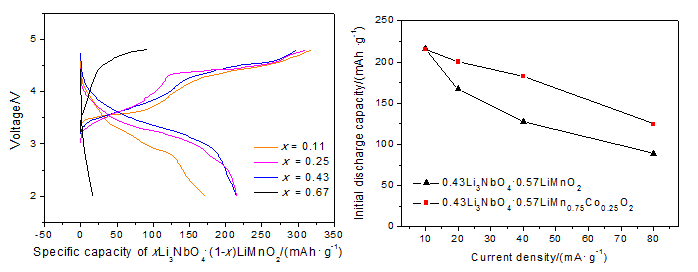
Lithium rich material xLi3NbO4·(1-x) LiMnO2 (0 < x < 1) was successfully synthesized by solid state method. Stoichiometric amounts of Li2CO3, Mn2O3 and Nb2O5 were mixed by ball milling, and the mixture was calcinated at 900℃ for 5 h under Ar atmosphere. X-ray diffraction (XRD) results indicate that the samples with 0.25 < x < 0.67 can be indexed as a cubic structure with Fm-3m space group. Electrochemical results show that the samples of x=0.25 and 0.43 have better electrochemical performance, both delivering 216 mAh·g-1 in the initial cycle between 2 V and 4.8 V. Although voltage decay is an intrinsic drawback of lithium excess materials, the sample of x=0.43 decays slower. We speculate that Li3NbO4 helps stabilizing the crystal structure. Ex-situ XPS and XAS studies show that the charging process can be divided into two stages. In the first stage, below 4.3 V, Mn3+ is oxidized to Mn4+, in the second stage, O2- is oxidized. The reversible oxidation of O2- is the origin of the achievement of large reversible capacity. Co3+ doped material 0.43Li3NbO4·0.57LiMn1-yCoyO2 (y=0.25; 0.5) was also synthesized by the same procedure. The structure of the doped material maintains the cubic structure with smaller lattice constant and the variation of lattice constant is in proportion to the amount of Co3+. Galvanostatic charge and discharge tests show that 0.43Li3NbO4·0.57LiMn0.75Co0.25O2 also delivers a large capacity of 215 mAh·g-1 in the first cycle between 2 V and 4.8 V, but the voltage plateau in the charging process decreased from 4.3 V to 4.1 V, it can be attributed to the weak dissociation energy of Mn-O bond and the overlap of Co3+/4+ 3d and O2- 2p energy band. The electrochemical impedance spectroscopy results show that a moderate amount of Co3+ doped into the material decreases the charge transfer resistance. After doped with Co3+, the rate capability is improved.
Yang Chun , Gong Zhengliang , Zhao Wengao , Yang Yong . Synthesis and Electrochemical Performance of Lithium Rich Cathode Materials xLi3NbO4·(1-x)LiMO2 (M=Mn, Co; 0 < x < 1) for Li-ion Batteries[J]. Acta Chimica Sinica, 2017 , 75(2) : 212 -217 . DOI: 10.6023/A16050240
[1] Tarascon, J.-M.; Armand, M. Nature 2001, 414(6861), 359.
[2] Etacheri, V.; Marom, R.; Elazari, R.; Salitra, G.; Aurbach, D. Energy Environ. Sci. 2011, 4(9), 3243.
[3] Du, K.; Hu, G. R. Chin. Sci. Bull. 2012, 57(10), 794. (杜柯, 胡国荣, 科学通报, 2012, 57(10), 794.)
[4] Zhao, Y.-J.; Feng, H.-L.; Zhao, C.-S.; Sun, Z.-Q. J. Inorg. Mater. 2011, 26(07), 673. (赵煜娟, 冯海兰, 赵春松, 孙召琴, 无机材料学报, 2011, 26(07), 673.)
[5] Yang, Y.; Gong, Z.; Wu, X.; Zheng, J.; Lü, D. Chin. Sci. Bull. 2012, 57(27), 2570. (杨勇,龚正良,吴晓彪,郑建明,吕东平, 科学通报, 2012, 57(27), 2570.)
[6] Ukei, K.; Suzuki, H.; Shishido, T.; Fukuda, T. Acta Crystallogr. C 1994, 50(5), 655.
[7] Yabuuchi, N.; Takeuchi, M.; Endo, D.; Ozaki, T.; Inamasu, T.; Son, J.-Y.; Cui, Y.-T.; Oji, H.; Komaba, S. Meet. Abstr. 2013, MA2013-02(12), 874.
[8] Yabuuchi, N.; Takeuchi, M.; Nakayama, M.; Shiiba, H.; Ogawa, M.; Nakayama, K.; Ohta, T.; Endo, D.; Ozaki, T.; Inamasu, T.; Sato, K.; Komaba, S. Proc. Natl. Acad. Sci. 2015, 112(25), 7650.
[9] Sathiya, M.; Abakumov, A. M.; Foix, D.; Rousse, G.; Ramesha, K.; Saubanère, M.; Doublet, M. L.; Vezin, H.; Laisa, C. P.; Prakash, A. S.; Gonbeau, D.; VanTendeloo, G.; Tarascon, J.-M. Nat. Mater. 2015, 14(2), 230.
[10] Hou, M.-Y.; Bao, H.-L.; Wang, K.; Wang, J.-Q.; Xia, Y.-Y. J. Electrochem. 2016, 22(3), 288. (候孟炎, 鲍洪亮, 王珂, 王建强, 夏永姚, 电化学, 2016, 22(3), 288.)
[11] Deng, Z. Q.; Manthiram, A. J. Phys. Chem. C 2011, 115(14), 7097.
/
| 〈 |
|
〉 |

