
Recent Development of the Synthetic Method for Si/Graphite Anode Materials
Received date: 2016-10-15
Revised date: 2017-01-21
Online published: 2017-03-03
Supported by
Project supported by the National Postdoctoral Program for Innovative Talents (No. BX201600140) and the China Postdoctoral Science Foundation funded Project (No. 2016M600484).
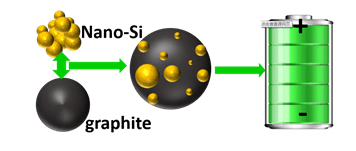
Rechargeable lithium-ion batteries (LIBs) are recognized as the most important power supply for portable electronic devices, electric vehicle and hybrid electric vehicle. There is a continuing demand for advanced LIBs with longer life spans and higher capacity. Graphite based anode materials are now widely employed in LIBs due to their excellent cycling stability and good conductivity. However, the theoretical capacity of graphite is as low as 372 mA·h·g-1 that is hard to meet the ever-increasing demand of high energy density LIBs. Recent years, Si based anode materials have attracted enormous attention due to its high reversible capacity (3579 mA·h·g-1). However, the main challenge facing Si is the huge volume change during lithiation/delithiation process. It is well accepted that nanostructured Si could effectively release the strain stress caused by volume variation, thus maintaining the conductive and structural integrity of the electrode. But, the high surface area of nanostructured anode materials would result in serious side reactions between electrode materials and electrolyte, which would consume a lot of Li+, and leading to low coulombic efficiency. Very recently, preparation of nano-Si/graphite composite as anode for LIBs has been demonstrated as a promising high-capacity anode. The Si/graphite anode is able to take full advantages of the properties of these two materials such as the high specific capacity of nano-sized Si, mechanical flexibility and good conductivity of graphite. These beneficial features make Si/graphite hybrid composite as an ideal anode candidate for high-performance LIBs. To date, a lot of fabricating strategies have been reported to prepare Si/graphite composite. The keys and interests are focused on how to make the nanosized Si and graphite particles distributed uniformly, and how to construct a stable framework with three-dimensional conductive network. An overview of the methodologies proposed in the last decade for combining nanosized Si and graphite is summarized, which are composed of a series of technological means. Here, these methodologies are classified in three categories on basis of the composite step, including solid-state approach, liquid-phase mixture method, and chemical vapor deposition process.
Key words: silicon; graphite; anode materials; synthetic method; Li-ion batteries
Du Jin , Lin Ning , Qian Yitai . Recent Development of the Synthetic Method for Si/Graphite Anode Materials[J]. Acta Chimica Sinica, 2017 , 75(2) : 147 -153 . DOI: 10.6023/A16100548
[1] (a) Whittingham, M. S. Chem. Rev. 2004, 104, 4271.
(b) Li, H.; Wang, Z.; Chen, L.; Huang, X. Adv. Mater. 2009, 21, 4593.
(c) Goodenough, J. B.; Kim, Y. Chem. Mater. 2009, 22, 587.
(d) Larcher, D.; Tarascon, J. M. Nat. Chem. 2015, 7, 19.
[2] Lv, Z.-Y.; Feng, R.; Zhao, J.; Fan, H.; Xu, D.; Wu, Q.; Yang, L.-J.; Chen, Q.; Wang, X.-Z.; Hu, Z. Acta Chim. Sinica 2015, 73, 1013. (吕之阳, 冯瑞, 赵进, 范豪, 徐丹, 吴强, 杨立军, 陈强, 王喜章, 胡征, 化学学报, 2015, 73, 1013.)
[3] Luo, F.; Zhen, J.-Y.; Chu, G.; Liu, B.-N.; Zhang, S.-L.; Li, H.; Chen, L.-Q. Acta Chim. Sinica 2015, 73, 808. (罗飞, 郑杰允, 褚赓, 刘柏男, 张素林, 李泓, 陈立泉, 化学学报, 2015, 73, 808.)
[4] Ye, Y.; Zhu, J.-Y.; Yao, Y.-N.; Wang, Y.-G.; Wu, P.; Tang, Y.-W.; Zhou, Y.-M.; Lu, T.-H. Acta Chim. Sinica 2015, 73, 151. (叶亚, 朱婧怡, 姚依男, 王雨果, 吴平, 唐亚文, 周益明, 陆天虹, 化学学报, 2015, 73, 151.)
[5] Qiu, Z.-P.; Zhang, Y.-J.; Xia, S.-B.; Dong, P. Acta Chim. Sinica 2015, 73, 992. (邱振平, 张英杰, 夏书标, 董鹏, 化学学报, 2015, 73, 992.)
[6] (a) Yoshio, M.; Wang, H.; Fukuda, K.; Umeno, T.; Abe, T.; Ogumi, Z. J. Mater. Chem. 2004, 14, 1754.
(b) Courtel, F. M.; Niketic, S.; Duguay, D.; Abu-Lebdeh, Y.; Davidson, I. J. J. Power Sources 2011, 196, 2128.
(c) Yoshio, M.; Wang, H.; Fukuda, K.; Hara, Y.; Adachi, Y. J. Electrochem. Soc. 2000, 147, 1245.
(d) Yang, S.; Song, H.; Chen, X. Electrochem. Commun. 2006, 8, 137.
[7] Liu, B.-N.; Xu, Q.; Chu, G.; Lu, H.; Yin, Y.-X.; Luo, F.; Zheng, J.-Y.; Guo, Y.-G.; Li, H. Energy Storage Sci. Technol. 2016, 5, 417. (刘柏男, 徐泉, 褚赓, 陆浩, 殷雅侠, 罗飞, 郑杰允, 郭玉国, 李泓, 储能科学与技术, 2016, 5, 417.)
[8] Lee, J. K.; Oh, C.; Kim, N.; Hwang, J. Y.; Sun, Y. K. J. Mater. Chem. A 2016, 4, 5366.
[9] Li, H.; Wang, Z.; Chen, L.; Huang, X. Adv. Mater. 2009, 21, 4593.
[10] Wilson, A. M.; Way, B. M.; Dahn, J. R.; Van Buuren, T. J. Appl. Phys. 1995, 77, 2363.
[11] Yuan, L. X.; Wang, Z. H.; Zhang, W. X.; Hu, X. L.; Chen, J. T.; Huang, Y. H.; Goodenough, J. B. Energ. Environ. Sci. 2011, 4, 269.
[12] Wu, H.; Cui, Y. Nano Today 2012, 7, 414.
[13] Li, H.; Huang, X.; Chen, L.; Wu, Z.; Liang, Y. Electrochem. Solid St. 1999, 2, 547.
[14] Choi, J. W.; Cui, Y.; Nix, W. D. J. Mech. Phys. Solids 2011, 59, 1717.
[15] Liu, X. H.; Zhong, L.; Huang, S.; Mao, S. X.; Zhu, T.; Huang, J. Y. ACS Nano 2012, 6, 1522.
[16] McDowell, M. T.; Lee, S. W.; Harris, J. T.; Korgel, B. A.; Wang, C.; Nix, W. D.; Cui, Y. Nano Lett. 2013, 13, 758.
[17] Li, J.; Dozier, A. K.; Li, Y.; Yang, F.; Cheng, Y. T. J. Electrochem. Soc. 2011, 158, A689.
[18] Gómez-Cámer, J.-L.; Bünzl, C.; Hantel, M.-M. Carbon 2016, 105, 42.
[19] Zhao, H.; Du, A.; Ling, M.; Battaglia, V.; Liu, G. Electrochim. Acta 2016, 209, 159.
[20] Lee, H.-Y.; Lee, S.-M. J. Power Sources 2002, 112, 649.
[21] Yu, H.-J.; Liu, X.-L.; Chen, Y.-X.; Liu, H.-B. Ionics 2016, 22, 1847.
[22] Dash, R.; Pannala, S. Sci. Rep. 2016, 6, 27449.
[23] Li, X.-X.; Yuan, X.-J.; Zhang, G.-Q.; Zhang, L. J. Guangdong Univ. Technol. 2014, 31, 27. (李新喜, 袁晓娇, 张国庆, 张亮, 广东工业大学学报, 2014, 31, 27.)
[24] Dimov, N.; Kugino, S.; Yoshio, M. J. Power Sources 2004, 136, 108.
[25] Wang, P.; Li, Y.-N.; Yang, J.; Zheng, Y. Int. J. Electrochem. Sci. 2006, 1, 122.
[26] Lee, H.-Y.; Lee, S.-M. Electrochem. Commun. 2004, 6, 465.
[27] Zhang, Y.; Zhang, X. G.; Zhang, H. L.; Zhao, Z. G.; Li, F.; Liu, C.; Cheng, H. M. Electrochim. Acta 2006, 51, 4994.
[28] Xu, W.; Flake, J. C. J. Electrochem. Soc. 2010, 157, A41.
[29] Zuo, P.; Yin, G.; Tong, Y. Solid State Ionics 2006, 177, 3297.
[30] Zhou, W.; Upreti, S.; Whittingham, M. S. Electrochem. Commun. 2011, 13, 158.
[31] Jo, Y. N.; Kim, Y.; Kim, J. S.; Song, J. H.; Kim, K. J.; Kwag, C. Y.; Lee, D. J.; Park, C. W.; Kim, Y. J. J. Power Sources 2010, 195, 6031.
[32] Lai, J.; Guo, H.-J.; Wang, Z.-X.; Li, X.-H.; Zhang, X.-P.; Wu, F.-X. Yue, P. J. Alloy. Compd. 2012, 530, 30.
[33] Gan, L.; Guo, H.-J.; Wang, Z.-X.; Li, X.-H.; Peng, W.-J.; Wang, J.-X.; Huang, S.-L.; Su, M.-R. Electrochim. Acta 2013, 104, 117.
[34] Yu, J.; Zhan, H.-H.; Wang, Y.-Y.; Zhang, Z.-L.; Chen, H.; Li, H.; Zhong, Z.; Su, F.-B. J. Power Sources 2013, 228, 112.
[35] Li, J.; Wang, J.-T.; Yang, J.-Y.; Ma, X.-L.; Lu, S.-G. J. Alloy. Compd. 2016, 688, 1072.
[36] Zhou, R.; Fan, R.; Tian, Z.; Zhou, Y.; Guo, H.; Kou, L.; Zhang, D. J. Alloy. Compd. 2016, 658, 91.
[37] Wang, H.; Xie, J.; Zhang, S.; Cao, G.; Zhao, X. RSC Adv. 2016, 6, 69882.
[38] Zhang, L.; Wang, Y.; Kan, G.; Zhang, Z.; Wang, C.; Zhong, Z.; Su, F. RSC Adv. 2014, 4, 43114.
[39] Kim, S.-Y.; Lee, J.; Kim, B.-H. ACS Appl. Mater. Interf. 2016, 8, 12109.
[40] Holzapfel, M.; Buqa, H.; Krumeich, F.; Novak, P.; Petrat, F. M.; Veit, C. Electrochem. Solid St. 2005, 8, A516.
[41] Jeong, S.; Lee, J. P.; Ko, M.; Kim, G.; Park, S.; Cho, J. Nano Lett. 2013, 13, 3403.
[42] Ko, M.; Chae, S.; Ma, J.; Kim, N.; Lee, H. W.; Cui, Y.; Cho, J. Nat. Energy 2016, 1, 16113.
/
| 〈 |
|
〉 |

