
Research Progress in Ketonization of Biomass-derived Carboxylic Acids over Metal Oxides
Received date: 2017-02-16
Online published: 2017-04-12
Supported by
Project supported by the National Natural Science Foundation of China (Grant Nos. 21676194 and 21373148) and the Ministry of Education of China Program of New Century Excellent Talents in University (Grant No. NCET-12-0407).
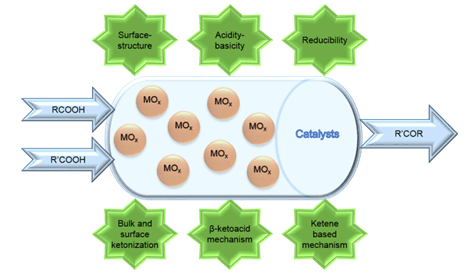
With the increasing needs for transportable fuels and the growing concerns on environmental pollution, significant attention has been paid to the conversion of renewable lignocellulosic biomass to liquid fuels. As a major component of bio-oil from biomass depolymerization, organic carboxylic acids make the bio-oil acidic, corrosive and unstable, which are harmful for storage, transportation, and upgrading of bio-oil. Therefore, the removal of carboxylic acids is very important. Ketonization reaction, also called ketonic decarboxylation, converts two moles carboxylic acids to ketone (symmetrical or asymmetrical ketones), carbon dioxide and water, which removes oxygen efficiently and increases the carbon chain length without using hydrogen. In addition, ketones are important chemicals and have been widely used in chemical industry as organic solvent. The mechanism and active site for ketonization are still under debate. Various mechanisms have been proposed for the ketonization, based on different reaction intermediates evolved (i.e., β-keto-acids, ketene, carboxylates and acyl carbonium ions). Ketonization reaction is a surface-structure-sensitive reaction, thus reaction activity depends on surface-structure of the metal oxides (such as crystal surfaces and particle size). The concerted function of oxygen anions (Brønsted bases) and unsaturated metal cations (Lewis acids) is crucial for ketonization. The amphoteric oxides show better catalytic activity than pure acidic or basic oxides. Oxygen vacancy formed on the surface of metal oxides is a key factor for high ketonization activity, which can stabilize the reaction product and reduce the activation energy. This paper reviews the progress in ketonization from the aspects of reaction mechanism, and the effects of surface structure, acidity and basicity, and reducibility of metal oxides on ketonization. The β-keto-acids based mechanism and ketene based mechanism will be discussed in detail to understand how does the C—C coupling happen and the fundamental role of α-H. Finally, the importance of surface structure and properties of metal oxides on the carboxylic acids ketonization reaction is explained.
Ding Shuang , Ge Qingfeng , Zhu Xinli . Research Progress in Ketonization of Biomass-derived Carboxylic Acids over Metal Oxides[J]. Acta Chimica Sinica, 2017 , 75(5) : 439 -447 . DOI: 10.6023/A17020061
[1] Huber, G. W.; Iborra, S.; Corma, A. Chem. Rev. 2006, 106, 4044.
[2] Corma, A.; Iborra, S.; Velty, A. Chem. Rev. 2007, 107, 2411.
[3] Goyal, H. B.; Seal, D.; Saxena, R. C. Renew. Sust. Energ. Rev. 2008, 12, 504.
[4] Tao, J. J.; Chen, S.; Yao, F. Q.; Wang, H. H. Acta Chim. Sinica. 2016, 74, 81 (in Chinese). (陶骏骏, 陈帅, 姚奉奇, 王海晖, 化学学报, 2016, 74, 81.)
[5] Ou, J. K.; Yang, L.; Xi, X. H. Chin. J. Chem. 2016, 34, 727.
[6] Dai, N.; Shang, R.; Fu, M. C.; Fu, Y. Chin. J. Chem. 2015, 33, 405.
[7] Li, J.; Huang, Y. B.; Guo, Q. X.; Fu, Y. Acta Chim. Sinica. 2014, 72, 1223 (in Chinese). (李江, 黄耀兵, 郭庆祥, 傅尧, 化学学报, 2014, 72, 1223.)
[8] Bertero, M.; Puente, G. D. L.; Sedran, U. Fuel. 2012, 95, 263.
[9] Ignatchenko, A. V.; Kozliak, E. I. ACS Catal. 2012, 2, 1555.
[10] Nagashima, O.; Sato, S.; Takahashi, R.; Sodesawa, T. J. Mol. Catal. A: Chem. 2005, 227, 231.
[11] Randery, S. D.; Warren, J. S.; Dooley, K. M. Appl. Catal., A 2002, 226, 265.
[12] Hendren, T. S.; Dooley, K. M. Catal. Today 2003, 85, 333.
[13] Dooley, K. M.; Bhat, A. K.; Plaisance, C. P.; Roy, A. D. Appl. Catal., A 2007, 320, 122.
[14] Murkute, A. D.; Jackson, J. E.; Miller, D. J. J. Catal. 2011, 278, 189.
[15] Ignatchenko, A. V.; Deraddo, J. S.; Marino, V. J.; Mercado, A. Appl. Catal., A 2015, 498, 10.
[16] Friedel, C. Justus Liebigs Ann. Chem. 1858, 108, 122.
[17] Hu, M.; Zhu, Z. Q.; Xu, Z. H. Chem. Ind. Eng. Prog. 2010, 29, 316 (in Chinese). (胡淼, 朱志庆, 徐泽辉, 化工进展, 2010, 29, 316.)
[18] Pestman, R.; Koster, R. M.; Duijne, A. V.; Pieterse, J. A. Z.; Ponec, V. J. Catal. 1997, 168, 265.
[19] Pham, T. N.; Shi, D.; Resasco, D. E. J. Catal. 2014. 314, 149.
[20] Pei, Z. F.; Ponec, V. Appl. Surf. Sci. 1996, 103, 171.
[21] Calaza, F. C.; Chen, T. L.; Mullins, D. R.; Xu, Y.; Overbury, S. H. Catal. Today 2015, 253, 65.
[22] Lee, Y.; Choi, J. W.; Suh, D. J.; Ha, J. M.; Lee, C. H. Appl. Catal., A 2015, 506, 288.
[23] Das, J.; Parida, K. React. Kinet. Catal. Lett. 2000, 69, 223.
[24] Parida, K.; Das, J. J. Mol. Catal. A: Chem. 2000, 151, 185.
[25] Martens, J. A.; Wydoodt, M.; Espeel, P.; Jacobs, P. A. Stud. Surf. Sci. Catal. 1993, 78, 527.
[26] Gumidyala, A.; Sooknoi, T.; Crossley, S. J. Catal. 2016, 340, 76.
[27] Yamada, Y.; Segawa, M.; Sato, F.; Kojima, T.; Sato, S. J. Mol. Catal. A: Chem. 2011, 346, 79.
[28] Sun, C. H.; Chen, Y. S.; Li, J. Inorg. Chem. Ind. 2008, 40, 44 (in Chinese). (孙春晖, 陈永生, 李佳, 无机盐工业, 2008, 40, 44.)
[29] Pulido, A.; Oliver-Tomas, B.; Renz, M.; Boronat, M.; Corma, A. ChemSusChem 2013, 6, 141.
[30] Pham, T. N.; Dachuan, S.; Resasco, D. E. Top. Catal. 2014, 57, 706.
[31] Snell, R. W.; Shanks, B. H. ACS Catal. 2013, 3, 783.
[32] Gaertner, C. A.; Serrano-Ruiz, J. C.; Braden, D. J.; Dumesic, J. A. Ind. Eng. Chem. Res. 2010, 49, 6023.
[33] Gaertner, C. A.; Serrano-Ruiz, J. C.; Braden, D. J.; Dumesic, J. A. J. Catal. 2009, 266,71.
[34] Gaertner, C. A.; Serrano-Ruiz, J. C.; Braden, D. J.; Dumesic, J. A. ChemSusChem 2009, 2, 1121.
[35] Rajadurai, S. Catal. Rev. 1994, 36, 385.
[36] Renz, M. Eur. J. Org. Chem. 2005, 2005, 979.
[37] Ning, P. G.; Cao, H. B.; Zhang, Y. Mod. Chem. Ind. 2008, 28, 22 (in Chinese). (宁朋歌, 曹宏斌, 张懿, 现代化工, 2008, 28, 22.)
[38] Pham, T. N.; Tawan, S.; Steven, P. C.; Resasco, D. E. ACS Catal. 2013, 3, 2456.
[39] Pacchioni, G. ACS Catal. 2014, 4, 2874.
[40] Mekhemer, G. A. H.; Halawy, S. A.; Mohamed, M. A.; Zaki, M. I. J. Catal. 2005, 230, 109.
[41] Pham, T. N.; Shi, D.; Sooknoi, T.; Resasco, D. E. J. Catal. 2012, 295, 169.
[42] Idriss, H.; Diagne, C.; Hindermann, J. P.; Kiennemann, A.; Barteau, M. A. J. Catal. 1995, 155, 219.
[43] Zhang, Y.; Gao, Z. L.; Chen, Y. S.; Li, X. Chin. J. Rare Met. 2010, 34, 574 (in Chinese). (张义, 高中良, 陈永生, 李煦, 稀有金属, 2010, 34, 574.)
[44] Zhang, Y.; Gao, Z. L.; Chen, Y. S.; Li, X. Inorg. Chem. Ind. 2010, 4, 33 (in Chinese). (张义, 高中良, 陈永生, 李煦, 无机盐工业, 2010, 4, 33.)
[45] Gliński, M.; Zalewski, G.; Burno, E.; Jerzak, A. Appl. Catal., A 2014, 470, 278.
[46] Zaytseva, Y. A.; Panchenko, V. N.; Simonov, M. N.; Shutilov, A. A.; Zenkovets, G. A.; Renz, M.; Simakova, I. L.; Parmon, V. N. Top. Catal. 2013, 56, 846.
[47] Crisci, A. J.; Dou, H.; Prasomsri, T.; Román-Leshkov, Y. ACS Catal. 2014, 4, 4196.
[48] Snell, R. W.; Shanks, B. H. ACS Catal. 2014, 4, 512.
[49] Teterycz, H.; Klimkiewicz, R.; ?aniecki, M. Appl. Catal., A 2003, 249, 313.
[50] Kobume, M.; Sato, S.; Takahashi, R. J. Mol. Catal. A: Chem. 2008, 279, 10.
[51] Wang, W. D.; Lin, P. Y.; Fu, Y. L.; Yu, S. M.; Meng, M.; Zhang, X. P. Chin. J. Chem. 2000, 18, 673.
[52] Vohs, J. M. Chem. Rev. 2013, 113, 4136.
[53] Stubenrauch, J.; Brosha, E.; Vohs, J. M. Catal. Today 1996, 28,431.
[54] Wang, Z. L.; Feng, X. D. J. Phys. Chem. B 2003, 107, 13563.
[55] Snell, R. W.; Shanks, B. H. Appl. Catal., A 2013, 451, 86.
[56] Sun, J.; Gao, L. Acta Chim. Sinica 2002, 60, 1524 (in Chinese). (孙静, 高濂, 化学学报, 2002, 60, 1524.)
[57] Kim, K. S.; Barteau, M. A. J. Catal. 1990, 125, 353.
[58] Ojamäe, L.; Aulin, C.; Pedersen, H.; Käll, P. O. J. Colloid Interface Sci. 2006, 296, 71.
[59] Glinski, M.; Kijenski, J.; Jakubowski, A. Appl. Catal., A 1995, 128, 209.
[60] Hasan, M. A.; Zaki, M. I.; Pasupulety, L. Appl. Catal., A 2003, 243, 81.
[61] Panchenko, V. N.; Zaytseva, Y. A.; Simonov, M. N.; Simakova, I. L.; Paukshtis, E. A. J. Mol. Catal. A: Chem. 2014, 388, 133.
[62] Tosoni, S.; Pacchioni, G. J. Catal. 2016, 344, 465.
/
| 〈 |
|
〉 |

