
Controlled Synthesis of Gold-Platinum Catalysts for Ethanol Electro-oxidation Reaction
Received date: 2017-11-02
Online published: 2018-03-12
Supported by
Project supported by the National Natural Science Foundation of China (Nos. 21473039, 21733004), Science and Technology Commission of Shanghai Mu-nicipality (No. 17520711200) and 973 program (No. 2015CB932303).
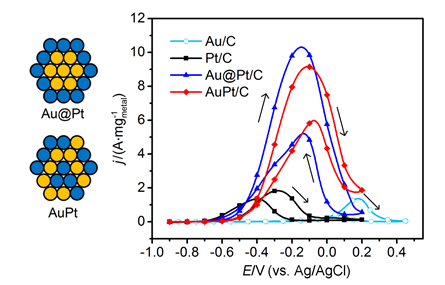
Ethanol oxidation reaction (EOR) is a common anode process for direct ethanol fuel cell (DEFC) and ethanol reforming electrolyzer. Au@Pt and AuPt alloy are widely used bimetallic catalysts, yet no comparative study has been reported of electrocatalysis of EOR on these two differently structured catalysts. The present work aims to synthesize and characterize carbon supported Au@Pt and AuPt with controlled composition and size, and compare their electrocatalytic activities and stabilities toward EOR in alkaline media. For the synthesis of Au@Pt/C, a 5-nm Au colloid was first obtained by adding excessive amount of sodium borohydride to a chloroauric acid precursor containing sodium citrate with a mixed ice-water bath. CO gas was bubbled into the Au colloidal solution at 60℃ under strong stirring to reduce a desired amount of potassium tetrachloroplatinate(Ⅱ) to terminate Pt quasi-monolayer shell on Au nanoparticle core. A sonicated carbon black (Vulcan XC-72) aqueous slurry was then dropwise added to the above Au@Pt colloid, and the mixture was kept stirring for 48 h to ensure the exhaustive loading of Au@Pt nanoparticles onto the carbon support. For the synthesis of AuPt/C with the same Au:Pt molar ratio and metal loading as that for Au@Pt/C, coreduction of the Au(Ⅲ) and Pt(Ⅱ) species was attained by using sodium borohydride as the reducing agent with the rest procedures being same as the above mentioned. X-ray diffractometry (XRD) revealed that the diffraction peaks for Au@Pt/C were virtually same as those for Au/C, consistent with a Pt quasi-monolayer, while the diffraction peaks for AuPt/C located in between those for Au/C and Pt/C. X-ray photoelectron spectroscopy (XPS) results were consitent with the different structures of the two catalysts, and the Pt core level shift suggested an upshift of Pt d-band center for both bimetallic catalysts. Cyclic voltammetry and chronoamperometry revealed markedly increased EOR current on Au@Pt/C and AuPt/C, as compared to that of Pt/C and Au/C. CO-stripping voltammetry on Au@Pt/C and AuPt/C indicated that surface reconstruction occurred by potential cycling, resulting in a decrease of exposed Pt sites but not the electrocatalytic activities. 1H NMR analysis confirmed the C2 pathway is predominant. Nevertheless, Au@Pt/C outperformed AuPt/C and Pt/C with a lower onset oxidation potential and a higher peak current for EOR, as well as a slightly higher selectivity toward C1 pathway. Although the synergetic effect of Au-Pt bimetallic interface for EOR is not well understood, the enhanced adsorption of ethanol, OH, acetyl and CO on Pt sites may be accountable for the observed results.
Wu Kuangheng , Zhou Yawei , Ma Xianyin , Ding Chen , Cai Wenbin . Controlled Synthesis of Gold-Platinum Catalysts for Ethanol Electro-oxidation Reaction[J]. Acta Chimica Sinica, 2018 , 76(4) : 292 -297 . DOI: 10.6023/A17110478
[1] Li, H. H.; Zhao, S.; Gong, M.; Cui, C. H.; He, D.; Liang, H. W.; Liang, W.; Yu, S. H. Angew. Chem., Int. Ed. 2013, 52, 7472.
[2] Coutanceau, C.; Baranton, S. WIREs Energy Environ. 2016, 5, 388.
[3] de Lucas-Consuegra, A.; Ana, R.; Calcerrada, A. B.; Linares, J. J.; Horwat, D. J. Power Sources 2016, 321, 248.
[4] Chen, H. M.; Xing, Z. L.; Zhu, S. Q.; Zhang, L. L.; Chang, Q. W.; Huang, J. L.; Cai, W. B.; Kang, N.; Zhong, C. J.; Shao, M. H. J. Power Sources 2016, 321, 264.
[5] Lamy, C.; Lima, A.; LeRhun, V.; Delime, F.; Coutanceau, C.; Leger, J. M. J. Power Sources 2002, 105, 283
[6] Rao, L.; Jiang, Y. X.; Zhang, B. W.; You, L. X. H.; Li, Z. H.; Sun, S. G. Prog. Chem. 2014, 26, 727(in Chinese). (饶路, 姜艳霞, 张斌伟, 游乐星, 李崭虹, 孙世刚, 化学进展, 2014, 26, 727.)
[7] Zheng, H. T.; Li, Y.; Chen, S.; Shen, P. K. J. Power Sources 2006, 163, 371.
[8] Wang, Y.; Zou, S.; Cai, W. B. Catalysts 2015, 5, 1507.
[9] Xu, C. W.; Cheng, L. Q.; Shen, P. K.; Liu, Y. L. Electrochem. Commun. 2007, 9, 997.
[10] Wang, Y.; Jiang, K.; Cai, W. B. Electrochim. Acta 2015, 162, 100.
[11] Adzic, R. R.; Zhang, J.; Sasaki, K.; Vukmirovic, M. B.; Shao, M.; Wang, J. X.; Nilekar, A. U.; Mavrikakis, M.; Valerio, J. A.; Uribe, F. Top. Catal. 2007, 46, 249.
[12] Mulvaney, S. P.; Keating, C. D. Anal. Chem. 2000, 72, 145.
[13] Enache, D. I.; Edwards, J. K.; Landon, P.; Solsona-Espriu, B.; Carley, A. F.; Herzing, A. A.; Watanabe, M.; Kiely, C. J.; Knight, D. W.; Hutchings, G. J. Science 2006, 311, 362.
[14] Song, H. M.; Anjum, D. H.; Sougrat, R.; Hedhili, M. N.; Khashab, N. M. J. Mater. Chem. 2012, 22, 25003.
[15] Chen, Y. G.; Zhuang, L.; Lu, J. T. Chin. J. Catal. 2007, 28, 870(in Chinese).(陈酉贵, 庄林, 陆君涛, 催化学报, 2007, 28, 870.)
[16] Li, J. F.; Yang, Z. L.; Ren, B.; Liu, G. K.; Fang, P. P.; Jiang, Y. X.; Wu, D. Y.; Tian, Z. Q. Langmuir 2006, 22, 10372.
[17] Dai, Y.; Chen, S. L. ACS Appl. Mater. 2014, 7, 823.
[18] Brankovic, S. R.; Wang, J. X.; Adzic, R. R. Surf. Sci. 2001, 474, 173.
[19] Liu, Y.; Gokcen, D.; Bertocci, U.; Moffat, T. P. Science 2012, 338, 1327.
[20] Engelbrekt, C.; Seselj, N.; Poreddy, R.; Riisager, A.; Ulstrup, J.; Zhang, J. D. J. Mater. Chem. A 2016, 4, 3278.
[21] Zhou, Y. W.; Du, C. Y.; Han, G.; Gao, Y. Z.; Yin, G. P. Electrochim. Acta 2016, 217, 203.
[22] Xu, C. X.; Wang, R. Y.; Chen, M. W.; Zhang, Y.; Ding, Y. Phys. Chem. Chem. Phys. 2010, 12, 239.
[23] Zeng, J.; Yang, J.; Lee, J. Y.; Zhou, W. J. Phys. Chem. B 2006, 110, 24606.
[24] Xu, Y. Y.; Dong, Y. N.; Shi, J.; Xu, M. L.; Zhang, Z. F.; Yang, X. K. Catal. Commun. 2011, 13, 54.
[25] Ye, W.; Kou, H.; Liu, Q.; Yan, J.; Zhou, F.; Wang, C. Int. J. Hydrogen Energ. 2012, 37, 4088.
[26] Kitchin, J. R.; Norskov, J. K.; Barteau, M. A.; Chen, J. G. Phys. Rev. Lett. 2004, 93, 156801.
[27] Demirci, U. B. J. Power Sources 2007, 173, 11.
[28] Wakisaka, M.; Mitsui, S.; Hirose, Y.; Kawashima, K.; Uchida, H.; Watanabe, M. J. Phys. Chem. B 2006, 110, 23489.
[29] Zhu, C.; Hai, Y.; Zhao, Z. G.; Yang, Y. Y. Acta Chim. Sinica 2017, 76, 30. (in Chinese) (朱婵, 海洋, 赵志刚, 阳耀月, 化学学报, 2017, 76, 30.)
[30] Zhou, W.; Lee, J. Y. Electrochem. Commun. 2007, 9, 1725.
[31] Maillard, F.; Savinova, E. R.; Stimming, U. J. Electroanal. Chem. 2007, 599, 221.
[32] Qin, Y. H.; Yang, H. H.; Zhang, X. S.; Li, P.; Zhou, X. G.; Niu, L.; Yuan, W. K. Carbon 2010, 48, 3323.
[33] Liang, Z. X.; Zhao, T. S.; Xu, J. B.; Zhu, L. D. Electrochim. Acta 2009, 54, 2203
[34] Lebedeva, N. P.; Koper, M. T. M.; Feliu, J. M.; Van Santen, R. A. J. Electroanal. Chem. 2002, 524, 242.
[35] McCallum, C.; Pletcher, D. J. Electroanal. Chem. 1976, 70, 277.
[36] Gilman, S. J. Phys. Chem. 1964, 68, 70.
[37] Suntivich, J.; Xu, Z.; Carlton, C. E.; Kim, J.; Han, B.; Lee, S. W.; Bonnet, N.; Marzari, N.; Allard, L. F.; Gasteiger, H. A.; Hamad-Schifferli, K.; Shao-Horn, Y. J. Am. Chem. Soc. 2013, 135, 7985.
[38] Chen, G. L.; Chen, S. P.; Zhen, C. H.; Zhou, Z. Y.; Sun, S. G. Acta Chim. Sinica 2001, 59, 1253(in Chinese). (陈国良, 陈声培, 甄春花, 周志有, 孙世刚, 化学学报, 2001, 59, 1253.)
[39] Bayer, D.; Berenger, S.; Joos, M.; Cremers, C.; Tübke, J. Int. J. Hydrogen Energ. 2010, 35, 12660.
[40] Teng, X. In Materials and Processes for Energy:Communicating Current Research and Technological Developments, Atrazhev, V. V.; Burlatsky, S. F., Formatex Research Center, Durham, 2013, pp. 473~484.
[41] Wang, S. Y.; Kristian, N.; Jiang, S. P.; Wang, X. Nanotechnology 2008, 20, 025605.
[42] Wang, H.; Jiang, K.; Chen, Q.; Xie, Z.; Cai, W. B. Chem. Commun. 2016, 52, 374.
/
| 〈 |
|
〉 |

