
Self-Consistent Field Theory Studies of Flexible Dendrimer in Good Solvent
Received date: 2018-05-09
Online published: 2018-06-22
Supported by
Project supported by the National Natural Science Foundation of China (Nos. 21320102005, 21774026) and Ministry of Science and Technology of the People's Republic of China (No. 2016YFA0203301).
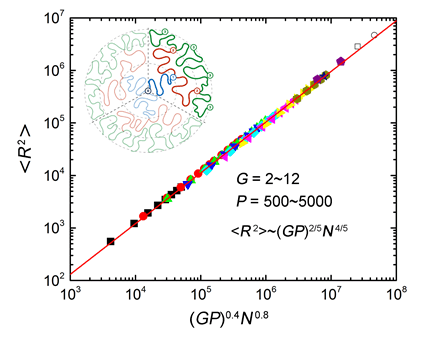
Dendrimers are a class of novel polymer materials, which have received a lot of attention in past decades. The property of a dendrimer material strongly depends on the conformational details of the molecules, including the monomer density distribution, the functional end-group distribution, and the molecular size. In this paper, we consider a dendrimer composed of flexible and long spacers, immersed in the athermal or good solvent. A self-consistent field theory (SCFT) with a pre-averaged excluded volume potential is employed to calculate the density profiles of the segments and the radius of gyration R of the dendrimers. The stretched conformation of the spacers, and the scaling laws between the dendrimer size and its topologic parameters are analyzed. Our main results are:(1) The segment density of the dendrimers obeys the "dense-core" model, and decreases smoothly along the radial direction. (2) Due to the folding-back conformation, the local density of the end-segments is proportional to the local segment density. The density profile of the end-segments does not have a lifted peak at the outer layer of the spherical molecule. (3) The conformation of the spacers with lower generation numbers is strongly stretched in the central region where the segments are crowded. The first-generation spacers are mostly stretched. However, the spacers with higher generation numbers are much weakly stretched in the outer region. (4) Our self-consistent field theory calculations give the scaling law of the dendrimer size R~(GP)1/5N2/5, where G is the generation number of the dendrimer, P is the spacer segment number, and N is the total segment number. This agrees with the Flory mean field calculation for dendrimer based on full segment number. But it disagrees with the pioneer theories based on a linear side chains and the results from Monte Carlo simulations, which gave R~(GP)2/5N1/5. This disagreement is attributed to the limited bond length in simulations and the unlimited stretchable spacers in SCFT. (5) If G is fixed, the scaling law is simplified to R~P3/5 in good solvent, which agrees with the pioneer theories.
Key words: dendrimer; mean-field theory; self-consistent field theory; scaling law
Shi Meng , Yang Yingzi , Qiu Feng . Self-Consistent Field Theory Studies of Flexible Dendrimer in Good Solvent[J]. Acta Chimica Sinica, 2018 , 76(9) : 715 -722 . DOI: 10.6023/A18050192
[1] Astruc, D.; Boisselier, E.; Ornelas, C. Chem. Rev. 2010, 110, 1857.
[2] Vincent, L.; Varet, J.; Pille, J.-Y.; Bompais, H.; Opolon, P.; Maksimenko, A.; Malvy, C.; Mirshahi, M.; Lu, H.; Vannier, J.-P.; Soria, C.; Li, H. Int. J. Cancer 2003, 105, 419.
[3] Jain, S.; Kaur, A.; Puri, R.; Utreja, P.; Jain, A.; Bhide, M.; Ratnam, R.; Singh, V.; Patil, A. S.; Jayaraman, N.; Kaushik, G.; Yadav, S.; Khanduja, K. L. Eur. J. Med. Chem. 2010, 45, 4997.
[4] Boas, U.; Heegaard, P. M. H. Chem. Soc. Rev. 2004, 33, 43.
[5] Zhang, S.; Yang, J.; Liu, M.; Lü, S.; Gao, C.; Wu, C.; Zhu, Z. Acta Chim. Sinica 2016, 74, 401. (张少飞, 杨建东, 柳明珠, 吕少瑜, 高春梅, 吴灿, 朱召彦, 化学学报, 2016, 74, 401.)
[6] Zhang, W.; Xu, N.; Yao, Z.; Li, K.; Zhu, Y.; Chen, L.; Ye, W.; Deng, W. Chin. J. Org. Chem. 2016, 36, 2039. (张薇, 徐妮为, 姚子健, 李宽, 朱玉, 陈良艳, 叶文玲, 邓维, 有机化学, 2016, 36, 2039.)
[7] Buhleier, G. E.; Wehner, W.; Vögtle, F. Synthesis-Stuttgart. 1978, 2, 155.
[8] Jana, C.; Jayamurugan, G.; Ganapathy, R.; Maiti, P. K.; Jayaraman, N.; Sood, A. K. J. Chem. Phys. 2006, 124, 204719.
[9] Porcar, L.; Hong, K.; Butler, P. D.; Herwig, K. W.; Smith, G. S.; Liu, Y.; Chen, W. R. J. Phys. Chem. B 2010, 114, 1751.
[10] Prosa, T. J.; Bauer, B. J.; Amis, E. J. Macromolecules 2001, 34, 4897.
[11] Pötschke, D.; Ballauf, M.; Lindner, P.; Fischer, M.; Vögtle, F. J. Appl. Cryst. 2000, 33, 605.
[12] Rosenfeldt, S.; Dingenouts, N.; Ballauf, M.; Werner, N.; Vögtle, F.; Lindner, P. Macromolecules 2002, 35, 8098.
[13] Mallamace, F.; Canetta, E.; Lombardo, D.; Mazzaglia, A.; Romeo, A.; Scolaro, L. M.; Maino, G. Physica A 2002, 304, 235.
[14] Prosa, T. J.; Bauer, B. J.; Amis, E. J.; Tomalia, D. A.; Scherrenberg, R. J. Polym. Sci. Part B:Polym. Phys. 1997, 35, 2913.
[15] Rathgeber, S.; Monkenbusch, M.; Kreitschmann, M.; Urban, V.; Brulet, A. J. Chem. Phys. 2002, 117, 4047.
[16] Qin, T.; Zeng, Y.; Chen, J.; Yu, T.; Li, Y. Acta Chim. Sinica 2017, 75, 99. (秦天依, 曾毅, 陈金平, 于天君, 李嫕, 化学学报, 2017, 75, 99.)
[17] de Gennes, P. G.; Hervet, H. Journal de Physique Lettres 1983, 44, L351.
[18] Lescanec, R. L.; Muthukumar, M. Macromolecules 1990, 23, 2280.
[19] Mansfield, M. L.; Klushin, L. I. Macromolecules 1993, 26, 4262.
[20] Mansfield, M. L.; Jeong, M. Macromolecules 2002, 35, 9794.
[21] Chen, Z. Y.; Cui, S.-M. Macromolecules 1996, 29, 7943.
[22] Murat, M.; Grest, G. S. Macromolecules 1996, 29, 1278.
[23] Boris, D.; Rubinstein, M. Macromolecules 1996, 29, 7251.
[24] Lyulin, A. V.; Davies, G. R.; Adolf, D. B. Macromolecules 2000, 33, 6899.
[25] Sheng, Y.-J.; Jiang, S.; Tsao, H.-K. Macromolecules 2002, 35, 7865.
[26] Götze, I. O.; Likos, C. N. Macromolecules 2003, 36, 8189.
[27] Timoshenko, E. G.; Kuznetsov, Y. A.; Connolly, R. J. Chem. Phys. 2002, 117, 9050.
[28] Bosko, J. T.; Prakash, J. R. Macromolecules 2011, 44, 660.
[29] Cui, W.; Su, C.-F.; Merlitz, H.; Wu, C.-X.; Sommer, J.-U. Macromolecules 2014, 47, 3645.
[30] Klos, J. S.; Sommer, J.-U. Macromolecules 2013, 46, 3107.
[31] Lewis, T.; Pryamitsyn, V.; Ganesan, V. J. Chem. Phys. 2011, 135, 204902.
[32] Lu, Y.; An, L.; Wang, Z.-G. Macromolecules 2013, 46, 5731.
[33] Mandal, T.; Dasgupta, C.; Maiti, P. K. J. Chem. Phys. 2014, 141, 144901.
[34] Rubio, A. M.; McBride, C.; Freire, J. J. Macromolecules 2014, 47, 5379.
[35] Chen, C.; Tang, P.; Qiu, F.; Shi, A.-C. J. Phys. Chem. B 2016, 120, 5553.
[36] Chen, W.-R.; Porcar, L.; Liu, Y.; Butler, P. D.; Magid, L. J. Macromolecules 2007, 40, 5887.
[37] Giupponi, G.; Buzza, D. M. A. J. Chem. Phys. 2004, 120, 10290.
[38] Yang, Y. Z.; Qiu, F.; Zhang, H. D.; Yang, Y. L. Macromolecules 2017, 50, 4007.
[39] Flory, P. J. Principles of Polymer Chemistry, Cornell University Press, New York, 1953.
[40] Matsen, M. W. J. Phys.:Condens. Matter 2002, 14, R21.
[41] Fredrickson, G. The Equilibrium Theory of Inhomogeneous Polymers, Oxford University Press, Oxford, 2006.
[42] Edwards, S. F. Proc. Phys. Soc. 1965, 85, 613.
/
| 〈 |
|
〉 |

