
Polarized Upconversion Luminescence from a Single NaYF4:Yb3+/Er3+ Microrod for Orientation Tracking※
Received date: 2021-12-31
Online published: 2022-02-17
Supported by
Youth Innovation Promotion Association of the Chinese Academy of Sciences(2020305); National Natural Science Foundation of China(12174391); National Natural Science Foundation of China(U1805252); National Natural Science Foundation of China(21875250); National Natural Science Foundation of China(12074379); National Natural Science Foundation of China(12104456); Natural Science Foundation of Fujian Province(2020I0037)
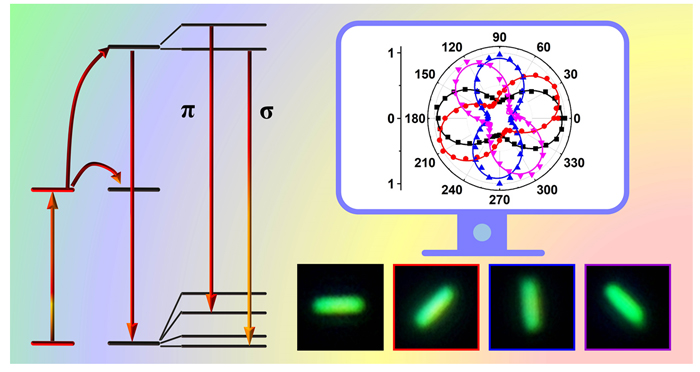
Polarized upconversion luminescence (UCL) of lanthanide (Ln3+)-doped micro/nano-crystals has shown great promise in areas such as single-particle tracking and biomedicine. The polarized UCL of Ln3+ ions is governed by their localized electronic structures and excited-state dynamics. In this work, β-NaYF4:Yb3+/Er3+ microrods with controllable morphologies and sizes were synthesized through a solvothermal method. Based on the customized confocal laser microscopic system, the polarized UCL of a single β-NaYF4:Yb3+/Er3+ microrod was systematically investigated. The emission polarization was probed by placing a half-wave plate coupled with a polarizer in front of the detector. As such, the polarized UCL spectra of a single NaYF4:Yb3+/Er3+ microrod can be recorded by rotating the half-wave plate under 980-nm excitation. It was observed that the UCL intensity of the microrod exhibited a periodic variation with the emission polarization angle tuning from 0° to 360°, indicating polarization anisotropy of the microrod. Specifically, different crystal-field (CF) transition lines originating from two identical multiplets of Er3+ displayed drastically distinct polarization dependence. This results in a higher degree of polarization (DOP) of the UCL intensity for a certain CF transition of Er3+ in comparison with that of the integrated UCL intensity of the multiplet. Polar plots of the UCL intensities for the CF transitions of Er3+ as a function of polarization angle could provide a qualitative vision of the DOP, with a narrower “neck” indicative of a larger DOP. Moreover, the polar plots of a certain CF transition of Er3+ showed a consistent orientation with the corresponding NaYF4:Yb3+/ Er3+ microrod and rotated with the rotating of the single microrod. Therefore, by utilizing the polar plots of the highly-polarized CF transition lines of Er3+, the spatial orientations of the microrod could be monitored, thus revealing the great potential of NaYF4:Yb3+/Er3+ microrods as sensitive anisotropic UCL probes for single-particle tracking.
Xiaoke Hu , Xiaoying Shang , Ping Huang , Wei Zheng , Xueyuan Chen . Polarized Upconversion Luminescence from a Single NaYF4:Yb3+/Er3+ Microrod for Orientation Tracking※[J]. Acta Chimica Sinica, 2022 , 80(3) : 244 -248 . DOI: 10.6023/A21120618
| [1] | Lei, P. P.; An, R.; Yao, S.; Wang, Q. S.; Dong, L. L.; Xu, X.; Du, K. M.; Feng, J.; Zhang, H. J. Adv. Mater. 2017, 29, 1700505. |
| [2] | Dong, H.; Sun, L. D.; Yan, C. H. J. Am. Chem. Soc. 2021, 143, 20546. |
| [3] | Zheng, W.; Huang, P.; Tu, D. T.; Ma, E.; Zhu, H. M.; Chen, X. Y. Chem. Soc. Rev. 2015, 44, 1379. |
| [4] | Qiu, X. C.; Zhou, Q. W.; Zhu, X. J.; Wu, Z. G.; Feng, W.; Li, F. Y. Nat. Commun. 2020, 11, 4. |
| [5] | Yang, D. D.; Peng, Z. X.; Zhan, Q. Q.; Huang, X. J.; Peng, X. Y.; Guo, X.; Dong, G. P.; Qiu, J. R. Small 2019, 15, 1904298. |
| [6] | Yang, D. D.; Peng, Z. X.; Guo, X.; Qiao, S. Q.; Zhao, P.; Zhan, Q. Q.; Qiu, J. R.; Yang, Z. M.; Dong, G. P. Adv. Opt. Mater. 2021, 9, 2100044. |
| [7] | Wang, F. Y.; Han, Y. M.; Wang, S. M.; Ye, Z. J.; Wei, L.; Xiao, L. H. Anal. Chem. 2019, 91, 11856. |
| [8] | Li, X.; Wei, L.; Pan, L. L.; Yi, Z. Y.; Wang, X.; Ye, Z. J.; Xiao, L. H.; Li, H. W.; Wang, J. F. Anal. Chem. 2018, 90, 4807. |
| [9] | Zhanghao, K.; Gao, J. T.; Jin, D. Y.; Zhang, X. D.; Xi, P. J. Innov. Opt. Heal. Sci. 2018, 11, 1730002. |
| [10] | Zhanghao, K.; Chen, L.; Yang, X. S.; Wang, M. Y.; Jing, Z. L.; Han, H. B.; Zhang, M. Q.; Jin, D. Y.; Gao, J. T.; Xi, P. Light Sci. Appl. 2016, 5, e16166. |
| [11] | Zhanghao, K. R.; Chen, X. Y.; Liu, W. H.; Li, M. Q.; Liu, Y. Q.; Wang, Y. M.; Luo, S.; Wang, X.; Shan, C. Y.; Xie, H.; Gao, J. T.; Chen, X. W.; Jin, D. Y.; Li, X. D.; Zhang, Y.; Dai, Q. H.; Xi, P. Nat. Commun. 2019, 10, 4694. |
| [12] | Zhanghao, K.; Liu, W. H.; Li, M. Q.; Wu, Z. H.; Wang, X.; Chen, X. Y.; Shan, C. Y.; Wang, H. Q.; Chen, X. W.; Dai, Q. H.; Xi, P.; Jin, D. Y. Nat. Commun. 2020, 11, 5890. |
| [13] | Cruz, C. A. V.; Shaban, H. A.; Kress, A.; Bertaux, N.; Monneret, S.; Mavrakis, M.; Savatier, J.; Brasselet, S. Proc. Natl. Acad. Sci. U. S. A. 2016, 113, E820. |
| [14] | Jin, D. Y.; Xi, P.; Wang, B. M.; Zhang, L.; Enderlein, J.; van Oijen, A. M. Nat. Methods 2018, 15, 415. |
| [15] | Liu, X.; Chen, H. M.; Wang, Y. T.; Si, Y. G.; Zhang, H. X.; Li, X. M.; Zhang, Z. C.; Yan, B. A.; Jiang, S.; Wang, F.; Weng, S. J.; Xu, W. D.; Zhao, D. Y.; Zhang, J. Y.; Zhang, F. Nat. Commun. 2021, 12, 5662. |
| [16] | Zheng, K. Z.; Loh, K. Y.; Wang, Y.; Chen, Q. S.; Fan, J. Y.; Jung, T.; Nam, S. H.; Suh, Y. D.; Liu, X. G. Nano Today 2019, 29, 100797. |
| [17] | Huang, J.; Li, Z.; Liu, Z. H. Acta Chim. Sinica 2021, 79, 1049. (in Chinese) |
| [17] | (黄菊, 李贞, 刘志洪, 化学学报, 2021, 79, 1049). |
| [18] | Wang, P. P.; Liang, T.; Zuo, M. M.; Li, Z.; Liu, Z. H. Acta Chim. Sinica 2020, 78, 797. (in Chinese) |
| [18] | (王培培, 梁涛, 左苗苗, 李贞, 刘志洪, 化学学报, 2020, 78, 797.) |
| [19] | Panov, N.; Lu, D. S.; Ortiz-Rivero, E.; Rodrigues, E. M.; Haro-Gonzalez, P.; Jaque, D.; Hemmer, E. Adv. Opt. Mater. 2021, 9, 2100101. |
| [20] | Lyu, Z. Y.; Dong, H.; Yang, X. F.; Sun, L. D.; Yan, C. H. J. Phys. Chem. Lett. 2021, 12, 11288. |
| [21] | Rodriguez-Sevilla, P.; Zhang, Y. H.; de Sousa, N.; Marques, M. I.; Sanz-Rodriguez, F.; Jaque, D.; Liu, X. G.; Haro-Gonzalez, P. Nano Lett. 2016, 16, 8005. |
| [22] | Chen, P.; Song, M.; Wu, E.; Wu, B. T.; Zhou, J. J.; Zeng, H. P.; Liu, X. F.; Qiu, J. R. Nanoscale 2015, 7, 6462. |
| [23] | Zhou, J. J.; Chen, G. X.; Wu, E.; Bi, G.; Wu, B. T.; Teng, Y.; Zhou, S. F.; Qiu, J. R. Nano Lett. 2013, 13, 2241. |
| [24] | Shi, S.; Sun, L. D.; Xue, Y. X.; Dong, H.; Wu, K.; Guo, S. C.; Wu, B. T.; Yan, C. H. Nano Lett. 2018, 18, 2964. |
| [25] | He, H. L.; Liu, J. X.; Li, K.; Yin, Z.; Wang, J. W.; Luo, D.; Liu, Y. J. Nano Lett. 2020, 20, 4204. |
| [26] | Wei, S. Q.; Shang, X. Y.; Huang, P.; Zheng, W.; Ma, E.; Xu, J.; Zhang, M. R.; Tu, D. T.; Chen, X. Y. Sci. China Mater. 2022, 65, 220. |
/
| 〈 |
|
〉 |

