
A Thermally Responsive Dielectric Switchable Zero-Dimensional Organic-Inorganic Hybrid Material: (C3H6NH2)2CoCl4
Received date: 2023-03-04
Online published: 2023-04-27
Supported by
National Natural Science Foundation of China(22201134); Natural Science Foundation for Colleges and Universities of Jiangsu Province(22KJB150028)
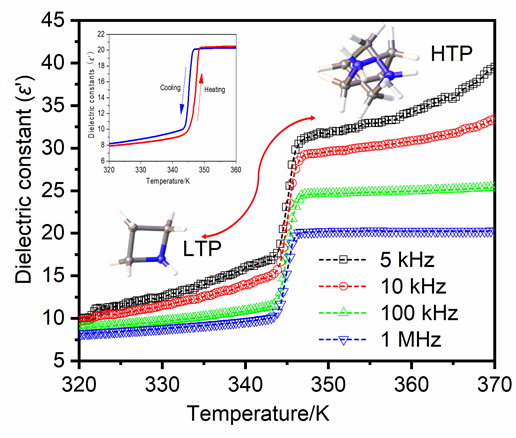
Stimuli-responsive smart materials have garnered significant interest due to their potential applications in information storage and sensors. These materials possess a simple preparation process, versatile structure, and are cost-effective, particularly the organic-inorganic hybrid-type thermally responsive dielectric switching materials. To this end, we selected azetidine hydrochloride and cobalt chloride hexahydrate and utilized a straightforward solvent evaporation method to obtain blue transparent crystals, (C3H6NH2)2CoCl4, a zero-dimensional organic-inorganic hybrid material exhibiting temperature responsiveness. It is notable that this compound undergoes a reversible structural phase transition at 347.7 K. And the enthalpy change of the material was consistent, as revealed by the differential scanning calorimetry (DSC) curves tested at different ramp-up and ramp-down rates. The heat absorption and exothermic peaks also displayed consistency at different rates, with the peaks demonstrating a tendency to contract. The crystal structure of the material underwent a phase transition from P21/n to Pnma space group, as evidenced by single crystal X-ray diffraction (SCXRD) data at variable temperatures. This transition was attributed to the deformation and displacement of the (CoCl4)2- anions and the ordered-disordered movements of the (C3H6NH2)+ cation. The dielectric test results of (C3H6NH2)2CoCl4 exhibited a step-like dielectric anomaly, with consistent dielectric changes over several dielectric cycles, demonstrating excellent dielectric switching properties. Weak interactions around the cations were calculated by Crystal Explorer, indicating that the main cause of the hybrid material formation was due to H•••H interactions between the cations and H•••Cl interactions between the anions and cations. Additionally, based on the ultraviolet-visible absorption spectroscopy, (C3H6NH2)2CoCl4 displayed an absorption edge at 743 nm, with an estimated optical bandgap Eg of 4 eV. Moreover, the material demonstrated exceptional stability, cycle life, and durability, indicating its potential for a wide range of applications in energy storage, sensors, catalysts, and other fields. In conclusion, this work provides novel insights into the structural design and property modulation of organic-inorganic hybrid materials.
Jian Chen , Zhuoer Cai , Shulin Jiao , Xiang Zhang , Jinzhong Hu , Min Liu , Baiwang Sun , Xiuni Hua . A Thermally Responsive Dielectric Switchable Zero-Dimensional Organic-Inorganic Hybrid Material: (C3H6NH2)2CoCl4[J]. Acta Chimica Sinica, 2023 , 81(5) : 480 -485 . DOI: 10.6023/A23030064
| [1] | Kang, S.; Jillella, R.; Park, S.; Park, S.; Kim, J. H.; Oh, D.; Kim, J.; Park, J. Nanomaterials 2022, 12, 3806. |
| [2] | Jia, Q. Q.; Ni, H. F.; Lun, M. M.; Xie, L. Y.; Lu, H. F.; Fu, D. W.; Guo, Q. J. Mater. Chem. C 2022, 10, 16330. |
| [3] | Bai, T. X.; Wang, X. C.; Wang, Z. Y.; Ji, S. J.; Meng, X.; Wang, Q. J.; Zhang, R. L.; Han, P. G.; Han, K. L.; Chen, J. S.; Liu, F.; Yang, B. Angew. Chem. Int. Ed. 2023, 62, e202213240. |
| [4] | Liu, S.; He, L.; Wang, Y.; Shi, P.; Ye, Q. Chinese Chem. Lett. 2022, 33, 1032. |
| [5] | Fukuta, Y.; Miyata, T.; Hamanaka, Y. J. Mater. Chem. C 2023, 11, 910. |
| [6] | Tian, Y.; Peng, H.; Wei, Q. L.; Chen, Y. X.; Xia, J. J.; Lin, W. C.; Peng, C. Y.; He, X. F.; Zou, B. S. Chem. Eng. J. 2023, 458, 141436. |
| [7] | Liu, H.-Y.; Zhang, H.-Y.; Chen, X.-G.; Xiong, R.-G. J. Am. Chem. Soc. 2020, 142, 15205. |
| [8] | Wang, C. C.; Yan, R. Y.; Cai, M. J.; Liu, Y. P.; Li, S. J. Appl. Surf. Sci. 2023, 610, 155346. |
| [9] | Guo, Z.-Y.; Zhou, H.-P. Acta Chim. Sinica 2021, 79, 223. (in Chinese) |
| [9] | (郭镇域, 周欢萍, 化学学报, 2021, 79, 223.) |
| [10] | Xu, H.-J.; Han, S.-G.; Sun, Z.-H.; Luo, J.-H. Acta Chim. Sinica 2021, 79, 23. (in Chinese) |
| [10] | 徐豪杰, 韩世国, 孙志华, 罗军华, 化学学报, 2021, 79, 23.) |
| [11] | Xu, W.-J.; He, C.-T.; Ji, C.-M.; Chen, S.-L.; Huang, R.-K.; Lin, R.-B.; Xue, W.; Luo, J.-H.; Zhang, W.-X.; Chen, X.-M. Adv. Mater. 2016, 28, 5886. |
| [12] | Han, S.; Zhang, J.; Sun, Z.; Ji, C.; Zhang, W.; Wang, Y.; Tao, K.; Teng, B.; Luo, J. Inorg. Chem. 2017, 56, 13078. |
| [13] | Wu, Y. L.; Lu, S. H.; Zhou, Q. H.; Ju, M. G.; Zeng, X. C.; Wang, J. L. Adv. Funct. Mater. 2022, 32, 4579. |
| [14] | Wu, L. K.; Feng, Y.; Wang, Z. J.; Li, L. H.; Hu, Z. B.; Ye, H. Y.; Li, J. R. Inorg. Chem. Commun. 2022, 142, 109641. |
| [15] | Wu, F. F.; Wei, Q. Y.; Li, X. Q.; Liu, Y.; Huang, W. Q.; Chen, Q.; Li, B. X.; Luo, J. H.; Liu, X. T. Cryst. Growth Des. 2022, 22, 3875. |
| [16] | Rok, M.; Zarychta, B.; Janicki, R.; Witwicki, M.; Bienko, A.; Bator, G. Inorg. Chem. 2022, 61, 5626. |
| [17] | RaeisianAsl, M.; Panahi, S. F. K. S.; Jamaati, M.; Tafreshi, S. S. Int. J. Energ. Res. 2022, 46, 13117. |
| [18] | Liu, Y. H.; Wang, W. Q.; Zhang, B. L.; Wang, Y. J.; Ren, M. P.; Jing, Z. H.; Yue, C. Y. CrystEngComm 2023, 25, 444. |
| [19] | Hua, X.-N.; Huang, C.-R.; Gao, J.-X.; Lu, Y.; Chen, X.-G.; Liao, W.-Q. Dalton T. 2018, 47, 6218. |
| [20] | Liu, J. Y.; Ye, S. Y.; Wan, M.; Wang, Y. N.; Tong, L.; Chen, L. Z. New J. Chem. 2022, 46, 1054.. |
| [21] | Rao, W.; Li, M.; You, X.; Wei, Z.; Zhang, M.; Wang, L.; Cai, H. Inorg. Chem. 2021, 60, 14706. |
| [22] | Hua, X.-N.; Gao, J.-X.; Chen, X.-G.; Li, P.-F.; Mei, G.-Q.; Liao, W.-Q. Dalton T. 2019, 48, 6621. |
| [23] | Jayatilaka, D.; Wolff, S. K.; Grimwood, D. J.; McKinnon, J. J.; Spackman, M. A. Acta Cryst. 2006, 62, 1107. |
| [24] | Dolomanov, O. V.; Bourhis, L. J.; Gildea, R. J.; Howard, J. A. K.; Puschmann, H. J. Appl. Cryst. 2009, 42, 339. |
| [25] | Sheldrick, G. M. Acta Cryst. 2015, A71, 3. |
/
| 〈 |
|
〉 |

