
Unveiling the Chemical Incompatibility of Au-Ag Heteronanoassembly
Received date: 2024-04-28
Online published: 2024-06-13
Supported by
National Key Research & Development Program of China(2021YFA1200101); National Key Research & Development Program of China(2018YFA0702001); National Natural Science Foundation of China(21991132)
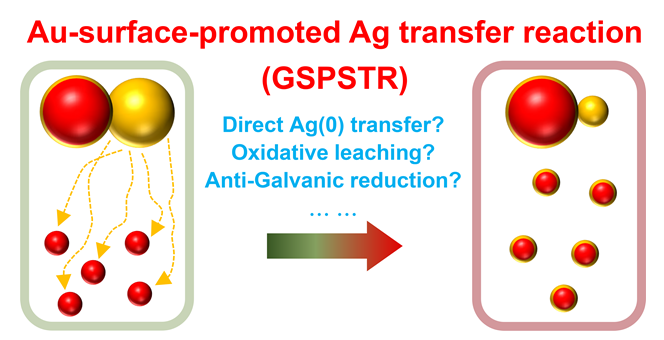
Metal nanoparticles displaying localized surface plasmon resonance (LSPR) are attractive to sensing, biological imaging, and nanomedical applications. Building nanoassemblies of different metals is of great value toward heterogeneous plasmon hybridization, LSPR tuning, and “lighting-up” of dark LSPR states. Based on the distinct activities of different nanounits and their spatial proximity, functional synergy or relay may be realized. Gold and silver nanomaterials strongly absorb and scatter light in the visible region, making them first choices for plasmonic engineering. However, silver is far less popular than gold in the bottom-up construction of plasmonic structures, which is mainly due to its unsatisfactory chemical and colloidal stabilities. On the other hand, the interband transition of silver nanoparticles is far away from their plasmon resonance, which, along with their relatively small plasmon loss, leads to strong and somewhat symmetric LSPR peaks superior to gold nanoparticles. More importantly, the simultaneous introduction of gold and silver into self-assembled structures is expected to generate properties and functions that cannot be realized by homogeneous assemblies. However, the dramatically different chemical properties of gold and silver might lead to a compatibility problem. To address this issue, Au-Ag heterodimeric nanoparticles featuring a charge transfer plasmon resonance are synthesized and utilized as ideal silver-containing materials to uncover the Au-Ag chemical incompatibility. The good colloidal stability of the Au-Ag nanoparticles enables their DNA grafting and DNA-programmable assembly. In addition, the bimetallic nature and the charge transfer plasmon resonance of the Au-Ag nanoparticles facilitate the observation of a silver etching reaction in the presence of gold nanoparticles. The chemical source of such an incompatibility is then proposed, which involves several “solid-solution-solid” pathways capable of promoting a “silver-transfer” to the gold surface. Such understanding finally leads to strategies toward improved gold-silver chemical compatibility. This work paves a way to the construction of heterogeneous nanoassemblies involving silver and other noble metals toward sensing, catalysis, light harvesting, and optoelectronics.
Chengjun Wang , Yueliang Wang , Huiqiao Wang , Zhaoxiang Deng . Unveiling the Chemical Incompatibility of Au-Ag Heteronanoassembly[J]. Acta Chimica Sinica, 2024 , 82(7) : 763 -771 . DOI: 10.6023/A24040147
| [1] | Kelly K. L.; Coronado E.; Zhao L. L.; Schatz G. C. J. Phys. Chem. B 2003, 107, 668. |
| [2] | Kreibig U.; Vollmer M. Optical properties of metal clusters, Springer, Berlin, 1995. |
| [3] | Barnes W. L.; Dereux A.; Ebbesen T. W. Nature 2003, 424, 824. |
| [4] | Yang X.; Zhang Z.; Su M.; Song Y. Acta Chim. Sinica 2022, 80, 80 (in Chinese). |
| [4] | (杨旭, 张泽英, 苏萌, 宋延林, 化学学报, 2022, 80, 80.) |
| [5] | Dong Y. Y.; Hu C. Y.; Xiong H. L.; Long R.; Xiong Y. J. ACS Catal. 2023, 13, 6730. |
| [6] | Aslam U.; Rao V. G.; Chavez S.; Linic S. Nat. Catal. 2018, 1, 656. |
| [7] | Jackman J. A.; Rahim Ferhan A.; Cho N.-J. Chem. Soc. Rev. 2017, 46, 3615. |
| [8] | Masson J.-F. ACS Sens. 2017, 2, 16. |
| [9] | Tokel O.; Inci F.; Demirci U. Chem. Rev. 2014, 114, 5728. |
| [10] | Hang Y.; Wang A.; Wu N. Chem. Soc. Rev. 2024, 53, 2932. |
| [11] | Wy Y.; Jung H.; Hong J. W.; Han S. W. Acc. Chem. Res. 2022, 55, 831. |
| [12] | Prodan E.; Radloff C.; Halas N. J.; Nordlander P. Science 2003, 302, 419. |
| [13] | Romero I.; Aizpurua J.; Bryant G. W.; García de Abajo F. J. Opt. Express 2006, 14, 9988. |
| [14] | Zhu W.; Esteban R.; Borisov A. G.; Baumberg J. J.; Nordlander P.; Lezec H. J.; Aizpurua J.; Crozier K. B. Nat. Commun. 2016, 7, 11495. |
| [15] | Ma J.; Huang L.; Zhou B.; Yao L. Acta Chim. Sinica 2022, 80, 1507 (in Chinese). |
| [15] | (马进越, 黄露霏, 周宝文, 姚琳, 化学学报, 2022, 80, 1507.) |
| [16] | Yang Q.; Liu X.; Wang C.; Xu M.; Yao J. Acta Chim. Sinica 2024, 82, 281 (in Chinese). |
| [16] | (杨青, 刘肖宇, 王晨, 徐敏敏, 姚建林, 化学学报, 2024, 82, 281.) |
| [17] | Brown L. V.; Sobhani H.; Lassiter J. B.; Nordlander P.; Halas N. J. ACS Nano 2010, 4, 819. |
| [18] | Deng T.-S.; Parker J.; Yifat Y.; Shepherd N.; Scherer N. F. J. Phys. Chem. C 2018, 122, 27662. |
| [19] | Sheikholeslami S.; Jun Y. W.; Jain P. K.; Alivisatos A. P. Nano Lett. 2010, 10, 2655. |
| [20] | Yamada Y.; Tsung C.-K.; Huang W.; Huo Z.; Habas S. E.; Soejima T.; Aliaga C. E.; Somorjai G. A.; Yang P. D. Nat. Chem. 2011, 3, 372. |
| [21] | Yan H.; He K.; Samek I. A.; Jing D.; Nanda M. G.; Stair P. C.; Notestein J. M. Science 2021, 371, 1257. |
| [22] | Huang J.; Mensi M.; Oveisi E.; Mantella V.; Buonsanti R. J. Am. Chem. Soc. 2019, 141, 2490. |
| [23] | Liu M. Z.; Guyot-Sionnest P. J. Phys. Chem. B 2004, 108, 5882. |
| [24] | Linic S.; Christopher P.; Ingram D. B. Nat. Mater. 2011, 10, 911. |
| [25] | Wang F.; Shen Y. R. Phys. Rev. Lett. 2006, 97, 206806. |
| [26] | Blaber M. G.; Henry A.-I.; Bingham J. M.; Schatz G. C.; Van Duyne R. P. J. Phys. Chem. C 2012, 116, 393. |
| [27] | Singh K. R. B.; Natarajan A.; Pandey S. S. ACS Appl. Bio Mater. 2023, 6, 4549. |
| [28] | Lee K. S.; El-Sayed M. A. J. Phys. Chem. B 2006, 110, 19220. |
| [29] | Hill C. M.; Pan S. J. Am. Chem. Soc. 2013, 135, 17250. |
| [30] | Zhu P.; Lou C.; Shi Y.; Wang C. Acta Chim. Sinica 2022, 80, 1385 (in Chinese). |
| [30] | (朱鹏飞, 娄晨思, 史雨翰, 王传义, 化学学报, 2022, 80, 1385.) |
| [31] | Jiang X.; Zeng Q.; Yu A. Langmuir 2007, 23, 2218. |
| [32] | Chen Y.; Wang C. G.; Ma Z. F.; Su Z. M. Nanotechnology 2007, 18, 325602. |
| [33] | An J.; Tang B.; Zheng X. L.; Zhou J.; Dong F. X.; Xu S. P.; Wang Y.; Zhao B.; Xu W. Q. J. Phys. Chem. C 2008, 112, 15176. |
| [34] | Xue J.; Jia Y.; Yang L.; Feng J.; Wu D.; Ren X.; Du Y.; Ju H.; Wei Q. Anal. Chem. 2020, 92, 14203. |
| [35] | Zhang Q.; Ge J.; Pham T.; Goebl J.; Hu Y.; Lu Z.; Yin Y. Angew. Chem. Int. Ed. 2009, 48, 3516. |
| [36] | Sun Y. G.; Mayers B.; Xia Y. N. Nano Lett. 2003, 3, 675. |
| [37] | Tang B.; An J.; Zheng X. L.; Xu S. P.; Li D. M.; Zhou J.; Zhao B.; Xu W. Q. J. Phys. Chem. C 2008, 112, 18361. |
| [38] | Hu S.; Yi T.; Huang Z.; Liu B.; Wang J.; Yi X.; Liu J. Mater. Horiz. 2019, 6, 155. |
| [39] | Chen N.; Wang Y. L.; Song X. J.; Li Y. J.; Deng Z. X. Nano Lett. 2022, 22, 8550. |
| [40] | Wen F.; Zhang Y.; Gottheim S.; King N. S.; Zhang Y.; Nordlander P.; Halas N. J. ACS Nano 2015, 9, 6428. |
| [41] | Fang L. L.; Liu D. L.; Wang Y. L.; Li Y. J.; Song L.; Gong M.; Li Y.; Deng Z. X. Nano Lett. 2018, 18, 7014. |
| [42] | Zhu Q. Q.; Song X. J.; Deng Z. X. Acta Chim. Sinica 2020, 78, 675 (in Chinese). |
| [42] | (朱青青, 宋晓君, 邓兆祥, 化学学报, 2020, 78, 675.) |
| [43] | Liu M.; Fang L. L.; Li Y. L.; Gong M.; Xu A.; Deng Z. X. Chem. Sci. 2016, 7, 5435. |
| [44] | Hao Y.; Li Y. J.; Song L.; Deng Z. X. J. Am. Chem. Soc. 2021, 143, 3065. |
| [45] | Ye Y. C.; Hao Y.; Ye M. Y.; Song X. J.; Deng Z. X. Small 2022, 18, 2202458. |
| [46] | Pal S.; Sharma J.; Yan H.; Liu Y. Chem. Commun. 2009, 6059. |
| [47] | Liu H.; Qu J.; Chen Y.; Li J.; Ye F.; Lee J. Y.; Yang J. J. Am. Chem. Soc. 2012, 134, 11602. |
| [48] | Xue C.; Métraux G. S.; Millstone J. E.; Mirkin C. A. J. Am. Chem. Soc. 2008, 130, 8337. |
| [49] | Wu X. M.; Redmond P. L.; Liu H. T.; Chen Y. H.; Steigerwald M.; Brus L. J. Am. Chem. Soc. 2008, 130, 9500. |
| [50] | Wu Z. Angew. Chem., Int. Ed. 2012, 51, 2934. |
| [51] | Sahu P.; Prasad B. L. V. Colloids Surf. A 2015, 478, 30. |
| [52] | Peng J.; Huang B.; Wang P.; Pei Y. J. Phys. Chem. A 2022, 126, 8910. |
| [53] | Gan Z.; Xia N.; Wu Z. Acc. Chem. Res. 2018, 51, 2774. |
| [54] | Liu X.; Astruc D. Adv. Mater. 2017, 29, 1605305. |
| [55] | Jin F.; Dong H.; Zhao Y.; Zhuang S.; Liao L.; Yan N.; Gu W.; Zha J.; Yuan J.; Li J.; Deng H.; Gan Z.; Yang J.; Wu Z. Acta Chim. Sinica 2020, 78, 407 (in Chinese). |
| [55] | (金凤鸣, 董宏伟, 赵燕, 庄胜利, 廖玲文, 闫楠, 古万苗, 查珺, 袁金云, 李进, 邓海腾, 甘自保, 杨金龙, 伍志鲲, 化学学报, 2020, 78, 407.) |
| [56] | Lei P. C.; Li Y. J.; Song X. J.; Hao Y.; Deng Z. X. Angew. Chem. Int. Ed. 2022, 61, e202203568. |
| [57] | Ye M. Y.; Song L.; Ye Y. C.; Deng Z. X. J. Am. Chem. Soc. 2023, 145, 25653. |
| [58] | Li Y. L.; Deng Z. X. Acc. Chem. Res. 2019, 52, 3442. |
| [59] | Herrero E.; Buller L. J.; Abru?a H. D. Chem. Rev. 2001, 101, 1897. |
| [60] | Chirea M.; Collins S. S.; Wei X.; Mulvaney P. J. Phys. Chem. Lett. 2014, 5, 4331. |
| [61] | Hong M.; Yokota Y.; Wong R. A.; Hayazawa N.; Kazuma E.; Kim Y. J. Phys. Chem. C 2021, 125, 16569. |
| [62] | Wang H.; Li Y.; Gong M.; Deng Z. Chem. Sci. 2014, 5, 1015. |
/
| 〈 |
|
〉 |

