



1 引言
优化催化剂结构是提高催化活性的最有效策略之一[11-14], 核壳复合纳米材料能够兼具外壳和内核材料的优良特点, 将内外两种材料的特性复合, 克服单一结构材料性能的不足[15-16], 并且核壳异质结构中核心和壳层之间会存在大面积紧密接触, 从而建立了高质量界面, 可实现高效的界面电荷分离和传输. 泡沫铜由于其三维多孔导电结构, 可以促进电子转移, 被广泛应用于氮还原合成氨(NRR)研究[17-18]. 此外, 引入其他元素可以有效地改变原材料的电子转移, 促进反应中间体的吸附, 从而提高合成氨催化剂的反应活性和选择性. Lan等[19]通过实验发现, Co和Zn在NRR中具有协同作用, 可以抑制竞争性析氢反应. He等[20]报道了Fe1/Cu2- Co3O4纳米棒电催化剂, 其具有丰富的氧空位, 其中Co3O4基底中的氧空位可以加速 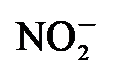 还原为NH3. Yang等[21]制备了CoP@Co核壳催化剂, 研究发现通过改变催化剂结构可以优化催化剂的合成氨反应性能. 上述研究表明, 钴基催化剂适用于NRR反应.
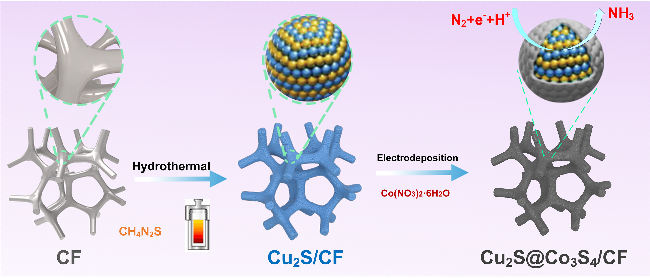
还原为NH3. Yang等[21]制备了CoP@Co核壳催化剂, 研究发现通过改变催化剂结构可以优化催化剂的合成氨反应性能. 上述研究表明, 钴基催化剂适用于NRR反应.由于泡沫铜具有三维纳米多孔结构可促进电子的转移, 因此在本研究中选择泡沫铜作为基底, Co基催化剂被发现可以抑制副产物的形成, 可结合Cu和Co基催化剂的优点创建一种高活性、高选择性核壳结构的催化剂, 促进NRR合成氨过程, 另外, 铜的电子结构也可以通过与电负性更强的p-block非金属元素(如硫)配对来调整, 空位缺陷可作为催化反应的活性中心进一步增强催化剂的内在性能, 当前大多数阴离子空位研究集中在氧空位缺陷上, 主要是因为其较低的形成能, 而具有较高形成能的硫、氮和磷阴离子空位缺陷却少有报道. 因此我们通过掺杂形成硫空位来促进催化剂的氮还原活性, 催化剂制备过程的示意图如图1所示.
2 结果与讨论
2.1 Cu2S@Co3S4/CF催化剂的形貌结构分析
核壳结构纳米复合材料的外壳和内核间具有强相互作用[22], 可以通过调整壳层结构来调控内核纳米颗粒的表面特性, 为了探索核壳结构对催化剂晶相的影响, 通过X射线衍射(XRD)对Cu2S/CF、Co3S4/CF和Cu2S@Co3S4/CF催化剂进行了研究.
如图2a所示, XRD图谱验证了Cu2S@Co3S4/CF催化剂的复合晶型结构[23], 对比了Cu2S/CF、Co3S4/CF和Cu2S@Co3S4/CF核壳催化剂的特征峰的2θ角, 如图2b所示, 核壳结构的Cu2S@Co3S4/CF的Cu(111)和(200)和(220)晶面的2θ角发生轻微的左移, 这说明Co改变了Cu2S/CF的晶格间距, 根据布拉格方程2dsinθ=nλ[24]可知, Co的掺杂使晶格结构中多数晶面间距增加, 这是由于Co2+的离子半径大于Cu2+的离子半径(7.3 nm), 半径较大的Co2+使得晶胞体积变大, 晶格扩张可改善OH吸附还可抑制H*物质之间的结合[25]. 此外, 这也可能归因于硫空位的产生, 核壳催化剂衍射峰中存在Co3S4也证实了Co的成功掺杂. 如图2c所示, 反应后样品中含有Co(OH)2和CoOOH物质, 证明催化剂发生了重构, 生成了活性物质.

为了研究Cu2S/CF、Co3S4/CF和Cu2S@Co3S4/CF催化剂的形貌, 将三种催化剂超声分散在乙醇中, 并使用透射电子显微镜(TEM)进行表征.
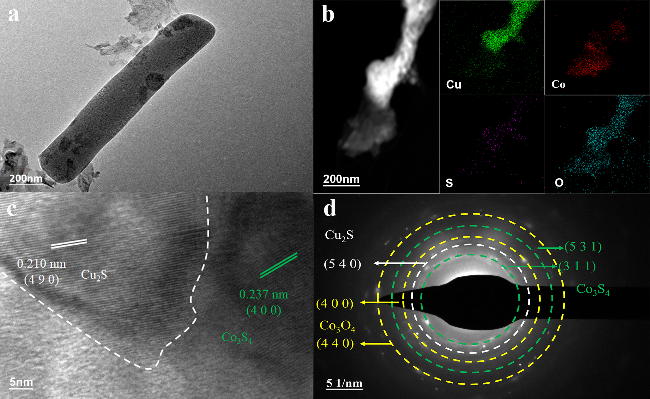
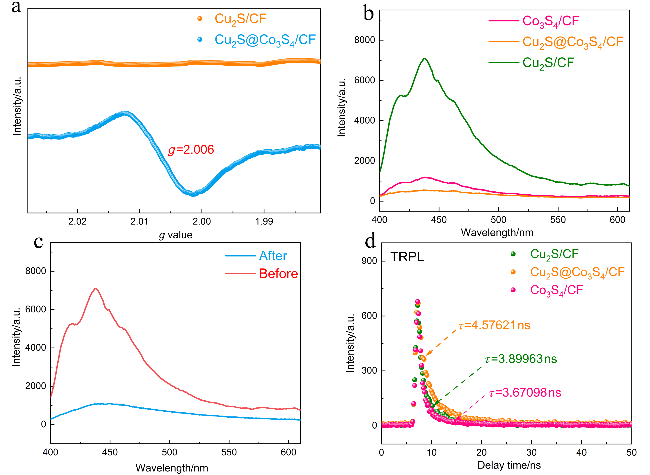
为进一步证实Cu2S@Co3S4/CF催化剂中硫空位的存在, 采用电子顺磁共振(EPR)对样品进行研究, Cu2S/CF、Cu2S@Co3S4/CF的EPR信号曲线如图4所示.
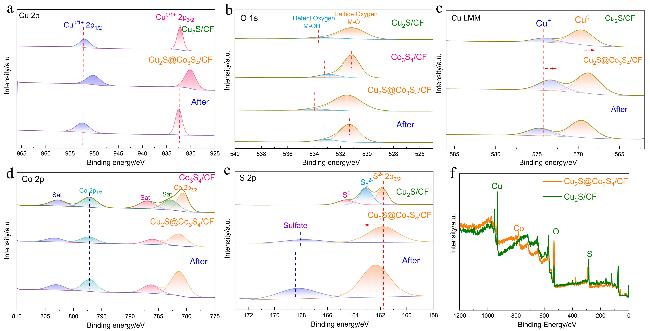
用X射线光电子能谱(XPS)研究了Co掺杂后的电子效应以及核壳结构催化剂的表面电子态. 由于荷电效应, 需要首先选择C谱进行拟合, 并根据碳谱对其它谱图进行荷电校准, 即采用污染碳的C 1s (284.80 eV)进行校准.
2.2 Cu2S@Co3S4/CF催化剂的电化学及合成氨性能测试
首先, 对Cu2S/CF、Co3S4/CF和核壳Cu2S@Co3S4/ CF催化剂进行了线性扫描伏安测试(LSV), 以确定它们的Tafel斜率, 所有电位均以可逆氢电极(RHE)为参考.
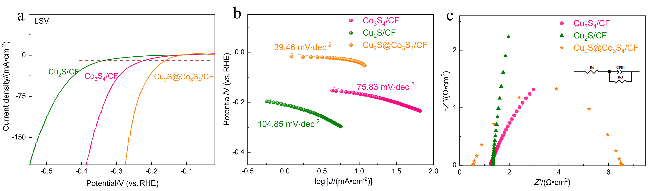
进一步的, 通过不同扫描速率下非法拉第区间的电化学双层电容(Cdl)来评估所制备的催化剂(图S5, 见支持信息), Cu2S@Co3S4/CF催化剂的Cdl值高于Cu2S/CF和Co3S4/CF, 表明Cu2S@Co3S4/CF具有更多活性位点.
通过H型电解池, 在环境温度(25 ℃)和大气压力下研究了Cu2S@Co3S4/CF催化剂的电化学合成氨性能, 实验装置图如图S1(见支持信息)所示. 首先, 向1 mol/L氢氧化钾溶液中通入Ar等惰性气体30 min以排除空气中N2的影响, 接着通入氮气30 min以达到氮气饱和状态使实验结果更加精准. 在紫外可见光光度计中采用纳氏试剂分光光度法对氮还原过程产生的氨进行测量, 并根据氨的校准曲线(图S2, 见支持信息)进行定量计算.
为了进一步证明我们实验的准确性, 进行了对比实验(图S6, 见支持信息), 在氩气气氛和空白电解质中反应后几乎检测不到氨, 进一步支持了NH3仅在氮气下生成的结论, 也验证了NRR实验结果的准确性.
测定了催化剂的氨产量和法拉第效率(图7a), 可以看出与Cu2S/CF和Co3S4/CF样品相比, 核壳结构的Cu2S@Co3S4/CF催化剂具有更高的氨合成率(122 μg• h-1•cm-2)和法拉第效率(34.6%), Co的存在不仅提高了Cu2S@Co3S4/CF的电导率, 还降低了电子转移阻力, 这两种组分之间的协同作用是Cu2S@Co3S4/CF在NRR中催化活性提高的原因, 以Cu2S为核以Co3S4为壳的核壳结构, 既最大限度地发挥了金属Co和Cu催化剂的优势, 又避免了它们的劣势(Cu基NRR的高反应活性会导致副反应, 而Co可以抑制副反应), 而且核壳结构使催化剂暴露出多个活性位点, 更多的催化表面积使反应传质速率更快[40-42], 从而促进了NRR工艺的发展.
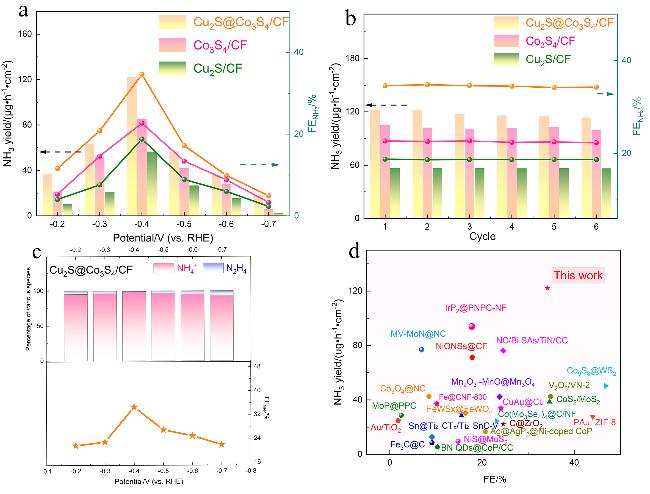
稳定性是评价电催化剂性能的重要指标之一, 在本工作中, 通过循环实验和长期恒电位测试来评价Cu2S/ CF、Co3S4/CF和核壳Cu2S@Co3S4/CF催化剂的稳定性, 如图7b所示, 六个循环中Cu2S@Co3S4/CF电催化氨合成效率基本保持不变没有发生衰减, 核壳Cu2S@Co3S4/CF催化剂表现出优异的电化学合成氨稳定性.
此外, 为了验证氨测量的准确性, 我们采用了离子色谱法(IC)与紫外-可见光检测方法相结合. 如图S7(见支持信息)所示, 离子色谱法计算出催化剂表现出120.6 μg•h-1•cm-2的氨产率, 法拉第反应效率为34.1%, 与通过紫外-可见光检测获得的值(图7a)基本一致. 这种一致性证实了本研究中所使用氨定量方法的可靠性, 并排除了纳氏试剂法可能的假阳性.
如图7d所示, 该催化剂表现出122 μg•h-1•cm-2氨产率, 法拉第反应效率为34.6%, 其性能高于最近报道的大多数贵金属和非贵金属基催化剂. 结合TEM和XPS可知, Cu2S@Co3S4/CF催化剂异质结构中存在电子协同效应, 从而提高了催化剂的NRR活性. 此外, EPR光谱证实了硫空位的存在, 硫空位在氮还原合成氨反应中不仅可以暴露活性金属位点, 自身还可以成为活性位点: 这些硫空位可以改善N2分子的吸附和活化并有利于金属-N2相互作用的过程, 因此可提高氮还原的性能[45-48]. 值得注意的是, 基于XPS结果, 核壳催化剂的Cu峰向较低的结合能级移动, 表明发生了电子转移, 证明硫空位可以调节局部电子密度分布, 从而促进电子转移[49].
综上可知Cu2S@Co3S4/CF核壳结构不仅增加了催化活性中心, 还具备丰富的孔隙结构和空间构型, 是高活性、高稳定性且高选择性的合成氨催化剂.
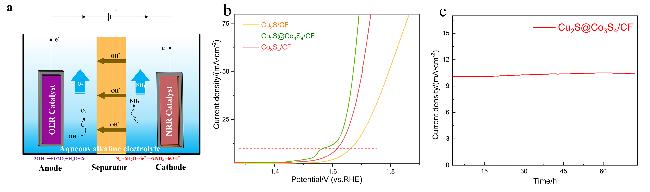
相比单独研究NRR和OER催化剂, NRR/OER双功能电催化剂更具有工程应用潜力, 然而, 这种催化剂在动力学上同时面临者缓慢的六电子(NRR)和四电子转移(OER)方面的巨大挑战, 因此迄今为止的报道很少, 催化剂在OER反应中LSV性能曲线如图S8(见支持信息)所示.
为了进一步探索催化剂在NRR过程的具体反应机理, 我们利用拉曼和红外技术对Cu2S/CF、Co3S4/CF和Cu2S@Co3S4/CF催化剂进行了研究.
如图9a所示, 在拉曼光谱中观察到生成了N-N、NH2、NH、NH3、HNNH和反应中间产物N2Hx (0≤x≤2)[50]. 对比Cu2S@Co3S4/CF氮还原反应前后拉曼光谱(图9b), 明显观察到CoOOH和Cu-OH活性相的产生, 说明催化剂在NRR过程中出现了表面重构现象. 一系列研究表明, 在催化剂中引入硫空位不仅能提高固氮反应的电子捕获能力, 还能将电子注入氮分子的反键轨道, 实现电子受体和供体的作用. 结合XPS、EPR和拉曼分析证明, Cu2S@Co3S4/CF催化剂具有大量硫空位缺陷和异质界面, 硫空位可有效吸附和活化N2, 从而提高NRR活性, Cu2S@Co3S4/CF的异质界面相互作用可为固氮反应提供丰富的反应位点, 并有效抑制析氢副反应.
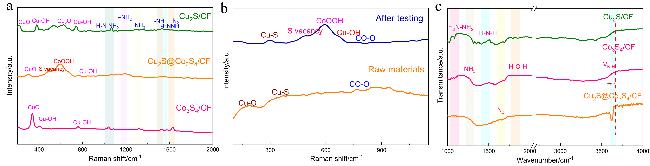
如图S9(见支持信息)所示, 在不同施加电位下进行了原位拉曼实验, 在拉曼光谱中观察到了NH2、NH3、HNNH的生成, 提供了催化剂表面氮还原反应发生的直接分子水平证据, 在施加电位-0.4 V下, HNNH中间体的弯曲振动信号表现出最高的强度, 表明在这种条件下*N2Hy中间体的形成最为显著. 这一观察结果与电化学性能结果非常吻合.
接着利用红外光谱进一步研究了NRR过程中催化剂的具体演化过程, 如图9c所示, 红外同样检测到一系列关键的中间体, 如N-Hx, NH3和*N2Hy, 推测出产物的形成来自于N2的吸附和反应, 表面吸附的H-O-H基团证明水分子在催化剂表面发生反应[51-53], 如在Cu2S/CF和Co3S4/CF催化剂吸附N2后的红外光谱曲线中, Cu2S@Co3S4/CF上的红外波段出现了蓝移, 这可能是由于附近的Cu-S配体通过形成Cu-S-Co界面而产生了吸电子感应效应, 这证明掺杂Co可优化催化剂电子结构. 结合红外光谱和拉曼光谱的谱图, 推测合成氨反应过程为首先催化剂表面吸附N2, 然后两个电子转移形成N2H2, 最后分解形成NH3.
2.3 Cu2S@Co3S4/CF催化剂应用于Zn-N2电池的性能研究


3 结论
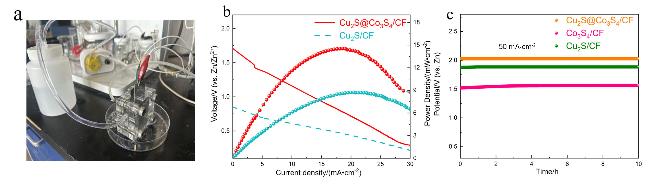
通过水热法和电沉积法制备的核壳结构Cu2S@Co3S4/CF电催化剂具有较高的合成氨效率和法拉第效率, 这种结构为氮还原反应过程提供了大量活性位点, 该催化剂表现出较高的氨产率, 达122 μg•h-1•cm-2, 法拉第反应效率为34.6%, 并且经过6次循环测试后性能没有发生衰减. 通过XPS等表征证实催化剂高性能的原因归因于Cu2S核向壳上表面活性物种提供了丰富的电子, 促进氮还原加氢反应. 此外硫空位的引入也促进了N2在催化剂表面的吸附和活化, 从而提高了电催化固氮性能. 并且其作为Zn-N2电池的阴极也具有14.6 mW•cm-2的出色功率密度, 可以在电化学合成NH3的同时实现储能, 具有实际应用价值.
4 实验部分
在常温常压下, 基于H型电解池采用三电极体系进行电催化氮气还原反应(所有电化学反应均在东华电化学工作站上进行), 其中电解池以Nafion 117膜分离开, 在NRR电解之前需要对膜进行预处理以除去其中杂质, 该膜在80 ℃的超纯水中浸泡1 h, 接着在80 ℃的质量分数为5%的H2O2水溶液中浸泡1 h, 然后在80 ℃的0.5 mol/L H2SO4水溶液中质子化1 h, 最后用超纯水洗涤2 h. 电化学催化活性和其他电化学性能在1.0 mol/L KOH电解液中使用东华电化学工作站进行测试, 使用制备好的催化剂作为工作电极, Pt箔片(2 cm×2 cm)作为对电极, Hg/HgO电极作为参考电极. 本工作中报道的所有电位均通过以下方程转换为可逆氢电极(RHE): E(vs. RHE)=E(vs. Hg/HgO)+0.098 V+0.059pH. 线性扫描伏安法(LSV)扫描速率为5 mV•s-1, 催化剂的交流阻抗谱(EIS)在开路电压下以105~10-2 Hz的频率进行测试, 此外, 根据循环伏安法(CV)在6个扫描速率(10~100 mV•s−1)下的曲线来计算催化剂的电化学双层电容.
首先, 对泡沫铜(CF, 厚度为1.0 mm, 反应面积1.0 cm×1.0 cm)进行预处理, 在3 mol/L HCl水溶液中超声30 min以去除表面的氧化物, 然后在乙醇和去离子水中超声处理10 min. 接着, 将0.8 mol/L硫脲溶解在50 mL去离子水中并搅拌30 min, 将处理后的泡沫铜(1.0 cm×1.0 cm)和混合溶液转移到一个50 mL聚四氟乙烯衬里的高压釜中进行水热反应(160 ℃, 6 h), 反应后得到的Cu2S/CF样品反复用水和乙醇洗涤, 然后在60 ℃真空干燥12 h, 最后在Co(NO3)2•6H2O溶液中将已干燥好的Cu2S/CF催化剂通过电沉积反应制备Cu2S@Co3S4/CF核壳催化剂.
(Zhao, C.)