



1 引言
有机电化学合成利用清洁无痕的电流驱动化学反应的进行, 无需使用化学计量的化学氧化还原试剂, 具有反应条件温和、原子经济性高、环境友好等优点[1]. 此外, 改变电极电势和电流能调控电化学合成反应的选择性, 实现目标分子的精准构建. 近年来, 有机电化学合成受到了科研工作者的广泛关注, 大量的科研成果被国内外科研团队报道[2]. 电化学反应通常需使用化学计量的无机盐作为支持电解质以提高反应液的导电率, 促进电子的传递和化学反应的进行. 然而, 难回收的无机盐电解质的使用不可避免增加了反应成本和环境副作用, 影响了反应的实用性. 因此, 无支持电解质条件下电化学反应体系已成为当前绿色化学研究领域的热点之一[3].
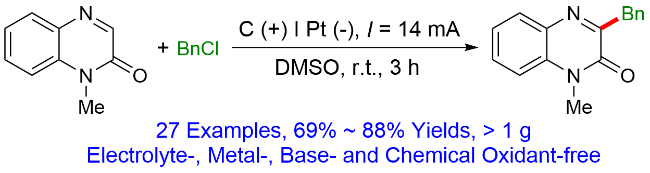
苄基作为有机化学中的核心结构单元, 不仅在有机合成领域占据重要地位, 同时也普遍存在于药物活性成分及生物功能分子中. 2023年, 全球销售额前200的小分子药物中约有30%的药物分子含有苄基官能团. 苄氯化合物是一种价廉易得的苄基化试剂, 被广泛用于苄基化反应. 3-苄基喹喔啉-2(1H)-酮作为药物化学领域一类特殊的药效团, 受到人们的广泛关注[9]. 2022年, 於兵[10]与杨道山[11]等分别报道了通过可见光催化实现喹喔啉-2(1H)-酮与苄溴的脱溴苄基化反应. 尽管该类可见光催化苄基化策略能够有效合成3-苄基喹喔啉-2(1H)-酮, 但其反应体系仍依赖于不可回收的均相光催化剂以及过量无机碱添加剂, 不仅提高了反应成本, 也增加了环境负担. 因此, 开发更加绿色、经济且实用的3-苄基喹喔啉-2(1H)-酮合成新方法具有重要的研究意义.
2 结果与讨论
2.1 无外加电解质参与的喹喔啉-2(1H)-酮和苄氯的电化学脱氯苄基化反应
2.1.1 苄基化反应条件的优化
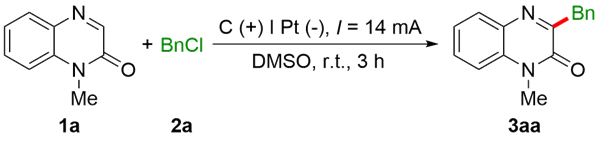
首先, 我们选择1-甲基喹喔啉-2(1H)-酮(1a)与氯化苄(2a)的反应为模型反应, 优化反应条件(表1). 经过一系列的条件筛选, 最终该反应的最优条件: 以石墨片电极(C(+))为阳极, 铂片电极(Pt(-))为阴极, 二甲基亚砜(DMSO)为溶剂, 在室温条件下以30 V为起始电压, 反应过程中电流缓慢上升, 0.5 h电流上升至14 mA达到恒定, 电压开始下降至17 V趋于稳定. 反应3 h以88%的气相产率生成目标产物1-甲基-3-苄基喹喔啉-2(1H)-酮(3aa)(表1, Entry 1). 将铂阴极更换为其他材料电极, 如石墨(C), 铜(Cu), 镍(Ni), 锌(Zn)等, 苄基化反应效率大幅降低(Entries 2~5). 使用铂片替代石墨片作为阳极时, 3aa的产率下降到53% (Entry 6). 使用乙腈(MeCN)作为溶剂时能以24%的气相收率得到目标产物3aa (Entry 7), 而用二氯乙烷(DCE)、N,N-二甲基甲酰胺(DMF)、乙醇(EtOH)或乙酸乙酯(EtOAc)作为溶剂时, 没有反应发生(Entry 8). 当氯化苄2a的用量降至1 equiv.时, 产物3aa的产率下降至56%; 然而, 增加2a的用量并不能有效提高反应产率(Entry 9). 氮气氛围对产率的提升没有帮助(Entry 10). 最后通过控制实验, 证明了电流是该反应必不可少的反应条件(Entry 11).
表1 反应条件优化aTable 1 Optimization of reaction conditionsa |
| Entry | Variations from the standard condition | Yieldb/% | |||
|---|---|---|---|---|---|
| 1 | None | 88 | |||
| 2 | C(+)|C(-) instead of C(+)|Pt(-) | 59 | |||
| 3 | C(+)|Cu(-) instead of C(+)|Pt(-) | 38 | |||
| 4 | C(+)|Ni(-) instead of C(+)|Pt(-) | 33 | |||
| 5 | C(+)|Zn(-) instead of C(+)|Pt(-) | 21 | |||
| 6 | Pt(+)|Pt(-) instead of C(+)|Pt(-) | 53 | |||
| 7 | MeCN instead of DMSO | 24 | |||
| 8 | DCE, DMF, EtOH, EtOAc instead of DMSO | N.R. | |||
| 9 | 1 or 2 equiv. of 2a was used | 56, 88 | |||
| 10 | Under N2 | 88 | |||
| 11 | Without electricity | N.R. | |||
a Conditions: C (50 mm×5 mm×2 mm) as the anode, Pt (50 mm×5 mm×0.1 mm) as the cathode, constant current=14 mA, 1a (0.2 mmol), 2a (0.4 mmol), DMSO (3 mL), r.t., 3 h.; b Estimated by GC using dodecane as an internal reference. |
2.1.2 喹喔啉-2(1H)-酮的苄基化反应底物扩展
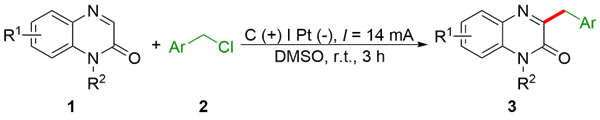
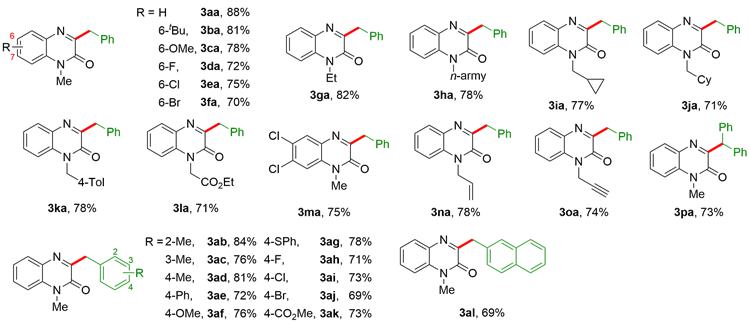
在确定了最优反应条件后(表1, Entry 1), 我们进一步探索了电催化喹喔啉-2(1H)-酮苄基化反应的底物普适性(表2). 喹喔啉-2(1H)-酮的苯环上分别用电中性氢原子、供电子基团和吸电子基团修饰都具有反应性, 能以70%~88%的分离产率得到目标产物3aa~3fa. 一系列N-取代的喹喔啉-2(1H)-酮衍生物, 包括乙基、正戊基、环丙基甲基、环己基甲基、4-甲基苄基和酯基, 都可以很好地兼容该反应体系, 以良好到优秀的分离收率得到目标产物3ga~3la. 二取代的喹喔啉-2(1H)-酮(3ma)也能够在反应体系中稳定存在. 不但如此, 含有烯基和炔基的喹喔啉-2(1H)-酮衍生物都能以较高的产率生成相应的产物3na和3oa, 表明该反应具有很好的官能团耐受性. 当使用喹啉、噻吩或噻唑等杂环化合物作为反应物时, 未能成功获得目标产物. 随后, 对苄氯底物进行了普适性考察. 苄氯取代基的位置对于苄基化反应产率的影响较小, 以76%~84%的分离产率得到目标产物3ab~3ad. 此外, 无论是苯环对位取代有供电子基或者吸电子基的氯化苄, 都以良好的收率得到目标产物(3ae~3ak). 值得注意的是, 本工作发展的电化学苄基化体系可以很好地兼容氧化敏感的硫醚官能团(3ag). 使用二苯氯甲烷和2-(氯甲基)-萘替换氯化苄都能以良好的产率生成相应的目标产物3pa (73%)和3al (69%). 当使用1-氯己烷、环己基氯等脂肪氯代烃作为自由基前体时, 反应未能发生.
表2 3-苄基喹喔啉-2(1H)-酮底物范围aTable 2 Scope of C3-benzyl-quinoxalin-2(1H)-onea |
 |
a Conditions: C (50 mm×5 mm×2 mm) as the anode, Pt (50 mm×5 mm×0.1 mm) as the cathode, constant current=14 mA, 1 (0.2 mmol), 2 (0.4 mmol), DMSO (3 mL), r.t., 3 h. |
2.2 放大实验
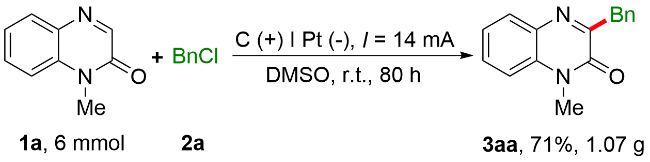
为了验证电催化喹喔啉-2(1H)-酮脱氯苄基化反应的实际应用价值, 对反应进行了放大实验. 如图式2所示, 当模型反应1a (6 mmol)和2a (12 mmol)在室温下以 14 mA的恒定电流搅拌反应, 能以71%的分离收率得到3aa (1.07 g). 以上实验结果表明, 反应扩大到克级规模时, 仍然保持较好的反应效率, 具有一定的实际应用潜力.
2.3 控制反应
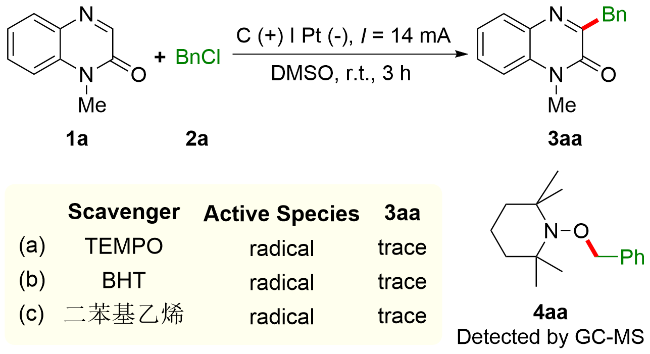
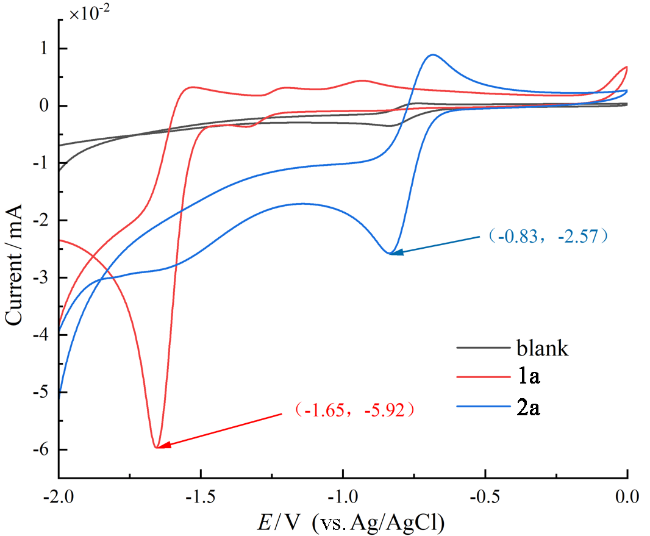
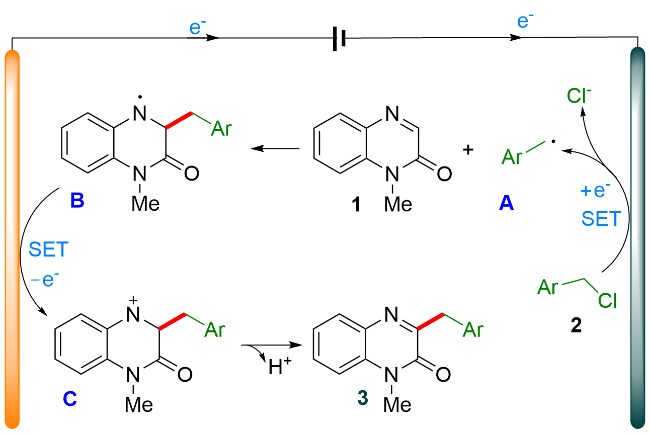
随后对反应的机理进行了探究(图式3). 在标准反应条件下, 加入2 equiv.的自由基抑制剂(四甲基哌啶氧化物(TEMPO)、2,6-二叔丁基对甲酚(BHT)或二苯基乙烯)后, 反应被抑制(图式3). 通过气相色谱-质谱(GC-MS)对反应混合物进行分析, 检测到了苄基- TEMPO加成物4aa的生成, 这表明苄基自由基是该反应的关键活性中间体. 随后, 对循环伏安实验进行了探讨. 喹喔啉-2(1H)-酮1a在-1.65 V (vs. Ag/AgCl)时显示还原峰(图1, 红色曲线). 氯化苄2a在-0.83 V (vs. Ag/AgCl)处呈现可逆还原峰(图1, 蓝色曲线), 说明氯化苄优先在阴极被还原.


3 结论
本工作报道了一种以廉价易得的苄氯作为苄基化试剂, 无外加电解质条件下电化学促进喹喔啉-2(1H)-酮和苄氯的脱氯交叉偶联反应, 以69%~88%的收率合成了27种3-苄基喹喔啉-2(1H)-酮化合物. 该方法具有反应条件温和绿色、位点选择性高、操作简单等优点, 为3-苄基喹喔啉-2(1H)-酮及其衍生物的制备提供了一种高效绿色的新方法.
Cheng, B.