


1 引言
磷光有机电致发光器件(PhOLEDs)可以同时捕获所有的激子来实现理论100%的内量子效率(IQE), 从而获得比荧光型器件更高的器件效率[1-3]. 但是这类器件在高电流区域会出现严重的外部量子效率(EQE)衰减现象, 这主要是由于聚集诱导淬灭(ACQ)和三重态-三重态湮灭(TTA)所引起的[4-5]. 因此需要将过渡金属磷光客体掺杂到适当的主体材料中, 以此缓解浓度猝灭现象来实现高效的器件性能, 这就意味着主体材料在电致发光(EL)性能以及PhOLEDs的生产成本方面起着至关重要的作用. 文献表明, 由空穴传输单元和电子传输单元共同构成的双偶极主体材料, 相比于传统的单极性主体材料, 这一类主体材料同时具有较好的空穴和电子传输能力, 能够更有效地提高器件的总体性能[6-8]. 近年来, 随着人们对热激活延迟荧光(TADF)分子的研究, 一些具有TADF特性的双偶极主体材料应用于磷光器件相继被报道, 并获得较高的效率, 但在亮度超过1000 cd•m−2的情况下, 这类器件往往会出现快的效率滚降速率, 从而阻碍了其在商业化中的应用[9-11]. 因此, 不断开发稳定且高效的双偶极主体材料对于实现PhOLEDs的高效率和低效率滚降至关重要.
咔唑因其高三重态能量和独特的空穴传输特性, 被广泛用作构建双偶极主体材料的空穴传输单元(p-型基团)[12-13], 而双偶极主体材料中的电子传输单元(p-型基团)有多种基团可以选择. 其中, 吡啶作为强吸电子基团, 具有高的电子迁移率及三线态能级, 已经多次作为双偶极主体材料中的电子传输单元来获得高性能的磷光器件[3,14-16]. 苏仕建等[14]选用具有电子传输能力的吡啶为核心, 在其2,6位和3,5位碳上引入苯基咔唑, 合成了两种双偶极主体材料26DCzPPy和35DCzPPy并应用于蓝色磷光器件, 获得了24%的外量子效率和46 lm• W−1的功率效率, 这是当时掺杂FIrpic的蓝光器件中的最高数据. 鉴于26DCzPPy和35DCzPPy出色的器件性能, 目前这两种化合物已成为OLED器件制备中常用的双偶极主体材料. Wang等[15]利用吡啶在经典的空穴型主体材料CBP的基础上设计合成了两种新的双偶极主体材料CPPY, 其结构就是将吡啶替换联苯中的一个苯环, 这种设计大大改善了CBP的电子传输能力. 将CPPY分别用作电子传输层和空穴传输层材料以及主体材料制备的绿色磷光器件效率明显高于CBP, 达到了21.5%. 唐本忠课题组[16]选用咔唑或9,9-二甲基-9,10-二氢吖啶作为电子供体, 吡啶作为电子受体, 设计了四种双偶极主体材料. 掺杂蓝、绿、红色三种磷光客体获得了高的器件效率和低效率滚降, 外量子效率分别为25.12%、24.73%和19.71%. 最近, 李久艳课题组[3]报道了三种双偶极主体材料H1、H2和H3, 其结构是将二苯并呋喃并入吡啶或嘧啶一起作为n-型基团, 吲哚咔唑为p-型基团. 其中, 以H3为主体材料, 掺杂Ir(ppy)3制备的绿色顶发光器件获得了极高的外量子效率41.1%.
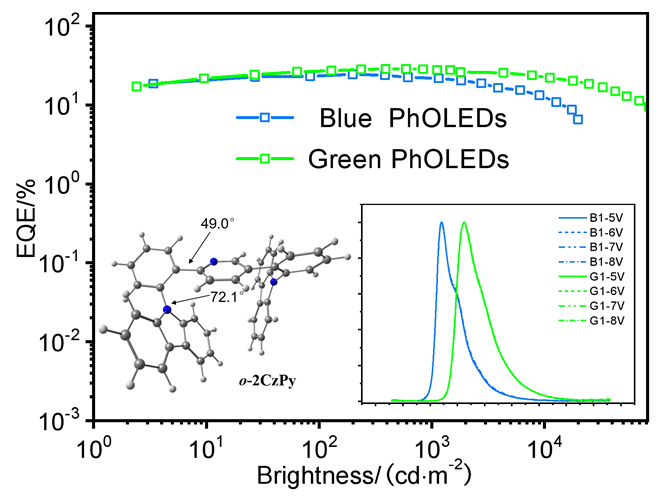
基于此, 本工作以咔唑为p-型基团, 亚苯基作为连接单元, 将吡啶引入分子结构中作为n-型基团, 通过邻位和间位的连接形式设计合成了两种吡啶类双偶极主体材料o-2CzPy和m-2CzPy. 通过改变这些材料结构中功能基团之间的连接方式, 适当的扭曲分子构型使分子获得较高的三重态能级和良好的电荷传输能力, 基于这些双偶极主体材料制备的磷光器件实现了高效率和低效率滚降. 其中, 基于o-2CzPy的蓝光器件最大外量子效率和电流效率分别达到了24.44%和45.16 cd•A−1, 接近于目前掺杂FIrpic的蓝色磷光器件中的最佳数据. 此外, 基于o-2CzPy的绿色磷光器件也获得了较优的器件效率, 最大外量子效率和电流效率分别为28.58%和96.91 cd•A−1. 即使在实际亮度为1000和6000 cd•m−2的情况下, 器件的外量子效率相对于最大值仅仅下降了1.9%和13.6%, 仍然保持在28.03%和24.70%. 与常用的双偶极主体材料26DCzPPy和35DCzPPy相比, o-2CzPy和m-2CzPy通过改变吡啶的连接位置(2,5位)和调整n-型基团/p-型基团的连接方式(邻位和间位), 也表现出了非常好的器件性能, 这为可应用于OLED器件的双偶极主体材料提供了更多选择.
2 结果与讨论
2.1 材料的合成与表征
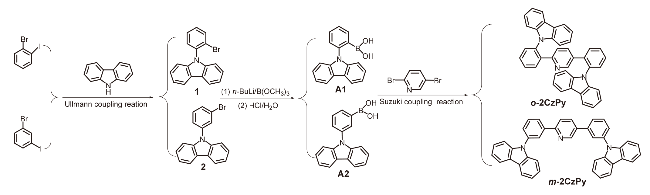
两种吡啶类双偶极主体材料的分子结构和具体合成方法如图1所示. 首先以直接购买的咔唑为起始原料, 分别与邻碘溴苯和间碘溴苯依次通过C—N Ullmann偶联反应和丁基锂反应得到相应的硼酸中间体2-(9-咔唑基)-1-苯硼酸(A1)和3-(9-咔唑基)-1-苯硼酸(A2)[3,17], 最后中间体A1和A2分别与2,5-二溴吡啶经过Suzuki偶联反应得到最终的主体材料o-2CzPy和m-2CzPy. 采用多次柱层析和重结晶对最终产物进行了提纯, 材料的纯度均达到可用于制备OLEDs器件的标准; 采用红外光谱、高分辨质谱、核磁(1H NMR和13C NMR)和元素分析等手段对其结构进行了表征和分析.
2.2 材料的热力学性质
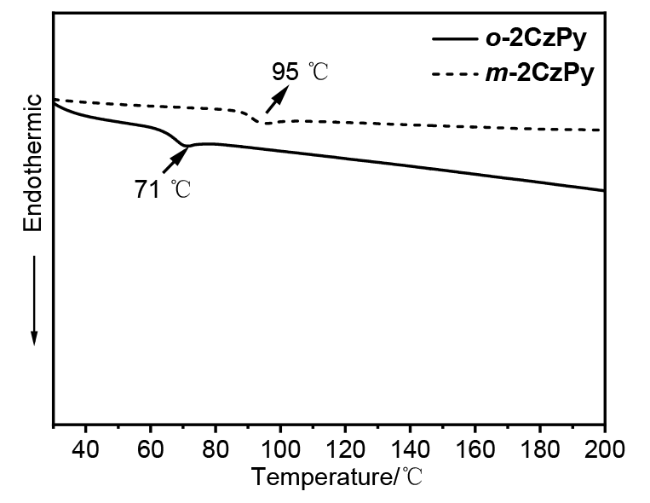
在氮气保护下, 通过热重分析法(TGA)测试得到化合物o-2CzPy和m-2CzPy的分解温度都大于350 ℃(支持信息图S9), 分别为365和417 ℃(以失重5%所对应的温度来计算), 较高的热分解温度表明这两种化合物均具有优异的热稳定性, 可以确保在蒸镀过程中不会分解. 图2是材料在氮气保护下, 第一次加热结束后快速冷却进行第二次加热的差热分析法(DSC)曲线, 从图中可以得到o-2CzPy和m-2CzPy的玻璃化转变温度分别为71和95 ℃, 均高于传统的主体材料mCP的玻璃化转变温度(60 ℃), 表明这两种主体材料在蒸镀过程中可以形成稳定的无定型态薄膜, 从而有利于提高器件的稳定性.
2.3 材料的光物理性质
图3(a)是以二氯甲烷为测试溶剂, 通过紫外吸收和荧光发射分析法得到了o-2CzPy和m-2CzPy在室温下的两种谱图. 由于这两种主体材料具有相同的官能团和相似的分子骨架, 所以它们具有类似的紫外吸收光谱曲线, 谱图中的293 nm处的吸收峰是由咔唑单元本身的π-π*电子跃迁引起的, 而324~340 nm处的吸收峰则是由整个共轭分子的n-π*电子跃迁引起的. 此外, 通过固体薄膜状态下的紫外吸收光谱(支持信息图S11), 根据带边吸收法计算出o-2CzPy和m-2CzPy的光学能隙值(Eg)分别为3.49 eV和3.47 eV[18]. 在最强吸收波长的激发下, 得到o-2CzPy和m-2CzPy在溶液中的荧光发射光谱, 发射蜂分别位于417 nm和431 nm. 通过对比图3(a)和图S11, 可以明显看出o-2CzPy和m-2CzPy在固体薄膜状态下的紫外吸收光谱和荧光发射光谱与溶液中相比, 谱图形状几乎完全相同, 而荧光发射峰发生蓝移, 这意味着邻位或间位的连接方式可以减弱分子间的相互作用.
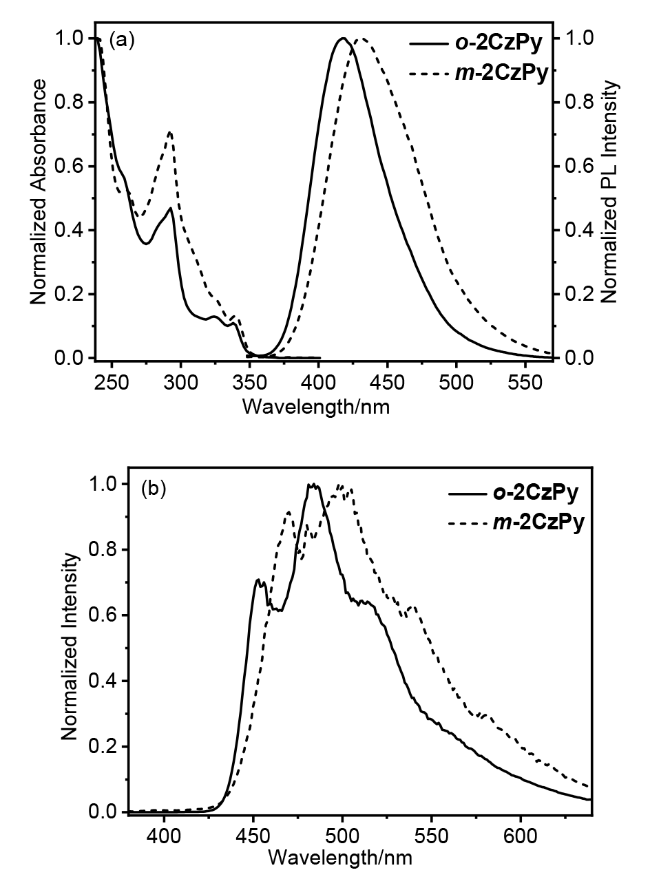
对于主体材料来说, 其三线态能级要高于客体分子, 因为高的三线态能级可以将能量充分传递给客体分子, 从而有利于客体发光分子捕获三线态激子, 避免能量由客体回传到主体. 为了计算这两种主体材料的三线态能级, 以2-甲基四氢呋喃为溶剂, 测定了它们在77 K下的低温磷光光谱. 如图3(b)所示, 通过磷光光谱起始峰值, 计算出了o-2CzPy和m-2CzPy的三线态能级分别为2.74 eV和2.64 eV. 对比常用的蓝色(FIrpic为2.65 eV)和绿色磷光客体材料(Ir(ppy)3为2.40 eV)的三线态能 级[19-20], 说明o-2CzPy可用于蓝色和绿色磷光器件的主体材料, 而m-2CzPy可用于绿色磷光器件的主体材料. 所有的光物理数据整理在表1中.
表1 o-2CzPy和m-2CzPy的物理性质数据Table 1 Summary of physical parameters for o-2CzPy and m-2CzPy |
| Compd. | $ \lambda_{\max }^{\mathrm{abs}}$/nm | $ \lambda_{\text {max }}^{\mathrm{em}}$/nm | Ega/eV | ETb/eV | HOMO/eV | Tg/℃ | Td/℃ |
|---|---|---|---|---|---|---|---|
| CH2Cl2 | |||||||
| o-2CzPy | 293, 324, 338 | 417 | 3.48 | 2.74 | -5.59 | 71 | 365 |
| m-2CzPy | 293, 326, 340 | 431 | 3.47 | 2.64 | -5.61 | 95 | 417 |
a The energy band gap, calculated by the absorption edge technique; b Measured in 2-MeTHF matrix at 77 K. |
2.4 材料的电化学性质和理论计算
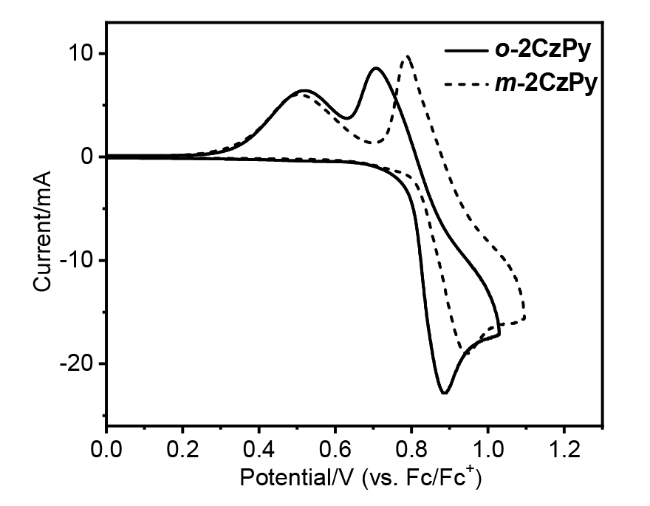
为了设计出最优的器件结构, 需要测出o-2CzPy和m-2CzPy的循环伏安(CV)曲线来计算出分子的最高占有分子轨道(HOMO)和最低未占有分子轨道(LUMO)能级. 图4是通过电化学循环伏安法测得的o-2CzPy和m-2CzPy在二氯甲烷溶液中的CV曲线, 在正向偏压扫描区域, o-2CzPy和m-2CzPy都经历了一个可逆的氧化过程, 这是由于它们结构中的p型基团咔唑部分被氧化引起的. 氧化峰的起始电位相对于二茂铁分别位于0.78 eV和0.81 eV. 根据$ \mathrm{HOMO}(\mathrm{eV})=-\left(E_{\mathrm{onset}}^{\mathrm{ox}}+4.8 \mathrm{eV}\right)$可以计算出o-2CzPy和m-2CzPy的HOMO能级分别为 -5.58 eV和-5.61 eV, 非常接近常用的空穴传输材料TAPC的HOMO能级(-5.50 eV)[6]. 显然, 当采用o-2CzPy或m-2CzPy做为主体材料匹配TAPC来制备器件时, 空穴可以有效地向发光层注入, 从而降低器件的启亮电压. 结合两种主体材料的HOMO能级、Eg值和公式ELUMO=EHOMO+Eg[21], 计算得出o-2CzPy和m-2CzPy的LUMO能级值分别为-2.10 eV和-2.14 eV.
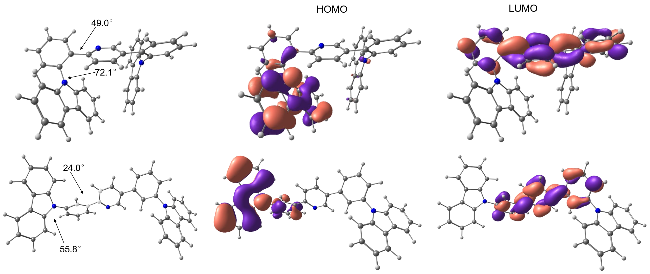
为了验证主体材料o-2CzPy和m-2CzPy具有双偶极特性, 需要通过Gaussian 09软件来优化它们的分子构型, 从而得到了o-2CzPy和m-2CzPy的最优分子构型以及HOMO/LUMO轨道电子云分布[22]. 如图5所示, 这两种主体材料的HOMO轨道电子云主要集中在咔唑基团, 部分分布在相邻的苯环上, 而它们的LUMO轨道电子云主要位于吡啶和相邻的两个苯环上, 表明o-2CzPy和m-2CzPy具有非常明显的双偶极特性, 拥有较好的空穴和电子传输能力. 此外, 相对于间位连接的m-2CzPy, 邻位连接的o-2CzPy具有更扭曲的立体构型, 苯环与相邻的咔唑和吡啶环之间的二面角分别达到72.1°和49.0°. 较大的二面角降低了分子中各个基团之间的共轭, 使o-2CzPy的三重态能级达到了2.74 eV.
2.5 材料的电致发光性质
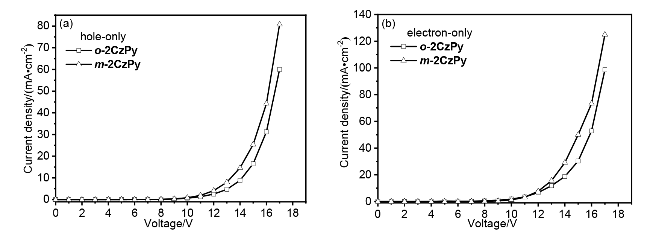
为了进一步验证主体材料o-2CzPy和m-2CzPy具有双偶极特性, 分别制备了结构为ITO/PEDOT:PSS (40 nm)/TAPC (5 nm)/o-2CzPy或m-2CzPy (80 nm)/TAPC (7 nm)/Al (200 nm)的单空穴器件和ITO/TmPyPB (7 nm)/o-2CzPy或m-2CzPy (80 nm)/TmPyPB (5 nm)/LiF (1 nm)/Al (200 nm)的单电子器件, 器件使用的材料分子结构及能级图见图S12(支持信息). 在这些单载流子器件中, 主体材料的厚度远远大于相邻层材料, 这样可以更好地衡量主体材料本身固有的电荷传输能力. 此外, 由于TAPC/Al和ITO/TmPyPB层的能级差分别高达2.3 eV和1.88 eV, 也能阻止电子和空穴的注入, 从而保证器件中只有空穴或者电子传输. 图6中的电流密度-电压曲线显示, 所有的单载流子器件都表现出一定的电流密度, 再次证明了这些主体材料具有双极性电荷传输的能力, 这与理论计算的结果非常吻合. 相比于m-2CzPy, 基于o-2CzPy的单载流子器件表现出更均衡的空穴电流和电子电流. 此外, 还可以通过制备单电荷器件并利用空间电荷限制电流技术(SCLC, space charge limited current)[23]来计算o-2CzPy和m-2CzPy的空穴迁移率和电子迁移率. 器件的具体结构和J-V曲线如图S13和S14(支持信息)所示, 计算得到o-2CzPy和m-2CzPy的空穴迁移率分别为6.13×10⁻³和3.97×10⁻³ cm2•V−1•s−1; 电子迁移率分别为1.12×10⁻³和4.26×10⁻⁴ cm2•V−1•s−1. 显然, 基于o-2CzPy的单电荷器件拥有更均衡的电荷迁移率, 从而有利于促进主体材料的正负载流子传输平衡, 提高器件的效率.
基于主体材料o-2CzPy较高的三线态能级和良好的双偶极电荷传输特性, 首先制备了以o-2CzPy为主体材料, FIrpic为客体材料的蓝色磷光器件B1来研究它的电致发光性质, 优化后的器件结构为ITO/PEDOT:PSS (40 nm)/TAPC (20 nm)/TCTA (5 nm)/o-2CzPy:6% (w) Firpic (20 nm)/TmPyPb (40 nm)/LiF (1 nm)/Al (200 nm), 器件结构中使用的材料分子结构及能级图见图S12. 如图S15(支持信息)所示, 器件B1的电致发光光谱仅来自FIrpic的发射光谱, 随着电压的升高, 发光峰位置没有发生任何变化, 说明器件具有很稳定的蓝光发射. 此外, 在电致发光光谱中没有出现光学微腔效应, 这也表明主体材料o-2CzPy的双偶极特性使得器件B1具有较好的载流子传输平衡. 从图7的J-V-B和效率曲线可以看出, 器件B1的启亮电压仅为2.9 V, 表明o-2CzPy的HOMO能级与相邻的空穴传输材料TAPC相匹配, 空穴可以有效地向发光层注入. 器件B1获得了较优异的性能数据, 器件的最大亮度(L)、最大电流效率(ηL)、最大功率效率(ηP)和最大外量子效率(ηext)分别达到19880 cd•m−2、45.16 cd•A−1、37.60 lm•W−1和24.44%. 近年来, 单主体材料掺杂FIrpic的磷光器件已经获得很高的效率, 如Poriel[24]、Lee[25]和Li[26]分别报道了50.0 cd•A−1 (24.1%)、53.1 lm•W−1 (31.4%)和55.6 cd•A−1 (25.3%)的器件效率数据. 显然, 基于o-2CzPy的器件B1的效率接近于文献报道的最佳数据. 此外, 器件B1的效率滚降也较为缓慢, 在6000 cd•m−2的高亮度下, 器件效率仍然保持在较高的水平, 具有28.62 cd•A−1的电流效率和15.49%的外量子效率, 这种低效率滚降对主体材料o-2CzPy在高电流下的实际应用是有利的. 关键的器件数据已列于表2中.
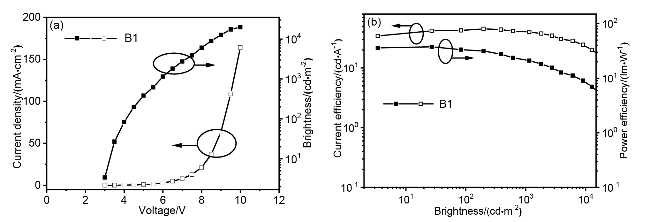
图7 基于o-2CzPy器件B1的(a)电流密度-电压-亮度和(b)效率曲线Figure 7 (a) The J-V-B characteristics and (b) efficiency curves for o-2CzPy hosted blue device B1 |
表2 基于o-2CzPy和m-2CzPy的电致发光器件数据总结Table 2 Electroluminescent performance for o-2CzPy and m-2CzPy based blue and green devices |
| Device | Host | Dopant | Vona/V | Lmax/(cd•m−2) | ηcb/(cd•A−1) | ηp,max/(lm•W−1) | ηextb/% | FWHM/nm | CIE (x, y) at 6 V | ΦPLQYc/% | τc/μs |
|---|---|---|---|---|---|---|---|---|---|---|---|
| B1 | o-2CzPy | FIrpic | 2.9 | 19880 | 45.16, 40.54, 28.62 | 37.60 | 24.44, 21.94, 15.49 | 46 | (0.14, 0.28) | 92.0 | 2.21 |
| G1 | o-2CzPy | Ir(ppy)3 | 2.9 | 108810 | 96.91, 95.05, 83.74 | 88.22 | 28.58, 28.03, 24.70 | 56 | (0.28, 0.63) | 95.4 | 0.92 |
| G2 | m-2CzPy | Ir(ppy)3 | 3.1 | 59386 | 83.84, 78.99, 62.77 | 73.56 | 24.48, 23.06, 18.33 | 60 | (0.29, 0.63) | 80.8 | 1.14 |
a The turn-on voltage, recorded at 1 cd•m−2; b Order of measured values: maximum, then at 1000 and 6000 cd•m−2; c Photoluminescence quantum yield (ΦPLQY) and lifetime (τ) measured in doped films. |
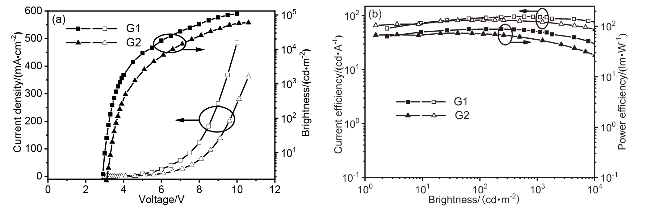
采用与上述蓝光器件相同的器件结构, 进一步研究了主体材料o-2CzPy和m-2CzPy在绿色磷光器件中的表现, 优化后的磷光客体材料Ir(ppy)3浓度为8% (w). 如图8和表2所示, 基于o-2CzPy和m-2CzPy的绿光器件G1和G2仍然具有较低的启亮电压, 分别为2.9 V和3.1 V. 其中, 基于o-2CzPy的器件G1获得最佳的器件性能数据, 最大电流效率、功率效率和外量子效率分别为96.91 cd•A−1、88.22 lm•W−1和28.58%, 而基于m-2CzPy的器件G2也具有较好的效率, 分别为83.84 cd•A−1、73.56 lm•W−1和24.48%. 近些年, Kim[27]、Chang[28]和Li[6]分别报道了30.9% (131.98 cd•A−1)、98.8 cd•A−1 (28.0%)和41.1%(顶发光器件结构)的器件效率数据, 代表了目前单主体掺杂Ir(ppy)3的磷光器件中的最好数据. 对比这些数据, 基于o-2CzPy的器件G1获得的数据是目前文献报道中的较高效率之一. 更重要的是, 基于o-2CzPy的器件G1的效率滚降幅度明显小于器件G2, 这与上述蓝色磷光器件B1的效率滚降情况相似. 在实际亮度为1000和6000 cd•m−2时, 器件G1的外量子效率和电流效率仍保持在28.03% (95.05 cd•A−1)和24.70% (83.74 cd•A−1). 与最大电流效率96.91 cd•A−1相比, 分别略下降1.9%和13.6%. 在蓝色和绿色磷光器件中, 基于o-2CzPy器件B1和G1均表现出好的光谱稳定性、高的器件效率和低的效率滚降, 这主要归功于o-2CzPy足够高的三重态能量以及优异的电荷平衡能力.


对于磷光器件而言, 电致发光光谱的半峰宽(FWHM)、发光层的量子产率和激发态寿命是影响器件色纯度、外量子效率和效率滚降的关键因素. 为了进一步分析o-2CzPy和m-2CzPy在磷光器件中良好的性能表现, 首先从图S15可以看出, 器件B1、G1和G2电致发光光谱都表现出较窄的半峰宽(FWHM), 计算得到FWHM分别为46、56和60 nm. 在电流密度为1 mA•cm−2时, 这三种器件的CIE坐标分别为(0.1409, 0.2795)、(0.2811, 0.6343)和(0.2906, 0.6322). 当电流密度逐步增加至50 mA•cm−2时, 器件G1的CIEy变化(ΔCIEy)不超过0.0001, 器件B1和G2不超过0.0006, 表明其发光光谱相当稳定, 色纯度高. 接着, 分别以FIrpic和Ir(ppy)3为客体材料通过真空蒸镀制备了掺杂薄膜, 客体材料的掺杂浓度与磷光器件中保持一致, 在无氧的条件下测试了它们的光致发光量子产率(ΦPLQY)和磷光寿命. 相比于m-2CzPy:Ir(ppy)3, 掺杂薄膜o-2CzPy:Firpic和o-2CzPy:Ir(ppy)3具有更高的绝对量子产率, 分别为92.0%和95.4%. 如此高的量子产率说明主客体材料间实现了充分的能量传递, 使得发光层的三线态激子能够有效地被客体发光分子所捕获, 从而获得高的器件外量子效率. 这三种掺杂薄膜的磷光寿命分别为2.21、0.92和1.14 μs, 较短的磷光寿命可以有效地减缓发光器件在高电流密度下的效率滚降. 这些实验结果验证了o-2CzPy在磷光器件中的良好表现.
3 结论
通过偶联反应, 成功设计并合成了两种含咔唑和吡啶的双偶极主体材料o-2CzPy和m-2CzPy. 通过改变这些材料结构中功能基团之间的连接方式, 使分子获得了较高的三重态能量和良好双偶极传输特性. 以o-2CzPy和m-2CzPy为主体材料制备的磷光器件表现出优异的性能. 相比于m-2CzPy, o-2CzPy具有更高的三重态能量和更优异的电荷平衡能力. 以o-2CzPy为主体制备的蓝色和绿色磷光器件获得了稳定的发光颜色、高的外量子效率和电流效率, 分别为24.44% (45.16 cd•A−1)和28.58% (96.91 cd•A−1). 即使在实际亮度为1000和6000 cd•m−2的条件下, 基于o-2CzPy的绿光器件仍然保持28.03%和24.70%的外量子效率, 与最大值相比效率仅仅下降了1.9%和13.6%, 这些研究结果表明这些双偶极主体材料在高效率且稳定的OLEDs显示领域具有一定的应用潜力.
4 实验部分
o-2CzPy的合成: 在50 mL的两口瓶中加入237 mg 2,5-二溴吡啶(1.0 mmol)、689 mg中间体A1 (2.4 mmol)、80 mg催化剂Pd(PPh3)4 (0.070 mmol)、15 mL甲苯和3 mL乙醇(甲苯和乙醇的体积比为5∶1), 抽真空通氮气. 当反应温度加到55 ℃时, 用注射器加入2.5 mL浓度为2 mol•L−1的K2CO3水溶液(5.0 mmol), 继续搅拌加热到80 ℃反应10 h. 将反应液冷却至室温, 加水和二氯甲烷萃取三次, 减压除去溶剂后通过柱层析和重结晶分离得到476 mg白色固体, 产率85%. 1H NMR (400 MHz, CDCl3) δ: 8.30 (s, 1H), 8.00 (dd, J=8.5, 2.9 Hz, 4H), 7.84~7.76 (m, 1H), 7.55~7.45 (m, 4H), 7.39 (dd, J=8.8, 3.8 Hz, 3H), 7.21~7.09 (m, 8H), 6.98~6.91 (m, 2H), 6.88 (d, J=8.6 Hz, 2H), 6.68 (dd, J=8.3, 2.3 Hz, 1H), 6.20 (d, J=7.7 Hz, 1H). 13C NMR (101 MHz, CDCl3) δ: 140.94, 137.15, 135.08, 134.74, 131.81, 129.93, 129.58, 128.92, 125.88, 123.21, 121.81, 120.18, 119.79, 109.90. IR (KBr) ν: 3053, 2929, 1594, 1502, 1470, 1452, 1315, 1232, 747, 722 cm−1. TOF-EI-MS (m/z): calcd for C41H27N3 561.2205, found 561.2220 [M]+. Anal. calcd for C41H27N3: C 87.67, H 4.85, N 7.48; found C 87.15, H 4.49, N 7.50.
m-2CzPy的合成参照o-2CzPy的合成方法. m-2CzPy为白色固体, 产率84%. 1H NMR (400 MHz, CDCl3) δ: 9.00 (s, 1H), 8.27 (d, J=1.7 Hz, 1H), 8.16 (d, J=7.7 Hz, 5H), 7.99 (dd, J=8.3, 2.4 Hz, 1H), 7.83 (d, J=7.8 Hz, 2H), 7.76~7.67 (m, 3H), 7.66~7.59 (m, 2H), 7.43~7.39 (m, 8H), 7.34~7.25 (m, 4H). 13C NMR (101 MHz, CDCl3) δ: 155.58, 148.25, 140.90, 140.79, 139.40, 138.66, 135.25, 134.42, 130.72, 127.73, 126.08, 125.85, 123.50, 120.51, 119.99, 109.68. IR (KBr) ν: 3106, 2925, 1476, 1450, 1334, 1313, 1230, 749, 724, 699 cm−1. TOF-EI-MS (m/z): calcd for C41H27N3 561.2205, found 561.2227 [M]+. Anal. calcd for C41H27N3: C 87.67, H 4.85, N 7.48; found C 87.34, H 4.59, N 7.49.
(Cheng, B.)