Article

Ultrafast Resonance Raman Characteristics of Sodium Polysulfides in Sodium-Sulfur Battery: An ab initio Assessment

  • Baoguo Zhao ,
  • Zhan Li ,
  • Huifang Ma ,
  • Hao Ren
Expand
  • aShandong Key Laboratory of Intelligent Energy Materials, School of Materials Science and Engineering, China University of Petroleum (East China), Qingdao 266580, Shandong, China
    bQingdao Key Laboratory of Terahertz Technology, College of Electronic and Information Engineering, Shandong University of Science and Technology, Qingdao 266590, Shandong, China

Received date: 2025-09-15

  Online published: 2025-11-24

Supported by

National Science Foundation of China (22473114, 62305196, U23B2087), and Shandong Provincial Natural Science Foundation of China (ZR2023MB034).

Abstract

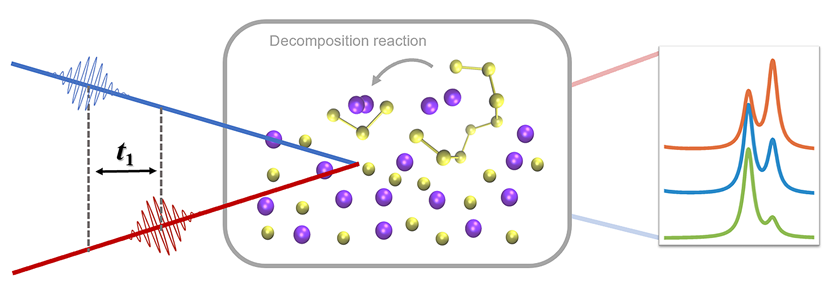
Sodium-sulfur batteries (NaSBs) are promising alternative to lithium-sulfur batteries due to their high theoretical energy density, low cost, and abundant raw materials. However, their practical development is significantly hindered by the polysulfide shuttle effect. This effect arises from soluble sodium polysulfide (NaPS) intermediates formed during cycling, which migrate between electrodes, causing irreversible sulfur loss and rapid capacity fade. Understanding the specific chemical species of these NaPS intermediates and their rapid reaction dynamics is essential for mitigating the shuttle effect and improving battery stability. Unfortunately, conventional analytical techniques lack the temporal resolution to capture the fast structural changes and reaction kinetics involved. To address this challenge, we propose utilizing ultrafast resonance Raman spectroscopy. Spontaneous resonance Raman (spRR) significantly enhances detection sensitivity for target molecules by matching the excitation light frequency to specific electronic transitions. By employing ultrafast broadband laser pulses, this approach can be extended to stimulated resonance Raman (stRR), achieving the necessary femtosecond time resolution to track NaPS evolution with high selectivity and spatial-temporal precision. Through high-accuracy ab initio quantum chemical calculations, we calculate and analyze the resonance Raman spectral signatures of key NaPS intermediates. Our results reveal distinct spectral fingerprints and their selective enhancement under specific excitation energies. These insights provide a deeper understanding of NaPS conversion dynamics and establish a foundation for real-time, in-situ monitoring of polysulfide species during battery operation. This work advances the fundamental knowledge required to develop efficient and stable NaSBs for future energy storage.

Cite this article

Baoguo Zhao , Zhan Li , Huifang Ma , Hao Ren . Ultrafast Resonance Raman Characteristics of Sodium Polysulfides in Sodium-Sulfur Battery: An ab initio Assessment[J]. Acta Chimica Sinica, 0 : 0 . DOI: 10.6023/A25090312

References

[1] J.-M. Tarascon, M. Armand, nature 2001, 414, 359.
[2] J. Huang, Y. Zhu, Y. Feng, Y. Han, Z. Gu, R. Liu, D. Yang, K. Chen, X. Zhang, W. Sun,Wuli Huaxue XuebaoActa Phys.-Chim. Sin. 2022, 38, 2208008.
[3] H. CHEN, H. LI, Y. XU, M. CHEN, L. WANG, X. DAI, D. XU, X. TANG, X. LI, Y. HU,Energy Storage Sci. Technol. 2023, 12, 1516.
[4] L. Ma, Y. Lv, J. Wu, Y. Chen, Z. Jin,Adv. Energy Mater. 2021, 11, 2100770.
[5] M. Armand, J.-M. Tarascon, nature 2008, 451, 652.
[6] J. B. Goodenough, K.-S. Park, J. Am. Chem. Soc. 2013, 135, 1167.
[7] S. Singsen, S. Suthirakun, P. Hirunsit, P. B. Balbuena, J. Phys. Chem. C 2022, 126, 16615.
[8] L. Wang, T. Wang, L. Peng, Y. Wang, M. Zhang, J. Zhou, M. Chen, J. Cao, H. Fei, X. Duan, Natl. Sci. Rev.2022, 9, nwab050.
[9] Y. Zhu, B. Liu, W. Liang, H. Xu,ACTA Chim. Sin. 2025, 83, 861.
[10] Q. Li, C. Geng, L. Wang, Q.-H. Yang, W. Lv, Renewables 2023, 1, 374.
[11] L. P. Wang, L. Yu, X. Wang, M. Srinivasan, Z. J. Xu, J. Mater. Chem. A 2015, 3, 9353.
[12] S. Ohno, W. Zeier, Nat. Energy 2022, 7, 686.
[13] X. Yu, A. Manthiram, ChemElectroChem 2014, 1, 1275.
[14] H. Ren, Z. Wang, S. Guo, W. Guo, G. Tian, B. Tian, J. Chem. Phys. 2021, 155.
[15] J. Chen, D. H. Chua, P. S. Lee, Small Methods 2020, 4, 1900648.
[16] J. Z. Hu, N. R. Jaegers, M. Y. Hu, K. T. Mueller, J. Phys. Condens. Matter 2018, 30, 463001.
[17] Q. Gu, J. A. Kimpton, H. E. Brand, Z. Wang, S. Chou,Adv. Energy Mater. 2017, 7, 1602831.
[18] X. Liu, D. Wang, G. Liu, V. Srinivasan, Z. Liu, Z. Hussain, W. Yang,Nat. Commun. 2013, 4, 2568.
[19] J. Xie, J. Li, W. Mai, G. Hong, Nano Energy 2021, 83, 105780.
[20] H. Ren, J. D. Biggs, S. Mukamel, J. Raman Spectrosc. 2013, 44, 544.
[21] H. Ren, Z. Lai, J. D. Biggs, J. Wang, S. Mukamel,Phys. Chem. Chem. Phys. 2013, 15, 19457.
[22] S. Duan, G. Tian, Y. Luo,Chem. Soc. Rev. 2024, 53, 5083.
[23] Z. Ma, B. Yao, D. Chu, Z. Xie, S. Duan, G. Tian, Phys. Rev. B 2025, 112, 125417.
[24] S. Deng, J. Yang, Y. Shao, Q. Ou, Z. Shuai, ChemPhotoChem 2024, 8, e202400117.
[25] H. Ren, J. Jiang, S. Mukamel, J. Phys. Chem. B 2011, 115, 13955.
[26] S. A. Oladepo, K. Xiong, Z. Hong, S. A. Asher, J. Handen, I. K. Lednev,Chem. Rev. 2012, 112, 2604.
[27] D. Buhrke, P. Hildebrandt,Chem. Rev. 2019, 120, 3577.
[28] L. Zhao, Y. Tao, Y. Zhang, Y. Lei, W. Lai, S. Chou, H. Liu, S. Dou, Y. Wang,Adv. Mater. 2024, 36, 2402337.
[29] E. L. Gray, J.-I. Lee, Z. Li, J. Moloney, Z. J. Yang, M. Chhowalla, ACS Nano 2025, 19, 8939.
[30] W. Gao, Y. Lu, X. Xiong, Z. Luo, Y. Yu, Y. Lu, S. Ullah, T. Wang, Y. Ma, Y. Zhong,Chem. Eng. J. 2024, 498, 155230.
[31] B. Tian, Y. Fang, S. Lei, K. Xu, C. He, S. Li, H. Ren,Chin. Chem. Lett. 2023, 34, 108144.
[32] K.-K. Lee, K. Park, H. Lee, Y. Noh, D. Kossowska, K. Kwak, M. Cho, Nat. Commun. 2017, 8, 14658.
[33] T. Kaewmaraya, T. Hussain, R. Umer, Z. Hu, X. Zhao,Phys. Chem. Chem. Phys. 2020, 22, 27300.
[34] K. Momma, F. Izumi,Appl. Crystallogr. 2008, 41, 653.
[35] T. Hussain, T. Kaewmaraya, Z. Hu, X. S. Zhao,ACS Appl. Nano Mater. 2022, 5, 12637.
[36] T. D. Kühne, M. Iannuzzi, M. Del Ben, V. V. Rybkin, P. Seewald, F. Stein, T. Laino, R. Z. Khaliullin, O. Schütt, F. Schiffmann, J. Chem. Phys. 2020, 152.
[37] M. Frisch, G. Trucks, H. B. Schlegel, G. E. Scuseria, M. A. Robb, J. R. Cheeseman, G. Scalmani, V. Barone, B. Mennucci, G. Petersson, Inc Wallingford CT 2009, 121, 150.
[38] Y. Shao, Y. Mei, D. Sundholm, V. R. I.Kaila, J. Chem. Theory Comput. 2020, 16, 587.
[39] D. Rappoport, F. Furche, J. Chem. Phys. 2010, 133.
[40] D. Jacquemin, V. Wathelet, E. A. Perpete, C. Adamo, J. Chem.Theory Comput. 2009, 5, 2420.
[41] R. L. Martin, J. Chem. Phys. 2003, 118, 4775.
[42] X. Mu, Y. Guo, Y. Li, Z. Wang, Y. Li, S. Xu, J. Raman Spectrosc. 2017, 48, 1196.
[43] T. Lu, J. Chem. Phys. 2024, 161.
[44] T. Lu, F. Chen, J. Comput. Chem. 2012, 33, 580.
[45] W. Humphrey, A. Dalke, K. Schulten, J. Mol. Graph. 1996, 14, 33.
[46] H. Ma, J. Liu, W. Liang, J. Chem.Theory Comput. 2012, 8, 4474.
[47] S. Duan, G. Tian, Y. Luo, J. Chem.Theory Comput. 2016, 12, 4986.
[48] A. Manian, R. Shaw, I. Lyskov, W. Wong, S. Russo, J. Chem. Phys. 2021, 155.
[49] Z. Li, Z. Hu, Y. Jiang, Q. Yuan, H. Sun, X.-B. Wang, Z. Sun, J. Chem. Phys. 2019, 150.
[50] D. S. Hall, J. Self, J. Dahn, J. Phys. Chem. C 2015, 119, 22322.
[51] R. Payne, I. E. Theodorou, J. Phys. Chem. 1972, 76, 2892.
Outlines

/