Review

Research Progress on Delivery and Detection of Hydrogen Selenide in Vivo

  • Qiuhong Mo ,
  • Jun Zhang ,
  • Pin Shang ,
  • Yibo Zhou ,
  • Zhihe Qing
Expand
  • School of Chemistry and Pharmaceutical Engineering, Changsha University of Science & Technology, Changsha 410000
*E-mail: yibozhou@163.com; qingzhihe@hnu.edu.cn

Received date: 2025-11-11

  Online published: 2025-12-17

Supported by

Project supported by the National Natural Science Foundation of China (22222402, 22474012), Natural Science Foundation of Hunan Province (2024JJ3001, 2025JJ50061), Scientific and Technological Plan Project of Changsha of China (kq2506009).

Abstract

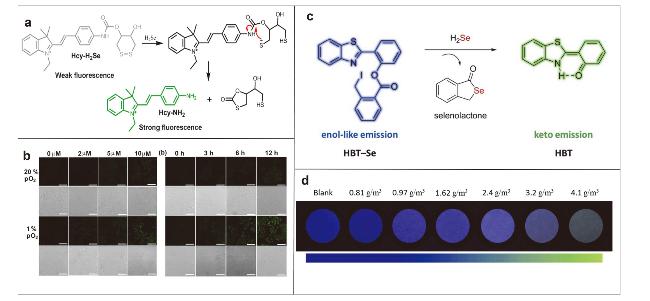
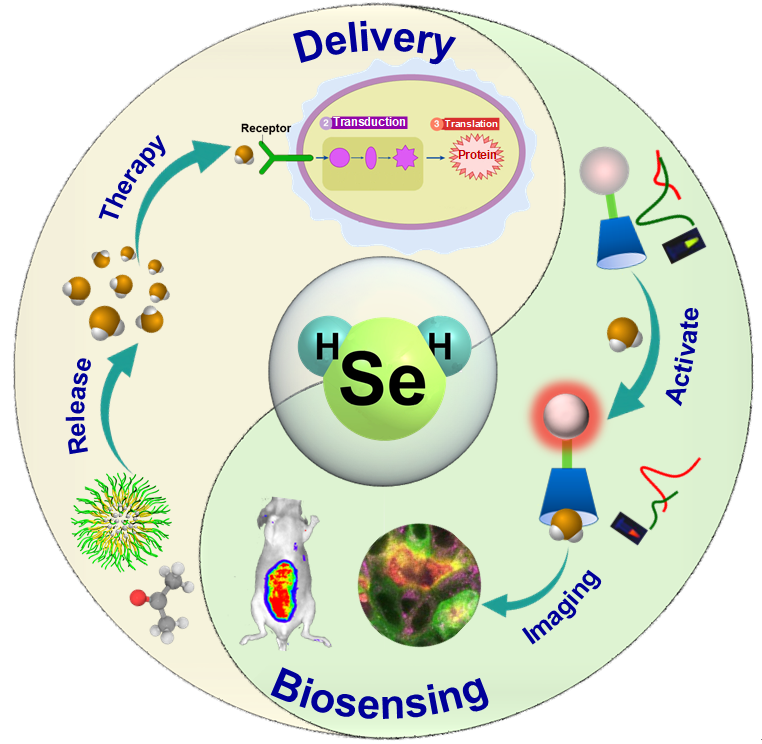
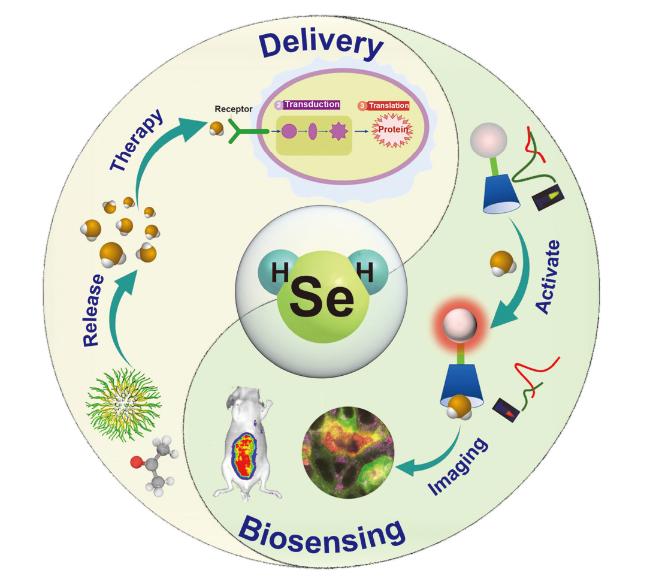
Hydrogen selenide (H₂Se), recognized as the fourth endogenous gaseous neurotransmitter after NO, CO, and H₂S, plays a significant role in signal transduction. It is involved in various essential physiological processes, including antioxidant defense, cellular signal transduction, and regulation of gene expression. Additionally, H₂Se is vital for maintaining cellular redox balance and protecting cells from oxidative stress damage. Studies have shown that selenium is an essential trace element for the human body, and H₂Se is a key active substance produced during selenium metabolism. Its biological functions were similar as other gaseous signaling molecules, such as hydrogen sulfide, but it also exhibits unique chemical properties. However, the direct detection of H₂Se is challenging because of the high toxicity, extremely low stability, and rapid decomposition in aqueous solutions. To address these challenges, researchers are focused on developing donor molecules that remain stable under physiological conditions and release H₂Se via stimulation. In recent years, several novel H₂Se donors based on hydrolysis or nucleophilic substitution reactions have been reported. These compounds can gradually release H₂Se under specific conditions, thereby safely regulating its biological effects. Meanwhile, to monitor the dynamic fluctuation of H₂Se in living cells, a variety of highly selective and sensitive fluorescent probes have been developed, which were activated through specific chemical reactions at the recognition site. Experimental results have shown that the exogenous H₂Se donors rapidly distribute into the cytoplasm after entering the cells and significantly enhance the activity of intracellular antioxidant enzymes, such as glutathione peroxidase. Also, the H₂Se not only effectively eliminates excessive reactive oxygen species (ROS) and alleviates the cell damage caused by oxidative stress, but also exerts anti-inflammatory effects. This review primarily summarizes topics such as the synthesis and release mechanisms of H₂Se donors, detection of H₂Se, aiming to explore the future development prospects in the field of H₂Se.

Cite this article

Qiuhong Mo , Jun Zhang , Pin Shang , Yibo Zhou , Zhihe Qing . Research Progress on Delivery and Detection of Hydrogen Selenide in Vivo[J]. Acta Chimica Sinica, 0 : 25110365 -25110365 . DOI: 10.6023/A25110365

References

[1] Vrionis H. A.; Wang S.; Haslam B.; Turner, R. J. Front. Mol. Neurosci.2015, 2, 69.
[2] Bothwell I. R.; Luo M. Org. Lett.2014, 16, 3056.
[3] Labunskyy V. M.; Hatfield D. L.; Gladyshev, V. N. Physiol. Rev.2014, 94, 739.
[4] Atkins J. F.; Gesteland R. F. Nature.2000, 407, 463.
[5] Carlisle A. E.; Lee N.; Matthew-onabanjo A. N.; Spears M. E.; Park S. J.; Youkana D.; Doshi M. B.; Peppers A.; Li R.; Joseph A. B.; Smith M.; Simin K.; Zhu L. J.; Greer P. L.; Shaw L. M.; Kim D. Nat. Metabolism.2020, 2, 603.
[6] Weekley C. M.; Harris, H. H. Chem. Soc. Rev.2013, 42, 8870.
[7] Huang G.; Liu Y.; Zhu X.; He L.; Chen T. Exploration.2025, 247, 121031.
[8] Hatfield, D. L; Tsuji, P. A; Carlson, B. A.; Gladyshev, V. N. Trends Biochem. Sci.2014, 39, 112.
[9] Alim I.; Caulfield J. T.; Chen Y.; Swarup V.; Geschwind D. H.; Ivanova E.; Seravalli J.; Ai Y.; Sansing L. H.; SteMarie E. J.; Hondal R. J.; Mukherjee S.; Cave J. W.; Sagdullaev B. T.; Karuppagoounder S. S.; Ratan R. R. Cell.2019, 177, 1262.
[10] Tian R.; Abarientos A.; Hong J.; Hashemi S. H.; Yan R.; Drager N.; Leng K.; Nalls M. A.; Singleton A. B.; Xu K.; Faghri F.; Kampmann M. Nat. Neurosci.2021, 24, 1020.
[11] Fujita H.; Tanakn Y. K.; Ogata S.; Suzuki N.; Kuno S.; Barayeu U.; Akaike T.; Ogra Y.; Iwai, K. Nat. Struct. Mol. Biol.2024, 31, 1277.
[12] Ito J.; Nakamura T.; Toyama T.; Chen D.; Berndt C.; Poschmann G.; Mourao A. S. D.; Doll S.; Suzuki M.; Zhang W.; Zheng J.; Trumbach D.; Yamada N.; Ono K.; Yazaki M.; Kawai Y.; Arsiawa M.; Ohsaki Y.; Shirakawa H.; Wahida A.; Proneth B.; Saito Y.; Nakagawa K.; Mishima E.; Conrad M. Mol. Cell.2024, 84, 4629.
[13] Ramakrishnan M.; Arivalagan J.; Satish L.; Mohan M.; Samuel Selvan Christyraj, J. R.; Chandran S. A.; Ju H. J.; John L. A.; Ramesh T.; Ignacimuthu S.; Kalishwaralal K. Chemosphere.2022, 306, 135531.
[14] Arthur J. R.; Mckenzie R. C.; Bckenzie, G. J. J. Nutr. Health Aging.2003, 133, 1457S.
[15] Hu J.; Huang S.; Zhu L.; Huang W.; Zhao Y.; Jin K.; Zhuge, Q. ACS Appl. Mater. Interfaces.2018, 10, 32988.
[16] Xu J.; Wang X.; Yin H.; Cao X.; Hu Q.; Lv W.; Xu Q.; Gu Z.; Xin H. ACS Nano.2019, 13, 8577.
[17] Zhang Y.; Zou Z.; Liu S.; Chen F.; Li M.; Zou H.; Liu H.; Ding, J. Asian J. Exp. Sci.2024, 19, 18263.
[18] Zhang Y.; Liu H.; Ding J. BME Front,2024, 5, 0055.
[19] Lee X. R.; Xiang, G. L. Clin. Neurol. Neurosurg.2018, 173, 157.
[20] Cao Z.; Liu J.; Yang X. Exploration.2024, 4, 0037.
[21] Zhuo Z.; Wang H.; Zhang S.; Bartlett P. F.; Walker T. L.; Hou, S. T. J. Cereb. Blood Flow Metab.2023, 43, 1060.
[22] Wahlgren N.; Ahmed N.; Davalos A.; Hacke W.; Millan M.; Muir K.; Roine R. O.; Toni D.; Lees, K. R. The Lancet.2008, 372, 1303.
[23] Blanco S.; Martinezlara E.; Siles E.; Peinado M. Á. Pharmaceutics.2022, 14, 1737.
[24] Hsu, S Y.; Chen, C H.; Mukda S.; Leu S. Antioxidants,2022, 11, 466.
[25] Bomer N.; Grote Beverborg N.; Hoes M. F.; Streng K. W.; Vermeer M.; Dokter M. M.; Ijmker J.; Anker S. D.; Cleland J. G. F.; Hillege H. L.; Lang C. C.; Ng L. L.; Samani N. J.; Tromp J.; Van Veldhuisen D. J.; Touw D. J.; Voors A. A.; Van Der Meer, P. Eur. J. Heart Fail.2019, 22, 1415.
[26] Ai Mubarak A. A.; Van Der Meer P.; Bomer, N. Curr. Heart Fail. Rep.2021, 18, 122.
[27] Jun E.; Ye J.; Huang I.; Kim Y.; Lee H. Acta Virol.2011, 55, 23.
[28] Yang J.; Wang L.; Huang L.; Che X.; Zhang Z.; Wang C.; Bai L.; Liu P.; Zhao, Y; Hu X.; Shi B.; Shen Y.; Liang X. J.; Wu C.; Xue X. Exploration.2021, 1, 61.
[29] Hoffmann P. R.; Berry, M. J. Mol. Nutr. Food Res.2008, 52, 1273.
[30] Wang J.; Wang Z.; Li Y.; Hou Y.; Yin C.; Yang, E; Liao Z.; Fan C.; Martin L. L.; Sun D. Biomaterials.2023, 302, 148746.
[31] Tao T.; Liu M.; Chen M.; Luo Y.; Wang C.; Xu T.; Jiang Y.; Guo Y.; Zhang, J. H. Pharmacol. Ther.2020, 4, 1594.
[32] Rataan A. O.; Geary S. M.; Zakharia Y.; Rustum Y. M.; Salem, A. K. Int. J. Mol. Sci.2022, 23, 2215.
[33] Eng S.; Wang H.; Xin Y.; Zhao W.; Zhan M.; Li J.; Cai R.; Lu L. Nano Today.2021, 40,101240.
[34] Donner M. W.; Siddique, T. Can. J. Chem.2018, 96, 795.
[35] Gannon S.; Chu, A. F. J. Am. Coll. Cardiol.2017, 69, 1811.
[36] Minoshima M.; Reja S. I.; Hashimoto R.; Iijima K.; Kikuchi K. Chem. Rev.2024, 124, 6198.
[37] Tpaiero H.; Townseng D. M.; Tew, K. D. Biomed. Pharmacother.2003, 57, 134.
[38] Shivakoti R. Gupte; N.; Yang W. T.; Mwelase N.; Kanyama C.; Tang A.; Pillay S.; Samaneka W.; Riviere C.; Berendes S.; Lama J.; Cardoso S.; Sugandhavesa P.; Semba R.; Christian P.; Campbell T.; Gupta A. Nutrients.2014, 6, 5061.
[39] Yao Y.; Pei F.; Kang P. Nutrition.2011, 27, 1095.
[40] Wang L.; Yin J.; Yang B.; Qu C.; Lei J.; Han J.; Guo, X. Biol. Trace Elem. Res.2019, 194, 96.
[41] Wang X.; Wang S.; He, S; Zhang F.; Tan W.; Lei Y.; Yu H.; Li Z.; Ning Y.; Xiang Y.; Guo, X. Sci. China. C Life Sci.2013, 56, 797.
[42] Shimada B. K.; Alfulaij N.; Seale, L. A. Int. J. Mol. Sci.2021, 22, 10713.
[43] Shi Y.; Yang W.; Tang X.; Yan Q.; Cai X.; Wu F.Front. Pediatr.2021, 273, 120784.
[44] Newton T. D.; Pluth, M. D. Chem. Sci.2019, 10, 10723.
[45] Newton T. D.; Bolton S. G.; Garcia A. C.; Chouinard J. E.; Golledge S. L.; Zakharov L. N.; Pluth, M. D. J. Am. Chem. Soc.2021, 143, 19542.
[46] Kang X.; Huang H.; Jiang C.; Cheng L.; Sang Y.; Caim X.; Dongm Y.; Sun L.; Wen X.; Xi Z.; Yi, L. J. Am. Chem. Soc.2022, 144, 3957.
[47] Dong Y.; Liang W.; Yi, L. J. Am. Chem. Soc.2024, 146, 24776.
[48] Liang W.; Dong Y.; Yi L. Anal. Chem.2025, 97, 16104.
[49] Rong X.; Liu C.; Wang Y.; Zhao X.; Wang Z.; Zhu, B. Sensors Actuators B: Chem.2025, 428, 137263.
[50] Sarkar U. D.; Rana M.; Chakrapani H. Chem. Sci.2024, 15, 19315.
[51] Hankins R. A.; Carter M. E.; Zhu C.; Chen C.; Lukesh, J. C. Chem. Sci.2022, 13, 13094.
[52] Pan X.; Song X.; Wang C.; Cheng T.; Luan D.; Xu K.; Tang B. Theranostics.2019, 9, 1794.
[53] Li G.; Feng Z.; Hou Z.; Chen R.; Cui H.; Wang T.; Li, P. Adv. Funct. Mater.2024, 35, 2417681.
[54] Liu M.; Bu F.; Li G.; Xie W.; Xu H.; Wang X. Inova Life.2024, 2, 2424526
[55] Hankins R.; Lukesh J. Molecules.2024, 29, 3863.
[56] Kuganesan M.; Samra K.; Evans E.; Singer M.; Dyson, A. Intensive Care Med. Exp.2019, 7, 71.
[57] Rishi A.; Peyroche G.; Saveanu C.; Dauplais M.; Lazard M.; Beuneu F.; Decourty L.; Malabat C.; Jacquier A.; Blanquet S.; Plateau P. Plos one.2012, 7, e36343.
[58] Kafle A.; Bhattarai S.; Miller J. M.; Handy, S. T. RSC Advances.2020, 73, 45180.
[59] Niu P.; Liu J.; Rong Y.; Liu X.; Wei L. Tetrahedron.2021, 89, 132174.
[60] Zhu Y.W.; Ngowi E. E.; Tang A.Q.; Chu T.; Wang Y.; Shabani Z. I.; Paul L.; Jiang T.; Ji X. Y.; Wu, D. D. Chem. Biol. Interact.2025, 407, 111328.
[61] Zhang J.; Su D.; Xue, S; Li G.; Xu S.; Zhang, Y. Eur. Food Res. Technol.2025, 251, 829.
[62] Peng X.; Wang Z. Anal. Chem.2019, 91, 10073.
[63] You Z.; Winckelmann A.; Vogl J.; Recknagel S.; Abad, C. Anal. Bioanal. Chem.2024, 416, 3117.
[64] Vacchina V.; Dumont J. Selenoproteins.2018, 1661, 145.
[65] Bagheri N.; Saraji M. Anal. Bioanal. Chem.2019, 411, 7441.
[66] Kim I. J.; Watson R. P.; Lindstrom, R. M. Anal. Chem.2011, 83, 3493.
[67] Tian Y.; Zhang, X. Sci. Sin. Chim.2024, 54, 1817.
[68] Zhang Y.; Jiang D.; Li J.; Wang J.; Liu K.; Liu, J. Chin. J. Org. Chem.2024, 44, 41(in Chinese). (张莹珍,江丹丹,李娟华,王菁菁,刘昆明,刘晋彪,有机化学. 2024, 44, 41.)
[69] Kong F.; Ge L.; Pan X.; Xu K.; Liu, X; Tang, B. Chem. Sci.2016, 7, 1051.
[70] Kong F.; Zhao Y.; Liang Z.; Liu X.; Pan X.; Luan D.; Xu K.; Tang B. Anal. Chem.2016, 89, 688.
[71] Xin F.; Tian Y.; Zhang X. Dyes Pigm.2020, 177,6890.
[72] Zhang X.; Chen B.; Pi H.; Liu T.Acta Chim. Sinica. 2024, 82, 1001(in Chinese).(刘童,皮慧慧,陈冰昆,张小玲,化学学报. 2024, 82, 1001.)
[73] Fan Y.; Chen Z.; Jiang, L. Acta Chim. Sinica.2024, 82, 1069(in Chinese). (蒋励,陈子晗,凡勇,化学学报. 2024, 82, 1069.)
[74] Tian Y.; Xin F.; Jing J.; Zhang, X. J. Mater. Chem. B.2019, 7, 2829.
[75] Hu B.; Cheng, R; Gao X.; Pan X.; Kong F.; Liu X.; Xu K.; Tang, B. ACS Appl. Mater. Interfaces.2018, 10, 17345.
[76] Zhang, C, X.; Wang, H, P.; Liu, M, Q.; Shen, Y, M.; Gu, B. Instrum. Anal. 2020, 39, 1494(in Chinese). (张春香,王慧平,刘梦琴,申有名, 谷标,分析测试学报. 2020, 39, 1494.)
[77] Kong Y.; Wu R.; Wang X.; Qin G.; Wu F.; Wang C.; Chen M.; Wang N.; Wang Q.; Cao D. RSC Advances.2022, 12, 27933.
[78] Han H. H.; Ge P. X.; Li W. J.; Hu X. L.; He X. P. Sensors.2025, 25, 1290.
Outlines

/