


1 引言
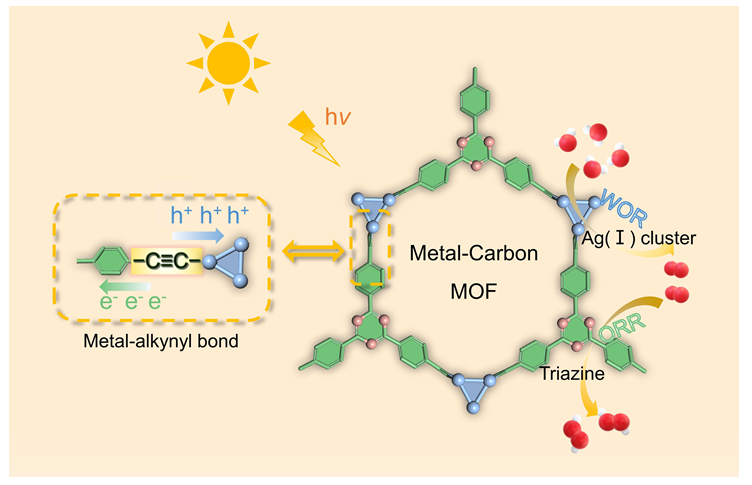
过氧化氢(H2O2)作为一种重要的绿色氧化剂, 在废水处理、燃料电池和医疗消毒等领域应用广泛[1-2]. 目前, 工业上主要依赖蒽醌法生产H2O2, 但该方法工艺流程复杂, 并涉及有机溶剂的使用, 导致高能耗和环境污染问题[3]. 相比之下, 太阳能驱动的光催化策略能够以100%的原子经济性直接利用水和氧气制备H2O2, 不仅避免了有机溶剂和苛刻反应条件的使用, 还兼具清洁、可再生与环境友好等优势, 为绿色化学和可持续能源转换提供了一条极具潜力的发展路径[4-6]. 理论上, H2O2可通过2e−氧还原反应(ORR, 方程式1)耦合2e−或4e−水氧化反应(WOR, 方程式2或3)制备[7]. 其中, 2e− ORR/4e− WOR耦合路径在热力学上更有利, 通过4e− WOR产生的O2可用作2e− ORR的反应物, 避免对外源O2的额外需求, 提高催化效率. 因此, 耦合2e− ORR反应与4e− WOR反应为实现无牺牲剂的光合成H2O2提供了一条可行的路径.
O2+2H++2e−→H2O2 (+0.68 V vs. NHE, pH=0)
2H2O+2h+→H2O2+2H+ (+1.76 V vs. NHE, pH=0)
2H2O+4h+→O2+4H+ (+1.23 V vs. NHE, pH=0)
银基材料因其独特的电子结构和优异的光响应特性, 在光催化领域得到了广泛应用[16]. 得益于其独特的d9s1激发态电子构型, Ag(I)离子在光照条件下能够有效调控电子分布, 从而降低电荷复合速率并加速光生载流子的传输. 这一特性可以提升体系的光响应与电荷利用效率[17]. 例如, 廖培钦课题组[18]通过将多核Ag(Ⅰ)簇与铁卟啉整合组装形成新型MOF框架Ag27TPyP-Fe, 成功实现了人工光合作用, 并通过实验与密度泛函理论(DFT)计算证实Ag(Ⅰ)簇在该体系中主导了4e− WOR过程. 另外, 李丹课题组[19-20]基于三核Ag(I)单元, 先后开发了块体MOF材料JUM-24及一系列二维MOF纳米片光催化剂. 这些材料均具备优异的光捕获能力与高效的H2O2光合性能. 更值得关注的是, 其中一例二维纳米片JNM-8-Ag在无牺牲剂体系中, H2O2产率达到了迄今最高记录. 在有机配体方面, 三嗪单元作为经典的光敏基团, 常用于构筑高性能MOF或者共价有机框架(COF)光催化剂[21]. 三嗪基MOF和COF材料不仅成功应用于荧光传感和燃料电池等领域, 更是凭借三嗪环的O2吸附能力和缺电子特性, 在光催化合成H2O2方面展现出独特优势[22-25]. 基于上述研究基础, 我们希望将Ag(Ⅰ)簇与三嗪单元整合到单一MOF框架中, 以构建高效H2O2光合成体系.
2 结果与讨论
2.1 物理表征分析
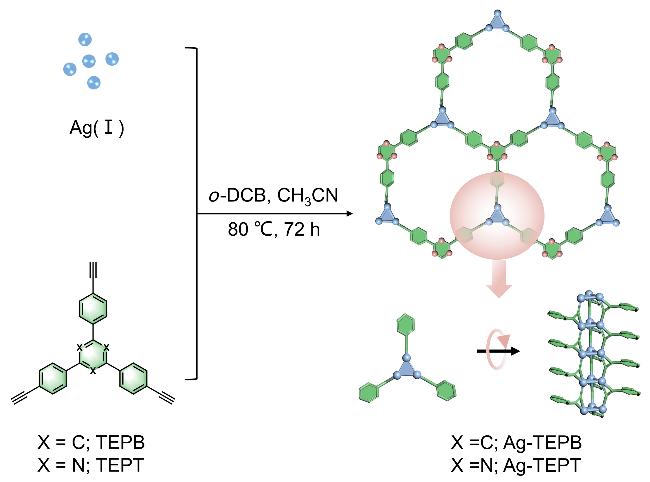
采用溶剂热法, 以三连接炔基配体2,4,6-三(4-乙炔基苯基)-1,3,5-三嗪)(TEPT)与Ag(CH3CN)4BF4为原料, 在邻二氯苯和乙腈混合溶剂中于80 ℃反应72 h, 成功制得棕黄色粉末状Ag-TEPT(图1, 支持信息图S1). 傅里叶变换红外光谱(FT-IR)分析(见支持信息图S2)显示, 产物中炔基的C—H键伸缩振动和弯曲振动特征峰显著减弱, 表明配体在MOF形成过程中发生了去质子化反应, 与Ag离子形成了配位键. 13C固体核磁共振(NMR)谱(见支持信息图S3)进一步证实, 炔基碳信号(δ 75~88)向低场移动并与芳香碳信号重叠, 这归因于Ag(Ⅰ)离子对sp杂化碳的去屏蔽效应, 证明了Ag—C键的形成[33]. 粉末X射线衍射(PXRD)表征(图S1)显示产物结晶度良好, 扫描电子显微镜(SEM)和透射电子显微镜(TEM)表征(见支持信息图S4, S5)表明其形貌均一. X射线光电子能谱(XPS)分析(见支持信息图S6)显示, Ag 3d3/2和Ag 3d5/2结合能分别是374.7 eV和368.7 eV, 且未观察到能量损失峰, 证实Ag-TEPT中银的氧化态为+1[34]. 为了探究不同炔基配体的电子特性, 在相同条件下合成了由1,3,5-三(4-乙炔基苯基)苯(TEPB)和Ag(CH3CN)4BF4构筑的Ag-TEPB[27]. PXRD分析表明二者具有同构结构(图S1), SEM和TEM图像显示其形貌与Ag-TEPT类似(图S4, S5). XPS分析确认Ag-TEPB中的银离子也呈+1价(图S6). 这两种MOF均由三核Ag(Ⅰ)簇通过σ和π配位模式与去质子化炔基配体连接, 沿c轴方向形成一维六方孔道. 其中, Ag−炔键作为连接金属簇与有机配体的桥梁, 可促进光生载流子的高效转移, 展现出良好的光催化应用前景. 热重分析(TGA, 见支持信息图S7)显示, 两种材料中的客体分子在210 ℃前均可完全脱除. 77 K N2吸附-脱附测试表明, Ag-TEPT的饱和吸附量为262.43 cm3•g−1 (STP), BET比表面积达139.22 m2•g−1(见支持信息图S8), 多孔结构为光催化过程提供了更多的活性位点.
2.2 光催化性能分析
在模拟太阳光(AM 1.5G)照射下, O2饱和水溶液体系中研究了AgC-MOF的H2O2光合成性能. 如图2a所示, Ag-TEPT的H2O2产量随时间呈线性增长, 生成速率高达2880 μmol•g−1•h−1, 而Ag-TEPB的产率仅为456 μmol•g−1•h−1 (见支持信息图S9), 说明具有缺电子特性的光敏三嗪单元在MOF的结构中扮演着关键角色. 值得注意的是, Ag-TEPT在空气和纯水条件下同样表现出优异的性能, 其H2O2生成速率保持在2024 μmol•g−1•h−1 (图2b), 表明其具备在实际环境中高效运行的潜力. Ag-TEPT的H2O2产率显著优于大多数已报道的光催化剂(见支持信息表S1). 此外, Ag-TEPT展现出优异的光催化稳定性, 在连续进行3轮光催化实验后其性能未发生明显衰减(见支持信息图S10), PXRD和SEM表征证明反应后材料仍保持完整的晶体结构和形貌(图2c, 支持信息图S11), XPS分析进一步表明反应过程中银离子保持+1价(图2d), 这些结果充分证明了Ag-TEPT作为高效稳定光催化剂的巨大潜力.
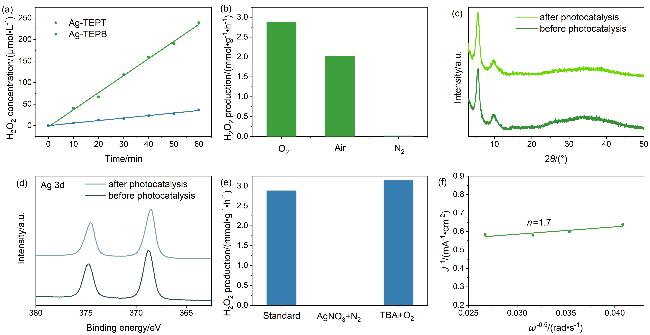
图2 (a) AgC-MOF光催化生成H2O2的时间曲线; (b) Ag-TEPT在不同气体氛围中的光催化H2O2产率对比; 光催化前后Ag-TEPT的(c) PXRD谱图和(d) XPS谱图; (e) Ag-TEPT在不同活性物质捕获剂作用下的H2O2产率对比; (f) RDE测试得到的Koutecky-Levich图Figure 2 (a) Time course of photocatalytic production of H2O2 for AgC-MOFs; (b) Comparison of photocatalytic H2O2 production rates by Ag-TEPT under different gas atmospheres; (c) PXRD patterns and (d) XPS spectra for Ag-TEPT before and after the photocatalytic reaction; (e) H2O2 production efficiency of Ag-TEPT under different active material capture agents; (f) Koutecky-Levich plots from RDE measurements |
为研究Ag-TEPT生成H2O2的反应路径, 我们开展了一系列对照实验. 如图2e所示, 在使用2 mg催化剂, 并加入叔丁醇(TBA, 25 mL 1 mmol/L溶液)的条件下, H2O2的生成量基本保持不变, 这证实2e− ORR是H2O2形成的主要途径, 因为TBA是2e− WOR途径中•OH自由基的清除剂. 旋转圆盘电极(RDE)测试测得Ag-TEPT的平均电子转移数为1.7, 这一数值与2e− ORR过程高度吻合(图2f, 支持信息图S12). 此外, 当采用N2持续鼓泡去除体系中的O2并加入AgNO3作为电子捕获剂时, 体系中基本无H2O2的生成, 这一结果表明2e− WOR途径对体系中的H2O2积累没有显著贡献(图2e). 综上, 这些结果表明H2O2的生成遵循2e− ORR与4e− WOR协同的双路径反应机制.
2.3 光电性质
为揭示AgC-MOF的电子结构特征, 我们对样品进行了紫外-可见漫反射光谱(UV-Vis DRS)测试. 光谱分析表明(图3a), Ag-TEPT和Ag-TEPB在225~450 nm范围均呈现显著的紫外吸收特征. 通过Tauc曲线拟合计算, 确定两者的光学带隙(Eg)分别为2.49 eV和2.57 eV(见支持信息图S13). 莫特-肖特基(Mott-Schottky)测试结果(图3b和S14)显示, Ag-TEPT和Ag-TEPB的导带电位分别为-1.26 V和-1.76 V (vs. Ag/AgCl). 基于上述实验结果, 我们构建了两种AgC-MOF的能带结构示意图(图3c). 能带分析表明: Ag-TEPT与Ag-TEPB的能带结构, 在热力学上均适用于光催化将O2还原为H2O2(方程式1)以及将H2O氧化为O2(方程式3)的反应, 而不适用于将H2O氧化为H2O2的反应(方程式2).
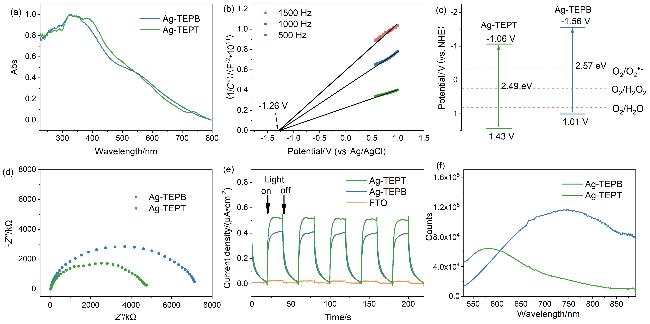


图3 (a) Ag-TEPT和Ag-TEPB的紫外-可见漫反射光谱; (b) Ag-TEPT的Mott-Schottky曲线图; (c)能带结构示意图; (d) Nyquist图; (e)光电流响应曲线; (f) Ag-TEPT和Ag-TEPB的PL光谱(激发波长500 nm)Figure 3 (a) UV-Vis DRS of Ag-TEPT and Ag-TEPB; (b) Mott-Schottky plots of Ag-TEPT; (c) Energy level diagrams; (d) Nyquist plots; (e) Photocurrent response curves; (f) PL emission spectra of Ag-TEPT and Ag-TEPB under 500 nm excitation |
得益于Ag−炔键的高效电子传输能力, AgC-MOF材料体系表现出卓越的光生电荷分离效率, 从而显著提升了光催化反应动力学性能. 为深入阐明光生电荷动力学与催化活性之间的关系, 我们测试了电化学阻抗谱(EIS), Ag-TEPT的Nyquist图谱呈现更小的半圆弧半径(图3d), 证实其具有更低的电荷转移阻抗[35]. 光电流测试(图3e)表明在相同测试条件下, Ag-TEPT表现出更强的光电流密度, 具有更优异的光生电子-空穴对分离效率[36]. 这主要是由于TEPT分子中的三嗪结构具有光敏性, 而TEPB的苯环则缺乏这种光响应特性. 通过稳态光致发光(PL)光谱表征(图3f)发现, 在500 nm激发光照射下, Ag-TEPB在750 nm处出现强荧光发射峰, 而Ag-TEPT仅在550 nm处观测到微弱的发射信号, 这直接证实了Ag-TEPT具有极低的电子-空穴复合率. 综合上述表征结果, 可以看出Ag-TEPT具有非常优异的电荷分离与传输特性, 这为其卓越的光催化性能提供了关键的科学解释.
3 结论
本研究通过M—C键将Ag(Ⅰ)簇与三嗪结构单元连接, 成功构建了一例新型MOF光催化剂Ag-TEPT. 在模拟太阳光照射下, Ag-TEPT展现出卓越的光催化H2O2合成性能, 产率高达2880 μmol•g−1•h−1, 这一数值显著优于目前已报道的大多数催化剂. 机理研究表明, H2O2的生成遵循双路径反应机制, 即2e− ORR与4e− WOR的协同作用. 光电化学测试进一步证实, Ag-TEPT具有显著增强的光电流响应和较低的电荷转移阻抗, 这归因于Ag−炔键独特的电子传导特性所赋予的优异光生电荷分离效率. 本研究不仅开发了一种高效稳定的光合成H2O2催化剂, 更重要的是提出了基于M—C键构建新型MOF光催化剂的设计策略, 为在分子级别设计高性能催化剂开辟了新途径.
(Cheng, B.)