


1 引言
2 结果与讨论
2.1 Gr@CNTs的制备与表征
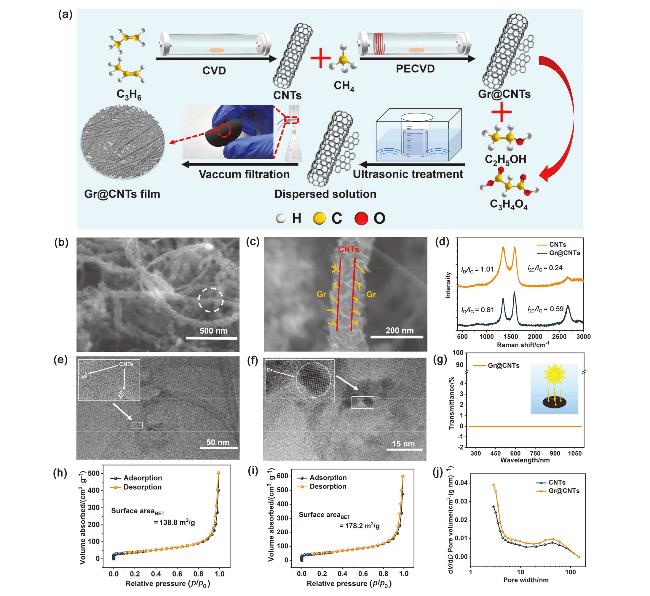
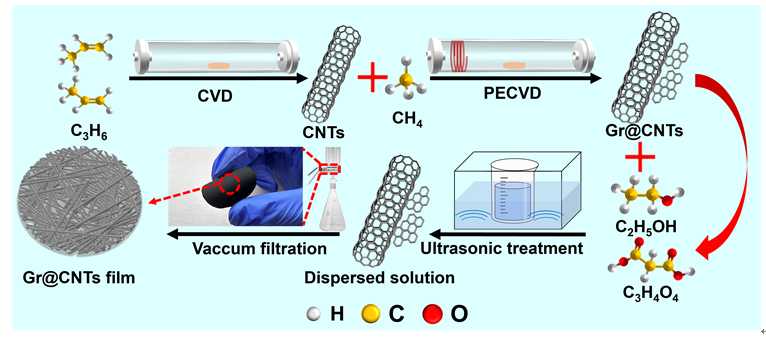
图1 (a) Gr@CNTs薄膜的制备流程图; (b), (c) Gr@CNTs异质结材料的SEM图像; (d) CNTs和Gr@CNTs拉曼图谱; (e), (f) Gr@CNTs异质结材料的TEM图像; (g) Gr@CNTs异质结薄膜在波长250~1100 nm范围内的透过率; (h) CNTs的N2吸脱附曲线; (i) Gr@CNTs的N2吸脱附曲线; (j) CNTs和Gr@CNTs的孔径分布Figure 1 (a) Preparation process of Gr@CNTs film. (b), (c) SEM image of Gr@CNTs heterostructure. (d) Raman spectra of CNTs and Gr@CNTs. (e), (f) TEM image of Gr@CNTs heterostructure. (g) Transmittance of Gr@CNTs heterostructure film in the wavelength range of 250~1100 nm. (h) N2 adsorption/desorption isotherm of CNTs. (i) N2 adsorption/desorption isotherm of Gr@CNTs. (j) Pore size distribution of CNTs and Gr@CNTs |
2.2 Gr@CNTs自支撑膜光热转化性能研究
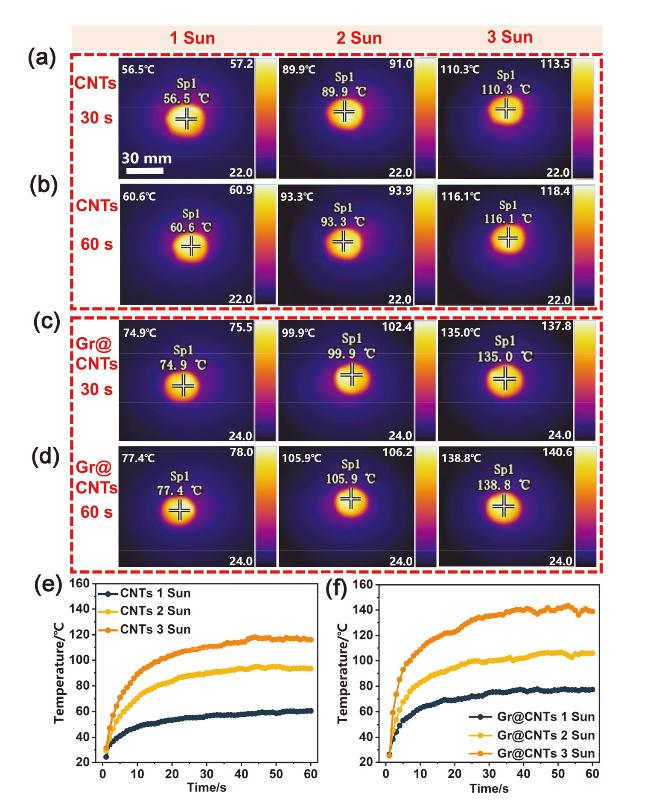
图2 (a) CNTs薄膜在干燥状态下1 Sun、2 Sun和3 Sun光照30 s时红外热成像图; (b) CNTs薄膜在干燥状态下1 Sun、2 Sun和3 Sun光照60 s时红外热成像图; (c) Gr@CNTs异质结薄膜在干燥状态下1 Sun、2 Sun和3 Sun光照30 s时红外热成像图; (d) Gr@CNTs异质结薄膜在干燥状态下1 Sun、2 Sun和3 Sun光照60 s时红外热成像图; (e) CNTs薄膜单独光照下在1 Sun、2 Sun和3 Sun表面温度随时间变化图像; (f) Gr@CNTs薄膜单独光照下在1 Sun、2 Sun和3 Sun表面温度随时间变化图像Figure 2 (a) Infrared thermal images of CNTs film under 1 Sun, 2 Sun, and 3 Sun illumination for 30 s in a dry state. (b) Infrared thermal images of CNTs film under 1 Sun, 2 Sun, and 3 Sun illumination for 60 s in a dry state. (c) Infrared thermal images of Gr@CNTs film under 1 Sun, 2 Sun, and 3 Sun illumination for 30 s in a dry state. (d) Infrared thermal images of Gr@CNTs film under 1 Sun, 2 Sun, and 3 Sun illumination for 60 s in a dry state. (e) Surface temperature change images of CNTs film under individual illumination at 1 Sun, 2 Sun, and 3 Sun over time. (f) Surface temperature change images of Gr@CNTs film under individual illumination at 1 Sun, 2 Sun, and 3 Sun over time |
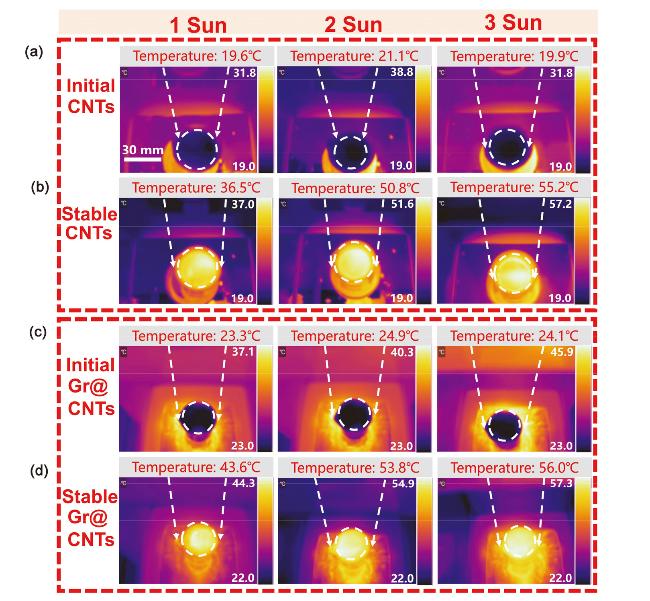
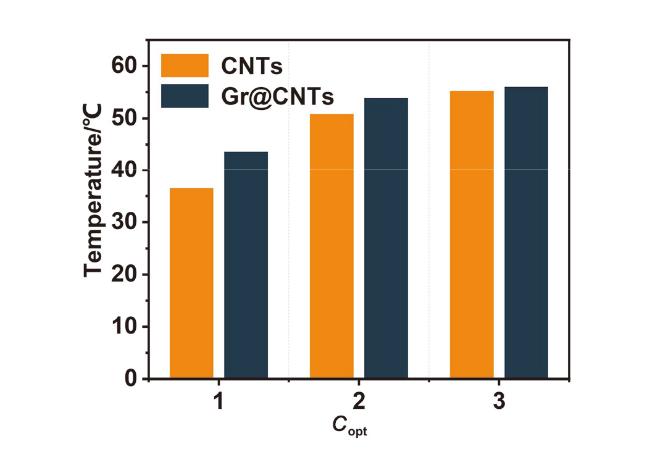
图3 (a) CNTs薄膜在蒸发状态1 Sun、2 Sun和3 Sun光照初始时红外热成像图; (b) CNTs薄膜在蒸发状态1 Sun、2 Sun和3 Sun光照稳定时红外热成像图; (c) Gr@CNTs薄膜在蒸发状态1 Sun、2 Sun和3 Sun光照初始时红外热成像图; (d) Gr@CNTs薄膜在蒸发状态1 Sun、2 Sun和3 Sun光照稳定时红外热成像图Figure 3 (a) Infrared thermal images of CNTs film at the initial stage of illumination under 1 Sun, 2 Sun, and 3 Sun during evaporation. (b) Infrared thermal images of CNTs film under 1 Sun, 2 Sun, and 3 Sun illumination at stable state during evaporation. (c) Infrared thermal images of Gr@CNTs film at the initial stage of illumination under 1 Sun, 2 Sun, and 3 Sun during evaporation. (d) Infrared thermal images of Gr@CNTs film under 1 Sun, 2 Sun, and 3 Sun illumination at stable state during evaporation |
2.3 Gr@CNTs自支撑膜功能化改性与蒸发器组装
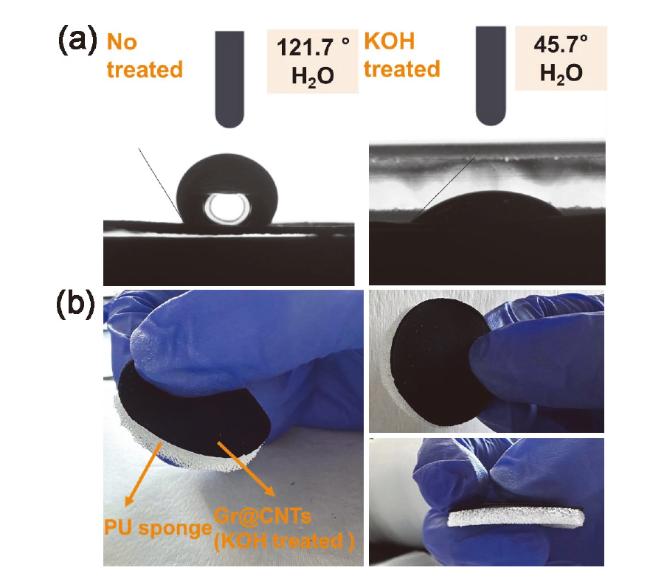
图5 (a) Gr@CNTs薄膜亲水改性之前与改性之后水接触角示意; (b) Gr@CNTs薄膜亲水改性后与聚氨酯海绵粘合组成结构光学照片Figure 5 (a) The water contact angles before and after hydrophilic modification of Gr@CNTs film; (b) The photograph of the composite structure formed by bonding Gr@CNTs film with PU sponge after hydrophilic modification |
2.4 Gr@CNTs蒸发器水蒸发性能研究
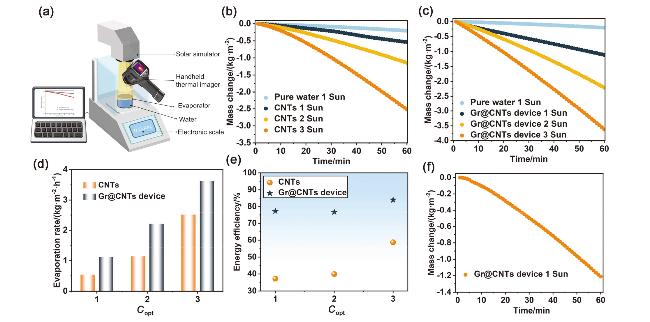


图6 (a)太阳能-蒸汽转化性能评估实验装置图; (b) CNTs薄膜在不同光照强度下水蒸发质量随时间变化图; (c) Gr@CNTs蒸发器在不同光照强度下水蒸发质量随时间变化图; (d) CNTs薄膜和Gr@CNTs蒸发器在不同光照强度下水蒸发速率对比图; (e) CNTs薄膜和Gr@CNTs蒸发器在不同光照强度下水蒸发效率图; (f) Gr@CNTs蒸发器在3.5% NaCl溶液中水蒸发质量随时间变化图Figure 6 (a) The experimental setup for evaluating solar-thermal photothermal conversion performance. (b) Graph of water evaporation mass versus time for CNTs film under different light intensities. (c) Graph of water evaporation mass versus time for Gr@CNTs film under different light intensities. (d) Comparison of water evaporation rates between CNTs film and Gr@CNTs evaporator under different light intensities. (e) Water evaporation efficiency diagram of CNTs film and Gr@CNTs evaporator under different light intensities. (f) Variation diagram of water evaporation mass with time for Gr@CNTs evaporator in 3.5% NaCl solution. |