Communication

Electrochemistry-Enabled Hydroxysulfurization of Aryl Alkenes for the Synthesis of β-Hydroxysulfides and Their Antifungal Ativities

  • Han Zhong-Yan ,
  • Chen Mei-Mei ,
  • Zhang Chi ,
  • Xue Wei ,
  • Gu Li-Jun
Expand
  • State Key Laboratory of Green Pesticide, Center for R&D of Fine Chemicals of Guizhou University, Guiyang 550025

Received date: 2025-12-08

  Online published: 2026-01-21

Supported by

Guizhou Provincial Basic Research Program (Natural Science) (No. QianKeHeJiChuZK [2024]YiBan086) and the starting grant of Guizhou University [(2023)5)].

Abstract

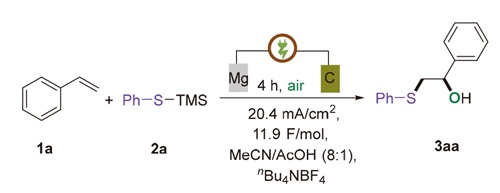
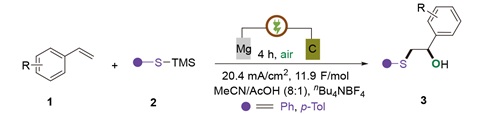
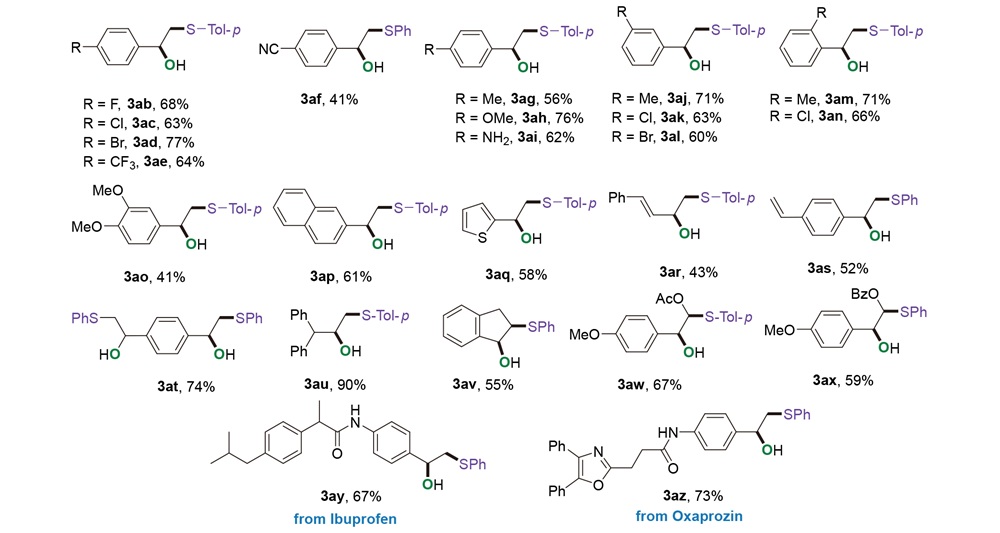
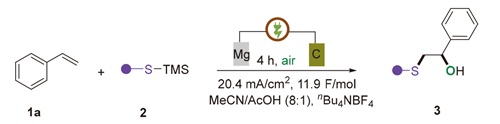
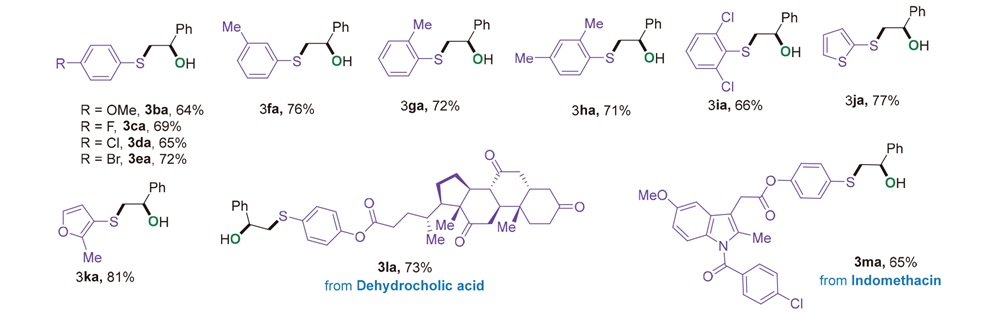
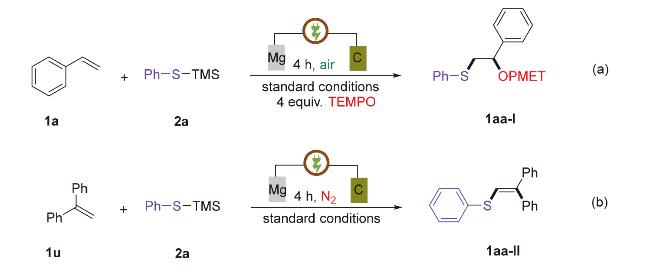
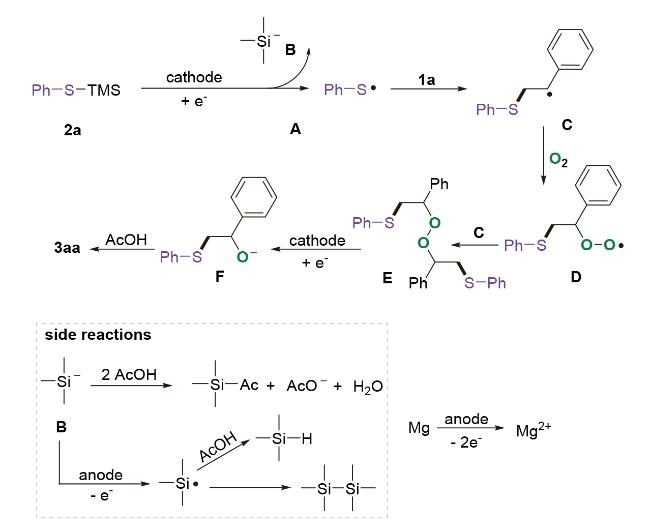
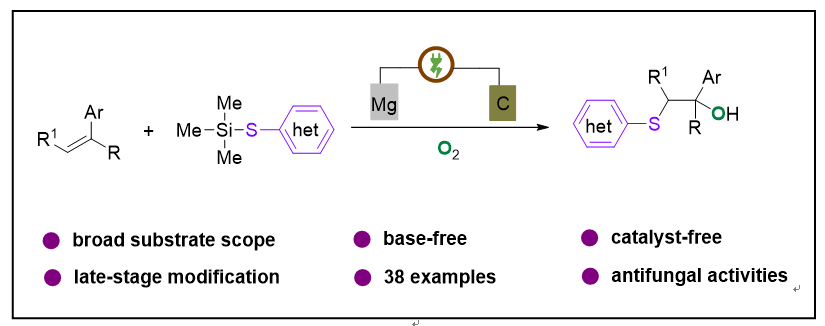
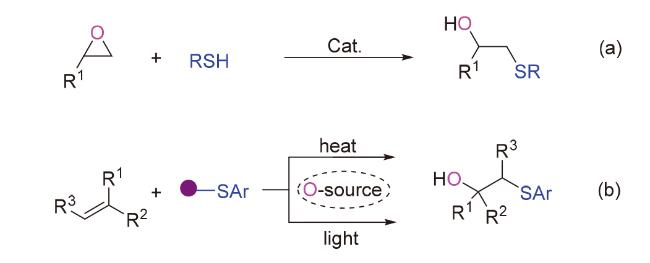
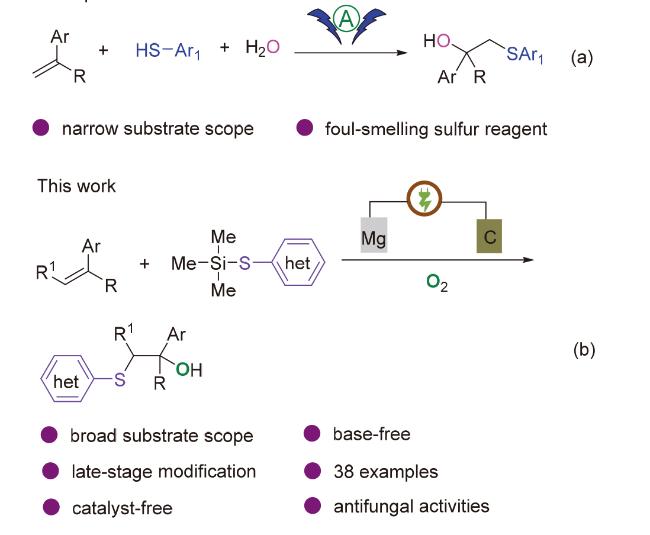
As the core skeleton structure of many drugs and natural products, β-hydroxysulfides exhibit a variety of biological activities, including anti-fungal, anti-tumor, anti-inflammatory, and anti-HIV properties. They are also used as synthetic building blocks. Complementary catalytic methods that facilitate the efficient synthesis of structurally diverse β-hydroxysulfides are highly sought after. Herein, a mild and efficient electricity-driven strategy has been developed for the synthesis of β-hydroxysulfides from aryl alkenes and trimethylsilyl sulfides in an undivided cell with Mg anode and graphite cathode, while exhibiting mild conditions, high atom-economy, and excellent functional group tolerance. The reaction avoids the use of transition-metal catalysts, peroxide reagents, and malodorous thiols. A representative procedure is described as follows. A mixture of styrene (28.3 mg, 0.2 mmol), (phenylthio)trimethylsilane (58.9 mg, 0.3 mmol), and nBu4NBF4 (65.8 mg, 0.2 mmol) in acetonitrile (8 mL) and acetic acid (1 mL) was added to a three-necked flask (10 mL). The electrolysis was performed in an undivided cell equipped with a Mg rod anode (Ø = 6 mm) and a graphite rod cathode (Ø = 6 mm) under a constant current of 16 mA (~20.4 mA/cm²) at room temperature for 4 h. After completion, the mixture was extracted with ethyl acetate. The combined organic layers were washed with brine, dried over anhydrous Na₂SO₄, filtered, and concentrated. The crude product was purified by silica gel column chromatography to afford the target compound. Based on the synthesis, the antifungal activities of the target compounds, β-hydroxysulfides, was tested using the mycelial growth rate method in vitro. With the commercial fungicide Azoxystrobin (Azo) as the positive control, the antifungal activities of the target compounds against two plant pathogenic fungi, Rhizoctonia solani (R.s.) and Botrytis cinerea (B.c.), were determined at a concentration of 100 μg/mL. Notably, some compounds showed higher inhibition rates against the tested fungi than the control agent Azoxystrobin. Among them, at a concentration of 100 μg/mL, compound (3ae) exhibited inhibition rates of 90% and 97% against R.s. and B.c., respectively. which were superior to those of the control agent Azoxystrobin (72% and 74%, respectively). Finally, a preliminary exploration was conducted on the relationship between the antifungal activities of the target compounds and their molecular structures, providing valuable insights for the future development of more efficient agricultural antifungal agents.

Cite this article

Han Zhong-Yan , Chen Mei-Mei , Zhang Chi , Xue Wei , Gu Li-Jun . Electrochemistry-Enabled Hydroxysulfurization of Aryl Alkenes for the Synthesis of β-Hydroxysulfides and Their Antifungal Ativities[J]. Acta Chimica Sinica, 0 : 25120401 . DOI: 10.6023/A25120401

References

[1] (a) Luo M.-J.; Xiao Q.; Li, J.-H. Chem. Soc. Rev.2022, 51, 7206—7237.
(b) Yin G.; Mu X.;Liu, G. Acc. Chem. Res.2016, 49, 2413—2423.
(c) Wang Y.; Bao Z.-P.; Mao X.-D.; Hou M.; Wu, X.-F. Chem. Soc. Rev.2025, 54, 9530—9573.
(d) Deng S.; Peng C.; Niu Y.; Xu,Y.; Zhang Y.; Chen X.; Wang H.; Liu S.; Shen, X. Acta Chim. Sinica.2024, 82, 119-125 (in Chinese).
(邓沈娜, 彭常春, 牛云宏, 许云, 张云霄, 陈祥, 王红敏, 刘珊珊, 沈晓, 化学学报, 2024, 82, 119—125).
(e) Fu X.; Zhao, W. Chin. J. Org. Chem.2019, 39, 625—647 (in Chinese).
(付晓飞, 赵文献, 有机化学, 2019, 39, 625—647).
(f) Zuo H.; Hu Y.; Qiao X.; Zhang Y.; Wang, S. Acta Chim. Sinica.2025, 83, 981—986 (in Chinese).
(左恒昕宇, 虎亚光, 乔霞, 张野, 王少华, 化学学报, 2025, 83, 981—986).
(g) Zhou L.; Ma L.; Xu B.; Zhang Z.-M.; Zhang, J. Chin. J. Chem.2024, 42, 2466—2470.
[2] (a) Li X.; Tao P.; Cheng Y.; Hu Q.; Huang W.; Li Y.; Luo Z.; Huang, J. Chin. J. Org. Chem.2022, 42, 4169—4201 (in Chinese).
(李秀英, 陶萍芳, 程泳渝, 胡琼, 黄伟娟, 李芸, 罗志辉, 黄国保, 有机化学, 2022, 42(12), 4169-4201).
(b) Zhu Y.; Wang Q.; Cornwall R. G.; Shi Y. Chem. Rev.2014, 114, 8199—8256.
(c) Yan D.; He, W. Chin. J. Org. Chem.2025, 45, 1781—1783 (in Chinese).
(鄢东, 何卫民, 有机化学, 2025, 45, 1781—1783).
(d) Cheng J.; Cheng Y.; Xie J.; Zhu C. Org. Lett.2017, 19, 6452-6455.
(e) Patel M.; Desai B.; Sheth A.; Dholakiya B. Z.; Naveen, T. Asian J. Org. Chem.2021, 10, 3201—3232.
(f) Wu Z.; Hu M.; Li J.; Wu W.; Jiang, H. Org. Biomol. Chem.2021, 19, 3036—3054.
(g) Guo Q.; Shen X.; Lu, Z. Chin. J. Chem.2024, 42, 760—776.
(h) Ye F.; Xu Y.; Zheng S.; Huang, G; Yuan, W. Chin. J. Chem.2025, 43, 1862—1868.
[3] (a) Wang X.; Studer, A. Acc. Chem. Res.2017, 50, 1712—1724.
(b) Cheng J.; Cheng Y.; Xie J.; Zhu C. Org. Lett.2017, 19, 6452—6455.
(c) Zhou Z.-L.; Zhang Y.; Cui P.-Z.; Li, J.-H. Chem. Eur. J.2024, 30, e202402458.
(d) Jiang, H.; Studer, A.Chem. Soc. Rev. 2020, 49, 1790-1811.
(e) Gui Q.-W.; Teng F.; Yang H.; Xun C.; Huang W.-J.; Lu Z.-Q.; Zhu, M.-X., Ouyang W.-T.; He, W.-M. Chem. Asian J.2022, 17, e202101139.
[4] (a) Feng M.; Tang B.; Liang S.-H.; Jiang, X. Curr. Top. Med. Chem.2016, 16, 1200—1216.
(b) Yang D.; Yan Q.; Zhu E.; Lv J.; He, W.-M. Chin. Chem. Lett.,2022, 33, 1798—1816
(c) Zhuang S.; You X.; Jin, W. Chin. J. Org. Chem.2025, 45, 3701—3718 (in Chinese).
(庄诗怡, 尤晓琴, 金伟伟, 有机化学, 2025, 45, 3701—3718).
[5] (a) Scott K. A.; Njardarson, J. T. Top. Curr. Chem.2018, 376: 5.
(b) Guruswamy, B.; Arul, R. Phosphorus, Sulfur, and Silicon and the Related Elements. 2013, 188, 1205—1213.
(c) Viola, F.; Balliano, G.; Milla, P.; Cattel, L.; Rocco, F.; Ceruti, M.; Bioorg. Med. Chem. 2000, 8, 223—232.
(d) Meng, L.-H.; Wang, C.-Y.; Mándi, A.; Li, X.-M.; Hu, X.-Y.; Kassack, M. U.; Kurtán, T. ; Wang, B.-G.; Org. Lett. 2016, 18, 5304—5307.
(e) Castro M. V.; Ióca L. P.; Williams D. E.; Costa B. Z.; Mizuno C. M.; Santos M. F.; Jesus K.; Ferreira É L.; Seleghim M. H.; Sette L. D.; Pereira Filho E. R.; Ferreira A. G.; Gonçalves N. S.; Santos R. A.; Patrick B. O.; Andersen R. J.; Berlinck, R. G. J. Nat. Prod.2016, 79, 1668—1678.
(f) O'Connor, S. E.; Grosset, A.; Janiak, P.; Fundam Clin Pharmacol. 1999, 13, 145—153;
(g) Wang Z.; Gausmann M.; Dickoff J.-H.; Christmann M. Green Chem.2024, 26, 2546—2551.
[6] (a) Nowrouzi N.; Abbasi M.; Shahidzadeh, E. S. Appl Organomet Chem.2023, 37: e6941.
(b) Marakalala M. B.; Mmutlane E. M.; Kinfe, H. H. Beilstein J. Org. Chem.2018, 14, 1668—1692.
(c) Hong J. E.; Jung Y.; Min D.; Jang M.; Kim S.; Park J.;Park, J. J. Org. Chem.2022, 87, 7378—7391.
(d) Azizi B.; Heravi M. R. P.; Hossaini Z.; Ebadi A.; Vessally E. RSC. Adv.2021, 11, 13138—13151.
(e) Luly J. R.; Yi N.; Soderquist J.; Stein H.; Cohen J.; Rerun T. J.; Plattner, J. J. J. Med. Chem.1987, 30, 1609—1616.
[7] (a) Song Y.; Zou Y.; Chen T.; Zhang Z.; Zhang, W. Angew. Chem. Int. Ed.2025, 64, e202504159.
(b) Azizi B.; Heravi M. R. P.; Hossaini Z.; Ebadi A.; Vessally E. RSC. Adv.2021, 11, 13138—13151.
(c) Adams H.; Bell R.; Cheung Y.-Y.; Jones D. N.; Tomkinson, N. C. O. Tetrahedron. Asymmetry1999, 10, 4129—4142.
(d) Gelebe, A. C.; Kaye, P. T.; Benzodiazepine A. Synth. Commun. 1996, 26, 4459—4475.
[8] (a) Dowsland J.; McKerlie F.; Procter, D. J. Tetrahedron Lett.2000, 41, 4923—4927.
(b) Lanke S. R.; Bhanage, B. M. Catal. Commun.2013, 41, 29—33.
(c) Ganesh V.; Chandrasekaran S. Synthesis.2009, 19, 3267—3278.
(d) Tanini D.; Pecchi T.; Ignat′ev N. V.; Capperucci A. Catalysts2022, 12, 1259—1281.
[9] (a) Yu E.; Li J.; Wang Y.; Chen Y.; Xiao F.; Deng, G. J. Org. Chem.2024, 89, 9287—9297.
(b) Zhang J.; Su R.; Zhou P.; Chen C.; Liu, W. J. Org. Chem.2025, 90, 217—224.
(c) Choudhuri, K.; Mandal, A.; Mal, P. Chem. Commun. 2018, 54,3759—3762.
(d) Shen Q.; Peng X.; Sui J.; Peng M.; Liu X.; Jiang H.; Tan R.; Zhou, M. Chin. J. Chem.2024, 42, 3129—3134.
(e) Das A.; Thomas, K. R. J. ACS Omega.2023,8, 18275—18289.
(f) Hong J. E.; Jung Y.; Min D.; Jang M.; Kim S.; Park J.;Park, J. J. Org. Chem.2022, 87, 7378—7391.
[10] (a) Cheng X.; Lei A.; Mei T.-S.; Xu H.-C.; Xu K.; Zeng C. CCS Chemistry.2022, 4, 1120—1152.
(b) Ma C.; Fang P.; Liu Z.-R.; Xu S.-S.; Xu K.; Cheng X.; Lei A.; Xu H.-C.; Zeng C.; Mei T.-S. Sci Bull.2021, 66, 2412—2429.
(c) Gao R.; Wen L.; Guo, W. Chin. J. Org. Chem.2024, 44, 892—902 (in Chinese).
(高瑞林, 文丽荣, 郭维斯, 有机化学, 2024, 44, 892—902).
(d) Wen Y.-C.; Zhu L.-J.; Yi R.-N.; Shen C.; Zhu H.-T.; Wang Z.-L.; He, L.-M. Acta Chim. Sinica.2025, 83, 1124—1128 (in Chinese).
(文延萃, 朱丽君, 易荣楠, 沈超, 祝海涛, 王祖利, 何卫民, 化学学报, 2025, 83, 1124—1128).
(e) Huang Y.-D.; Zhang Y.-Y.; Zhou Y.-J.; Xue R.; Wang G.-A.; Cui F.-H.; Meng X.-J.; Wang M.-R.; Pan Y.-M.; Tang H.-T. Org. Lett.2025, 27, 2764—2768.
(f) Xiong P.; Xu, H.-C. Acc. Chem. Res.2019, 52, 3339—3350.
(g) Yuan Y.; Lei, A. Acc. Chem. Res.2019, 52, 3309-3324.
(h) Jiang Y.-Y.; Dou G.-Y.; Xu K.; Zeng, C.-C. Org. Chem. Front.2018, 5, 2573—2577.
(i) Zeng W.; Wang Y.; Peng C.; Qiu, Y. Chem. Soc. Rev.2025, 54, 4468—4501
(j) Zhuang S.; Zhou F.; Gao X.; Liu C.; Jin, W. Chin. J. Chem.2025, 43, 2722—2728.
(k) Li, S.; Lu, J.; Liu, J.; Jiang, L.; Yi, W. Acta Chim. Sinica. 2024, 82, 110—114 (in Chinese).
(李珊, 路俊欣, 刘杰, 蒋绿齐, 易文斌, 化学学报, 2024, 82, 110—114).
[11] (a) Sauer G. S.; Lin S. ACS Catal.2018, 8, 5175—5187.
(b) Tan, Y.-F.; Zhao, Y.-N.; Yang, D.; Lv, J.-F.; Guan, Z.; He, Y.-H.J. Org. Chem. 2023, 88, 5161—5171.
(c) Yang J.; Lei Y.; Li Y.; Duan M.; Zhang Y.; Yang S.; Tian G.; Zhao Y.; Duan R.; Li J.; Song W.; Chen C.; Zhao, J. Sci. China. Chem.2025, 68, 3770—3777.
(d) Zhang C.; Yang M.; Qiu Y.; Song M.; Wang H.; Yang M.; Xie W.; Wu J.; Ye S. Chem. Sci.2022, 13,11785—11791.
(e) Qi, C.; Laktsevich-Iskryk, M.; Mazzarella D. Chem. Commun., 2025, 61, 4265—4278.
(f).Martins, G. M.; Shirinfar, B.; Hardeick, T.; Ahmed, N. ChemElectroChem 2019, 6,1300—1315.
[12] Wang Y.; Deng L.; Mei H.; Du B.; Han J.; Pan Y. Green Chem.2018, 20, 3444—3449.
[13] (a) Zeng L.; Li J.; Gao J.; Huang X.; Wang W.; Zheng X.; Gu L.; Li G.; Zhang S.; He Y. Green Chem.2020, 22, 3416—3420
(b) Zhang C.; Zhou Y.; Zhao Z.; Xue W.; Gu L. Chem. Commun.2022, 58, 13951—13954
(c) Zhao, Z.; Yan, H.; Zhou, Y.; Xue, W.; Gu, L.; Zhang, S. Chin. J. Chem. 2024, 42, 2049—2055
(d) Zhao Z.; Zhang H.; Yan H.; Yu X.; Gu L.; Zhang S. Org. Lett.2024, 26, 6114—6119
(e) Ding S.; Zhang C.; Zhao Z.; He L.; Li X.; Li G.; Gu L. Tetrahedron2024, 163, 134131
(f) Zhao Z.; Zhang H.; Gu L. Chem. Commun.2025, 61, 3868—3871
(g) Zhang C.; Han Z.; Zhao Z.; Zhou Y.; Gu L. Org. Lett.2025, 27, 9121—9129
(h) Zhou Y.; Lei J.; Chen M.; Zhang C.; Zhao Z.; Gu L. Chem. Commun.2026, 62, 247—250.
[14] (a) Zou H.; Wang Y.; Pu H.; Fu H.; Cheng Z.; Tian F.; Gu L.; Xue, W. J. Agric. Food Chem.2025, 73, 27363—27371.
(b) Liu Y.; Xin H.; Wang Y.; Zhou Q.; Tian J.; Hu C.; Luo X.; Pu H.; Xue W. Mol. Divers.2025, 29, 2192—2208.
(c) Meng K.; Deng T.; Liu M.; Pu H.; Zhang Y.; Zou H.; Xing Y.; Xue W. Bioorg. Chem.2024, 153, 107965.
Outlines

/