Article

Preparation of High-Efficiency FAPbBr₃ Perovskite Solar Cells via TEAOH Interface Modification

  • Wang Jiayan ,
  • GUO Huanhuan ,
  • Yin Xiaoyao ,
  • Zhang Yunzhao ,
  • Wang Wei ,
  • Zhao Chenrui ,
  • Chen Jie ,
  • Wen Jie ,
  • Sun Weihai
Expand
  • aSchool of Materials Science and Engineering, Huaqiao University, Engineering Research Center of Environment-FriendlyFunctional Materials, Ministry of Education. Fujian Key Laboratory of Photoelectric Functional Materials, Institute of Materials Physical Chemistry, Xiamen; School of Chemical Engineering and Biotechnology;
    bXingtai University, Xingtai, Hebei 054001, China

Received date: 2025-10-19

  Online published: 2026-01-30

Supported by

National Natural Science Foundation of China (No. 61804058),Young and Middle-aged Teachers' Scientific Research Promotion Program of Huaqiao University (ZQN-706),Scientific Research Project of the Education Department of Hebei Province (BJK2022068),Overseas Returnees Support Program of Hebei Province (C20220306),Education and Teaching Research and Practice Project of Xingtai University (JGZ24002)

Abstract

Formamidinium lead bromide (FAPbBr3) perovskite solar cells (PSCs) have attracted increasing attention for applications in tandem photovoltaics, semi-transparent devices, and photocatalysis owing to their wide bandgap, excellent thermal stability, and high open-circuit voltage. Compared with iodide-based perovskites, FAPbBr3 exhibits superior resistance to moisture, heat, and phase instability. However, its relatively wide bandgap limits the short-circuit current density in single-junction devices, and severe interfacial defect-induced nonradiative recombination at the electron transport layer (ETL)/perovskite interface further constrains device performance, especially in hole-transport-layer-free (HTL-free) architectures.
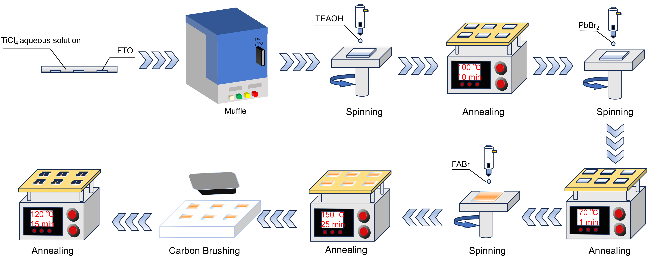
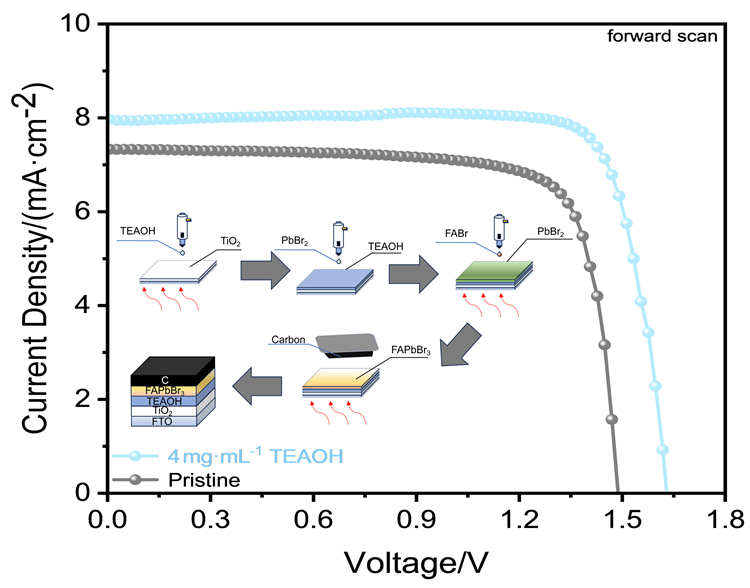
In this work, high-quality FAPbBr3 perovskite films were fabricated via a two-step solution spin-coating method, in which PbBr2 films were first deposited followed by the spin-coating of a formamidinium bromide (FABr) methanol solution. To regulate interfacial charge transport and suppress defect-assisted recombination, tetraethylammonium hydroxide (TEAOH) was introduced as an interfacial modifier at the TiO2/FAPbBr3 interface. By systematically tuning the concentration of the TEAOH aqueous solution, the influence of interfacial modification on perovskite crystallization, defect passivation, and carrier dynamics was comprehensively investigated.
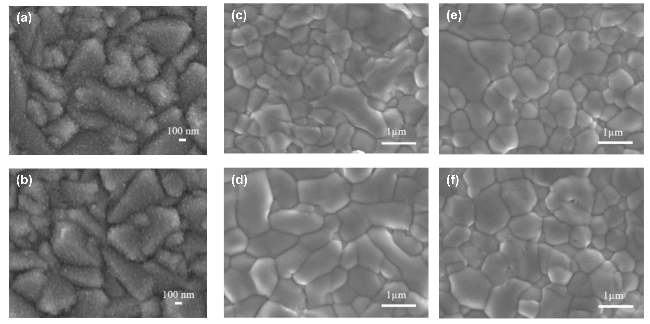
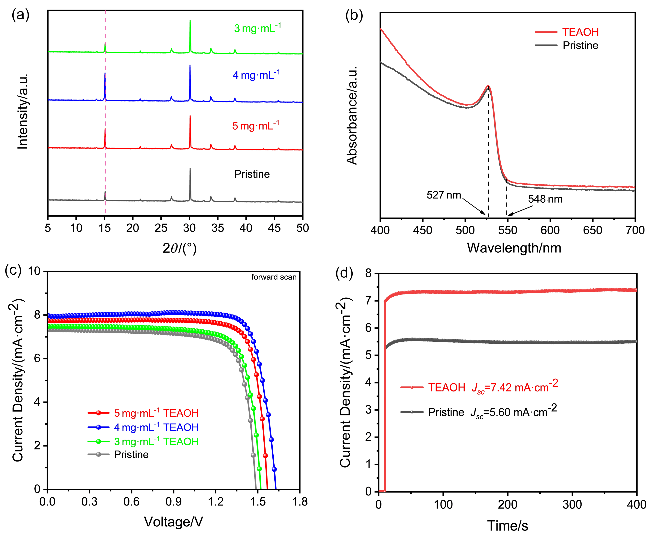
Morphological characterization by scanning electron microscopy revealed that an optimal TEAOH concentration of 4 mg·mL-1 significantly improved the film quality, featuring enlarged grain size, reduced grain boundary density, and a more compact and uniform morphology. X-ray diffraction analysis confirmed enhanced crystallinity and improved phase purity of the FAPbBr3 films after TEAOH modification. Meanwhile, ultraviolet-visible absorption spectra demonstrated strengthened light-harvesting capability, which can be attributed to the improved microstructure and reduced optical scattering losses.
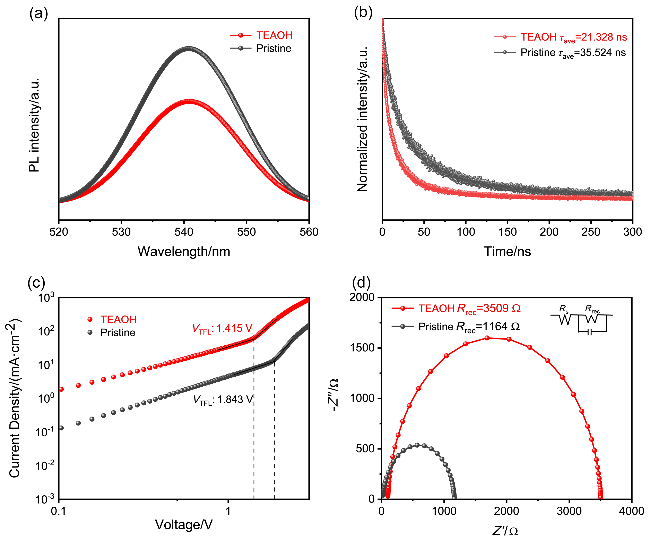
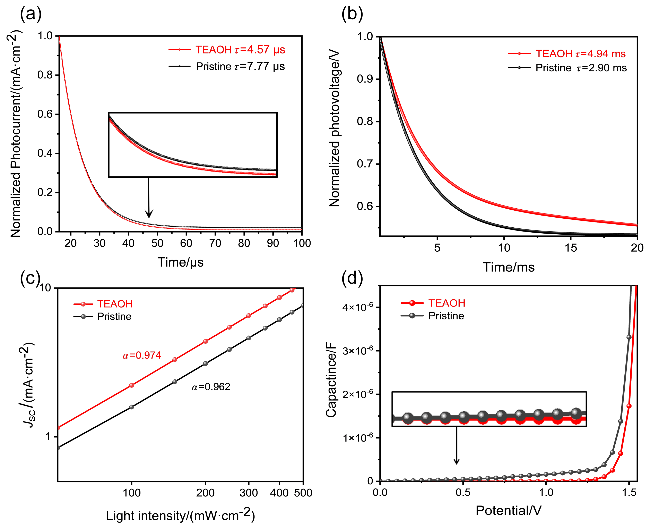
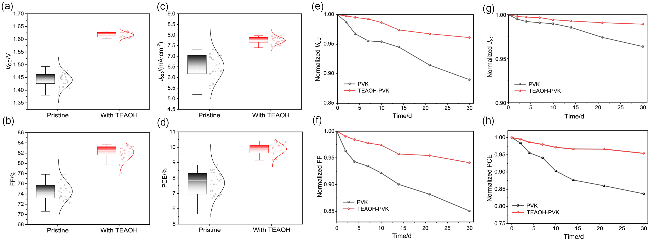
Electrical and spectroscopic analyses, including steady-state and time-resolved photoluminescence, space-charge-limited current measurements, electrochemical impedance spectroscopy, and transient optoelectronic characterization, consistently revealed that TEAOH modification effectively reduced interfacial defect density, suppressed nonradiative recombination, and promoted faster electron extraction at the TiO2/FAPbBr3 interface. As a result, the optimized HTL-free FAPbBr3 PSC delivered a high open-circuit voltage of 1.63 V, a short-circuit current density of 7.99 mA·cm-2, and a fill factor of 83.74%, achieving a power conversion efficiency of 10.91%, which represents the highest reported efficiency for HTL-free FAPbBr3-based PSCs to date. In addition, the modified devices exhibited stable current output under continuous illumination.
This study demonstrates that TEAOH interfacial engineering is a simple yet highly effective strategy to simultaneously improve crystallization quality, interfacial charge transport, and photovoltaic performance in wide-bandgap perovskite solar cells, offering valuable insights for the development of efficient and stable perovskite optoelectronic devices.

Cite this article

Wang Jiayan , GUO Huanhuan , Yin Xiaoyao , Zhang Yunzhao , Wang Wei , Zhao Chenrui , Chen Jie , Wen Jie , Sun Weihai . Preparation of High-Efficiency FAPbBr₃ Perovskite Solar Cells via TEAOH Interface Modification[J]. Acta Chimica Sinica, 0 : 25100347 . DOI: 10.6023/A25100347

References

[1] Akkerman Q.A.; Manna, L. ACS Energy Lett.2020, 5,604.
[2] Li N.X.; Tao S.X.; Chen, Y.H; Niu X.X.; Onwudinanti C.K.; Hu C.; Qiu Z.W.; Xu Z.Q.; Zheng G.H.; Wang L.G.; Zhang Y.; Li L.; Liu H.F.; Lun Y.Z.; Hong J.W.; Wang X.Y.; Liu Y.Q.; Xie H.P.; Gao Y.L.; Bai Y.; Yang S.H.; Brocks G.; Chen Q.; Zhou H.P. Nat. Energy.2019, 4,408.
[3] Xu L.; Wu D.; Lv W.X.; Xiang Y.; Liu Y.; Tao Y.; Yin J.; Qian M.Y.; Li P.; Zhang L.Q.; Chen S.F.; Mohammed O.F.; Bakr O.M.; Duan Z.; Chen R.F.; Huang W. Adv. Mater.2022,34,2107111.
[4] Zou,Y.; Li,Z.; Chen,H.H.; Liu,Y.C.; Tong,A.L.; Yan,H.Y.; He,R.W.; Hua,G.X.; Zeng,W.D.; Sun,W.H. CHINESE JOURNAL OF LUMINESCENCE.2021,42,682.
(邹宇,李昭,陈衡慧,刘伊辰,童安玲,颜惠英,何若玮,花国鑫,曾伟东,孙伟海. 发光学报. 2021,42.682.)
[5] Wang H.; Zhang C.Q.;Huang W.Q.;Zou X.P.;Chen Z.Y.;Sun S.L.;Zhang L.X.;Li J.M.;Cheng J.;Huang S.X.;Gu M.K.;Chen X.Y.;Guo X.;Gui R.X.; Wang, W.M. Phys. Chem. Chem. Phys.2022,24,27585.
[6] Shaw B.K.;Castillo-Blas, C.;Thorne, M.F.;Ríos Gómez, M.L.;Forrest, T.;Lopez, M.D.;Chater, P.A.;McHugh, L.N.;Keen, D.A.; Bennett, T.D. Chem. Sci. 2022, 13,2033.
[7] Jeon N.J.;Noh J.H.;Kim Y.C.;Yang W.S.;Ryu S.; Seok S.I. Nat. Mater.2014, 13,897.
[8] Kieslich G.;Sun S.J.; Cheetham A.K. Chem. Sci.2015, 6,3430.
[9] Zhu J.W.;Tang M.X.;He B.L.;Zhang W.Y.;Li,X.K.; Gong,Z.K.; Chen,H.Y.; Duan,Y.Y.; Tang, Q.W. J. Mater. Chem. A.2020, 8,20987.
[10] Ti J.J.;Zhu J.W.;He B.L.;Zong Z.H.;Yao X.P.;Tui R.;Huang H.;Chen C.;Chen H.Y.;Duan Y.Y.; Tang, Q.W. J. Mater. Chem. A.2022,10,6649.
[11] Cui L.F.; He B.L.;Ding Y.; Zhu,J.W.; Yao,X.P.; Ti,J.J.; Chen,H.Y.; Duan,Y.Y.; Tang Q.W. Chem. Eng. J.2022,431,134193.
[12] Carulli F.;He M.D.;Cova F.;Erroi A.;Li L.;Brovelli, S. ACS Energy Lett.2023, 8,1795.
[13] Li,H.; Wang,Z.Y.; Zheng,S.Z.; Zhu,W.H.; Zhang,Y.Y.; Wang,Y.; Sun,W.H.; Wu,J.H.Surf. Interf. 2025,62,106255.
[14] Zhao Y.Y.;Wang Y.D.;Duan J.L.;Yang X.Y.; Tang, Q.W. J. Mater. Chem. A.2019, 7,6877.
[15] Eperon G.E.;Stranks S.D.;Menelaou C.;Johnston M.B.;Herz L.M.; Snaith, H.J. Energy Environ. Sci.2014, 7,982.
[16] Klug M.T.;Osherov A.;Haghighirad A.A.;Stranks S.D.;Brown P.R.;Bai S.;Wang J.T.W.;Dang X.N.;Bulovic V.;Snaith H.J.; Belcher, A.M. Energy Environ. Sci.2017, 10,236.
[17] Zheng,Q.S.;Cao,F.X.;Wang,Y.H.;Tong,A.L.;Wang,S.B.;Chen,P.X.;Zhao,Z.Y.;Wang,Y.;Sun,W.H.;Pan,W.C.;Li,Y.L.;Wu J.H. Inorg. Chem. Front.2024,11,6627.
[18] Das Adhikari R.;Baishya H.;Patel M.J.;Yadav D.; Iyer P.K. Small.2024, 20,2404588.
[19] Duan J.L.;Zhao Y.Y.;Wang Y.D.;Yang X.Y.; Tang, Q.W. Angew. Chem. Int. Ed.2019, 58,16147.
[20] Tu Y.G.;Xu G.N.;Yang X.Y.;Zhang Y.F.;Li Z.J.;Su R.;Luo D.Y.;Yang W.Q.;Miao Y.;Cai R.;Jiang L.H.;Du X.W.;Yang Y.C.;Liu Q.S.;Gao Y.;Zhao S.;Huang W.;Gong Q.H.; Zhu, R. Sci. China-Phys. Mech. Astron.2019, 62,974221.
[21] Zhu,W.H.; Wang,Y.J.; Li,H.; Wang,Y,; Zheng S.Z.; Wang,Z.Y.; Chen,S.T.; Sun,W.H.Acta Chim. Sinica.2025,83,616.
(朱文昊;汪玉杰;李浩;汪杨;郑松志;王则远;陈劭添;孙伟海. 化学学报.2025,83,616.)
[22] Dong Q.F.;Fang Y.J.;Shao Y.C.;Mulligan P.;Qiu J.;Cao L.; Huang J.S. Science.2015, 347,967.
[23] Shaw B.K.;Castillo-Blas, C.;Thorne, M.F.;Ríos Gómez, M.L.;Forrest, T.;Lopez, M.D.;Chater, P.A.;McHugh, L.N.;Keen, D.A.; Bennett, T.D.Chem. Sci. 2022, 13,2033.
[24] Li Y.R.;Zhang Y.;Zhu P.D.;Li J.B.;Wu J.W.;Zhang J.Y.;Zhou X.Y.;Jiang Z.Y.;Wang X.Z.; Xu, B.M. Adv. Funct. Mater.2023, 33,2309010.
[25] Tong,A.L.; Jin,Z.H.; Chen,X.H.; Zhu,W.H.; Zheng,Q.S.; Wang,Y.H.; Wang,Y.; Ma,N.G; Sun W.H.; Fu,C.P.; Wu,J.H.; Li Y.L. Chem. Eng. J.2025,503,158507.
[26] Yin,X.Y.;Zhu,W.H.; Shi,P.Y.; Li,Z.S.; Wang,Y.C.; Zhu,N.M.; Wang,Y.; Sun,W.H.Chin.J.Inorg.Chem. 2025,41,469.
(殷逍遥;朱文昊;施谱垚;李宗盛;王艺超;朱能敏;汪杨;孙伟海. 无机化学学报. 2025,41,469.)
[27] Wang X.;Zhang D.;Liu B.Z.;Wu X.;Jiang X.F.;Zhang S.F.;Wang Y.;Gao D.P.;Wang L.N.;Wang H.L.;Huang Z.M.;Xie X.F.;Chen T.;Xiao Z.G.;He Q.Y.;Xiao S.;Zhu Z.L.; Yang S.F. Adv. Mater.2023, 35,2305946.
[28] Amelenan Torimtubun A.A.;Mendez M.;Sanchez J.G.;Pallares J.;Palomares E.; Marsal, L.F. Sustain. Energ. Fuels.2021, 5,6498.
[29] Zheng,S.Z.; Li,H.; Wang,Z.Y.; Wang,Y.; Yin,C. Chen X.H.; Zhu,W.H.; Sun W.H. Chinese Science Bullwtin.2024,69,2814.
(郑松志;李浩;王则远;汪杨;阴聪;陈宣衡;朱文昊;孙伟海. 科学通报. 2024,69,2814.)
[30] Yan F.R.;Duan J.L.;Guo Q.Y.;Zhang Q.Y.;Yang X.Y.;Yang P.Z.; Tang, Q.W. Sci. China Mater.2023, 66,485.
[31] He J.C.;Sheng W.P.;Yang J.;Zhong Y.;Su Y.;Tan L.C.; Chen, Y.W. Energy Environ. Sci.2023, 16,629.
[32] He,R.W.; Wu,Y.J.; Li,Z.; Wang,Y.; Zhu,W.H.; Tong,A.L.; Chen,X.H.; Pan,W.C.; Sun,W.H.; Wu,J.H.Surf.Interf. 2024,48,104274.
[33] Tong,A.L.; Chen,X.H.; Wang,Y.; Wang,Y.H.; Zheng,Q.S.; He,R.W.; Jin,Z.H.; Sun,W.H.; Li,Y.L.;Wu,J.H.ACS Appl. Mater. Interfaces. 2024,16,50640.
[34] Xu,T.T,;Xu,J.C.;Yuan,L.H.;Xu,G.Y.;Zhang,C.;Zhang,R.P.;Huang,S.H.;Wu,X.X.;Zeng,G.X.;Li,Y.W.Chin. J. Chem. 2025,43,2219.
[35] Yue W.; Yang H.; Cai H. Y.; Xiong Y. M.; Zhou T.; Liu Y. J.; Zhao J.; Huang F. Z.; Chen Y. B.; Zhong J. Adv. Mater.2023, 35, 2301548.
[36] Jafarzadeh F.; Dong L.R.; Jang D.J.; Wagner M.; Koch G.; Qiu S.D.; Feroze S.; Cerrillo J.G.; Brabec C.J.; Carlo A. D.; Brunetti F.; Egelhaaf H.J.; Matteocci F. Sol. RRL.2024, 8, 2400530.
[37] Zhang Y. F.; Liang, Y. Q; Wang, Y. J.; Guo F.W.; Sun L.C.; Xu, D.S. ACS Energy Lett.2018, 3, 1808.
[38] Liu Y.W.; Kim B. J.; Wu H.;Boschloo G.; Johansson E. M J.; ACS Appl. Energy Mater.2021, 4, 9276.
[39] Arora N.; Dar M. I.; Mojtaba A.J.; Giordano Fabrizio.; Oellet N.; Jacopin G.; Friend R.H.; Zakeeruddin S. M.; Gratzel M.Nano Lett. 2016, 16, 7155.
Outlines

/