Applications and Perspectives of Metal-Organic Framework Materials in Electrocatalytic Conversion of Low-Concentration CO2

  • Huang Da-Shuai ,
  • Liao Pei-Qin
Expand
  • MOE Key Laboratory of Bioinorganic and Synthetic Chemistry, School of Chemistry, Sun Yat-Sen University, Guangzhou 510275

Received date: 2026-01-05

  Online published: 2026-01-30

Supported by

Project supported by the National Key Research and Development Program of China (No. 2024YFF0506100), National Natural Science Foundation of China (No. 22371304 and No. 224B2117), Fundamental Research Funds for the Central Universities, Sun Yat-Sen University (No. 24lgzy006) and the Guangzhou Science and Technology Program (No. SL2023A04J01767).

Abstract

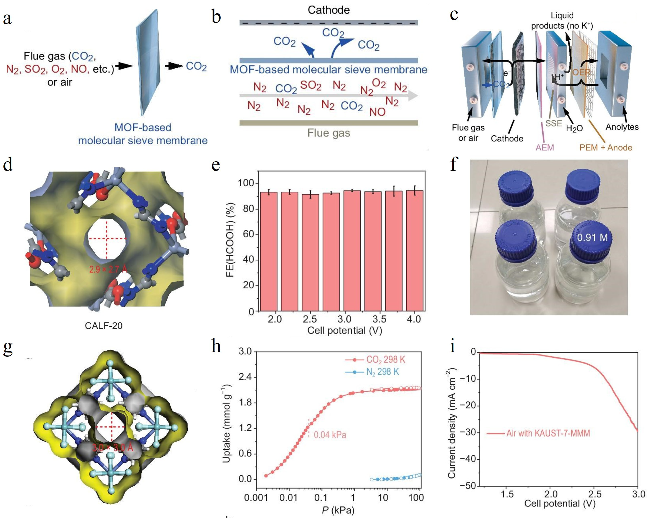
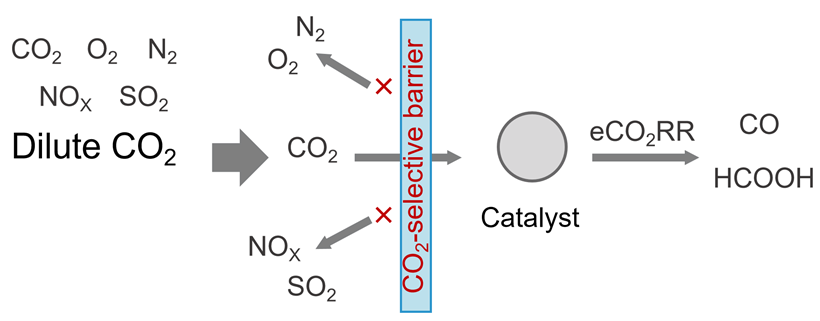
Efficient capture and electrocatalytic conversion of low-concentration carbon dioxide (15% in flue gas and ~400 ppm in ambient air) represents a promising pathway toward carbon emission mitigation and value-added chemical production. In principle, directly utilizing dilute CO2 streams could bypass energy-intensive purification steps and improve the overall process economics. However, electrocatalytic CO2 reduction (eCO2RR) under low CO2 partial pressures is fundamentally limited by sluggish CO2 mass transfer, severe competition from the hydrogen evolution reaction, and performance deterioration induced by impurities (e.g., O2, NOx, and SO2). Moreover, conventional neutral/alkaline electrolytes suffer from pronounced carbonate formation, leading to substantial carbon losses and low single-pass carbon efficiency. These challenges indicate that simply improving intrinsic catalytic activity is insufficient; instead, new materials and system-level strategies are required to simultaneously enrich CO2, regulate interfacial microenvironments, and decouple separation from conversion. Metal-organic frameworks (MOF), featuring tailorable pore architectures, designable pore chemistry, and the capability of integrating multiple functions into a single material or device component, provide a unique platform to address the above limitations. This Perspective highlights recent advances in MOF-based materials for eCO2RR using low-concentration CO2 feedstocks, with an emphasis on representative design paradigms spanning “molecular-scale synergy - reaction-environment regulation - device-level integration”. First, capture and conversion can be coupled within individual MOFs by embedding CO2-philic motifs and catalytic centers into the same porous scaffold, enabling preferential CO2 enrichment, and facilitated transport to active sites under simulated flue gas. Second, reaction-environment engineering, particularly under acidic conditions, offers a viable solution to suppress carbonate formation and enhance carbon utilization; protonation of N-rich frameworks can strengthen CO2 adsorption/transport while limiting proton accessibility to catalytic sites, leading to high Faradaic efficiency and improved single-pass conversion even with dilute CO2 inputs. Third, device-level strategies further decouple CO2 purification from downstream electrolysis by integrating MOF-based molecular sieving mixed-matrix membranes (e.g., MOF/PIM-1 composites) into membrane electrode assemblies, allowing in situ enrichment of flue gas- or air-derived CO2 and impurity removal prior to catalytic conversion. Collectively, these advances demonstrate how MOFs can enable progressive innovations from materials design to interfacial regulation and electrolyzer integration. Finally, key challenges and opportunities are discussed, including mechanistic understanding under complex impurity mixtures, long-term stability, scalable manufacturing of MOF-based layers and membranes, and compatibility with industrial capture and electrolysis infrastructures.

Cite this article

Huang Da-Shuai , Liao Pei-Qin . Applications and Perspectives of Metal-Organic Framework Materials in Electrocatalytic Conversion of Low-Concentration CO2[J]. Acta Chimica Sinica, 0 : 26010006 . DOI: 10.6023/A26010006

References

[1] Osman M. B.; Tierney J. E.; Zhu J.; Tardif R.; Hakim G. J.; King J.; Poulsen C. J.,Nature 2021, 599, 239-244.
[2] Allen M. R.; Frame D. J.; Huntingford C.; Jones C. D.; Lowe J. A.; Meinshausen M.; Meinshausen N.,Nature 2009, 458, 1163-1166.
[3] Duan H.; Zhou S.; Jiang K.; Bertram C.; Harmsen M.; Kriegler E.; van Vuuren, D. P.; Wang, S.; Fujimori, S.; Tavoni, M.; Ming, X.; Keramidas, K.; Iyer, G.; Edmonds, J.,Science 2021, 372, 378-385.
[4] Rogelj J.; den Elzen, M.; Höhne, N.; Fransen, T.; Fekete, H.; Winkler, H.; Schaeffer, R.; Sha, F.; Riahi, K.; Meinshausen, M.,Nature 2016, 534, 631-639.
[5] Li H.; Zick M. E.; Trisukhon T.; Signorile M.; Liu X.; Eastmond H.; Sharma S.; Spreng T. L.; Taylor J.; Gittins J. W.; Farrow C.; Lim S. A.; Crocellà V.; Milner P. J.; Forse A. C.,Nature 2024, 630, 654-659.
[6] Sanz-Pérez, E. S.; Murdock, C. R.; Didas, S. A.; Jones, C. W.,Chem. Rev. 2016, 116, 11840-11876.
[7] Ren S.; Joulié D.; Salvatore D.; Torbensen K.; Wang M.; Robert M.; Berlinguette C. P.,Science 2019, 365, 367-369.
[8] Nitopi S.; Bertheussen E.; Scott S. B.; Liu X.; Engstfeld A. K.; Horch S.; Seger B.; Stephens I. E.L.; Chan, K.; Hahn, C.; Nørskov, J. K.; Jaramillo, T. F.; Chorkendorff, I.,Chem. Rev. 2019, 119, 7610-7672.
[9] Huang L.; Gao G.; Zhao J.; Roberts W. L.; Lu X.,Nat. Catal. 2025, 8, 968-976.
[10] García de Arquer, F. P.; Dinh, C.-T.; Ozden, A.; Wicks, J.; McCallum, C.; Kirmani, A. R.; Nam, D.-H.; Gabardo, C.; Seifitokaldani, A.; Wang, X.; Li, Y. C.; Li, F.; Edwards, J.; Richter, L. J.; Thorpe, S. J.; Sinton, D.; Sargent, E. H.,Science 2020, 367, 661-666.
[11] Yang Y.; Louisia S.; Yu S.; Jin J.; Roh I.; Chen C.; Fonseca Guzman, M. V.; Feijóo, J.; Chen, P.-C.; Wang, H.; Pollock, C. J.; Huang, X.; Shao, Y.-T.; Wang, C.; Muller, D. A.; Abruña, H. D.; Yang, P.,Nature 2023, 614, 262-269.
[12] Huang D.-S.; Wang Y.; Tang Y.; Huang J.-R.; Li P.-X.; Liang C.-P.; Zhao Z.-H.; Liao P.-Q.; Chen X.-M.,Natl. Sci.Rev. 2025, 12, nwaf329.
[13] Song Y.; Musgrave C. B.; Su J.; Huang L.; Guo W.; Liu Y.; Li G.; Xin Y.; Zhang Q.; Feng X.; Liao C.; Liu S.; Kwok R. T.K.; Lam, J. W. Y.; He, M.; Choong, K. S.; Feng, Z.; Tang, B. Z.; Goddard, W. A.; Ye, R.,Nat. Nanotechnol. 2025, 21, 78-86.
[14] Dai Y.; Li H.; Wang C.; Xue W.; Zhang M.; Zhao D.; Xue J.; Li J.; Luo L.; Liu C.; Li X.; Cui P.; Jiang Q.; Zheng T.; Gu S.; Zhang Y.; Xiao J.; Xia C.; Zeng J.,Nat. Commun. 2023, 14, 3382.
[15] Huang D.-S.; Zhu H.-L.; Zhao Z.-H.; Huang J.-R.; Liao P.-Q.; Chen X.-M.,ACS Catal. 2022, 12, 8444-8450.
[16] Ding J.;Bin Yang, H.; Ma, X.-L.; Liu, S.; Liu, W.; Mao, Q.; Huang, Y.; Li, J.; Zhang, T.; Liu, B.,Nat. Energy 2023, 8, 1386-1394.
[17] Huang D.-S.; Qiu X.-F.; Huang J.-R.; Mao M.; Liu L.; Han Y.; Zhao Z.-H.; Liao P.-Q.; Chen X.-M.,Nat. Synth. 2024, 3, 1404-1413.
[18] Zhang H.; Li D.; Chen Z.; Wang Y.; Sun H.; Liu F.; Liu M.; Zheng Y.; Huang H.,Chin. J. Chem. 2024, 42, 1846-1852.
[19] Lu J.; Wang Q.; Jin Z.; Xiao Y.; Huang B.-H.; Zhang C.-H.; Yang G.-Z.; Zhou Y.; Ke F.-S.,Chin. J. Chem. 2024, 42, 2788-2794.
[20] Jin S.; Hao Z.; Zhang K.; Yan Z.; Chen J.,Angew. Chem. Int. Ed. 2021, 60, 20627-20648.
[21] Guan Y.; Li Y.; Li Z.; Hou Y.; Lei L.; Yang B.,Adv. Mater. 2025, 37, 2417567.
[22] Belsa B.; Xia L.; Golovanova V.; Polesso B.; Pinilla-Sánchez, A.; San Martín, L.; Ye, J.; Dinh, C.-T.; García de Arquer, F. P.,Nat. Rev. Mater. 2024, 9, 535-549.
[23] Lai W.; Qiao Y.; Zhang J.; Lin Z.; Huang H.,Energy Environ. Sci. 2022, 15, 3603-3629.
[24] Jia S.; Ma X.; Sun X.; Han B.,CCS Chem. 2022, 4, 3213-3229.
[25] Goeppert A.; Czaun M.; Surya Prakash, G. K.; Olah, G. A.,Energy Environ. Sci. 2012, 5, 7833-7853.
[26] Chu S.,Science 2009, 325, 1599-1599.
[27] Keith D. W.; Holmes G.; St. Angelo,D.; Heidel, K.,Joule 2018, 2, 1573-1594.
[28] Wei W.; Li D.; Yan X.; Mu X.; Li Z.; Liu Z.,Carbon Capture Sci. Technol. 2024, 13, 100235.
[29] Buckingham J.; Reina T. R.; Duyar M. S.,Carbon Capture Sci. Technol. 2022, 2, 100031.
[30] Wang M.; Joel A. S.; Ramshaw C.; Eimer D.; Musa N. M.,Appl. Energy 2015, 158, 275-291.
[31] Gouedard C.; Picq D.; Launay F.; Carrette P. L.,Int. J. Greenh. Gas Control 2012, 10, 244-270.
[32] Bui M.; Adjiman C. S.; Bardow A.; Anthony E. J.; Boston A.; Brown S.; Fennell P. S.; Fuss S.; Galindo A.; Hackett L. A.; Hallett J. P.; Herzog H. J.; Jackson G.; Kemper J.; Krevor S.; Maitland G. C.; Matuszewski M.; Metcalfe I. S.; Petit C.; Puxty G.; Reimer J.; Reiner D. M.; Rubin E. S.; Scott S. A.; Shah N.; Smit B.; Trusler J. P.M.; Webley, P.; Wilcox, J.; Mac Dowell, N.,Energy Environ. Sci. 2018, 11, 1062-1176.
[33] Dutcher B.; Fan M.; Russell A. G.,ACS Appl. Mater. Interfaces 2015, 7, 2137-2148.
[34] Yang Q.; Wang X.; Zhang J.; Mao Y.; Xi S.; Liu Y.-C.; Hsu Y.-H.; Zhang L.; Bin Dolmanan, S.; Wang, M.; Wang, B.; Zang, Y.; Zhang, M.; Leow, W. R.; Hung, S.-F.; Wang, Z.; Lum, Y.,Nat. Synth. 2025, 4, 1396-1407.
[35] Jouny M.; Luc W.; Jiao F.,Ind. Eng. Chem. Res. 2018, 57, 2165-2177.
[36] Jin J.; Wicks J.; Min Q.; Li J.; Hu Y.; Ma J.; Wang Y.; Jiang Z.; Xu Y.; Lu R.; Si G.; Papangelakis P.; Shakouri M.; Xiao Q.; Ou P.; Wang X.; Chen Z.; Zhang W.; Yu K.; Song J.; Jiang X.; Qiu P.; Lou Y.; Wu D.; Mao Y.; Ozden A.; Wang C.; Xia B. Y.; Hu X.; Dravid V. P.; Yiu Y.-M.; Sham T.-K.; Wang Z.; Sinton D.; Mai L.; Sargent E. H.; Pang Y.,Nature 2023, 617, 724-729.
[37] Luo J.-P.; Zhang J.; Yin N.; Wang T.-P.; Tan Z.-C.; Han W.; Shi Q.,Chem. Eng. J. 2022, 442, 136210.
[38] Hou P.; Song W.; Wang X.; Hu Z.; Kang P.,Small 2020, 16, 2001896.
[39] Jiao L.; Yang W.; Wan G.; Zhang R.; Zheng X.; Zhou H.; Yu S.-H.; Jiang H.-L.,Angew. Chem. Int. Ed. 2020, 59, 20589-20595.
[40] Ding M.; Liu X.; Ma P.; Yao J.,Coord. Chem. Rev. 2022, 465, 214576.
[41] Zhang Y.; Ding L.; Xie Z.; Zhang X.; Sui X.; Li J.-R.,Chin. Chem. Lett. 2025, 36, 109676.
[42] Zhao Z.-H.; Huang J.-R.; Huang D.-S.; Zhu H.-L.; Liao P.-Q.; Chen X.-M.,J. Am. Chem. Soc. 2024, 146, 14349-14356.
[43] Liu Y.-Y.; Huang J.-R.; Zhu H.-L.; Liao P.-Q.; Chen X.-M.,Angew. Chem. Int. Ed. 2023, 62, e202315579.
[44] Kim C.; Bui J. C.; Luo X.; Cooper J. K.; Kusoglu A.; Weber A. Z.; Bell A. T.,Nat. Energy 2021, 6, 1026-1034.
[45] Li H.-Y.; Kong X.-J.; Han S.-D.; Pang J.; He T.; Wang G.-M.; Bu X.-H.,Chem. Soc. Rev. 2024, 53, 5626-5676.
[46] Lees E. W.; Bui J. C.; Romiluyi O.; Bell A. T.; Weber A. Z.,Nat. Chem. Eng. 2024, 1, 340-353.
[47] Liu W.; Lv Z.; Li X.; Wang C.; Tian C.; Feng X.; Wang B.; Yang W.,J. Am. Chem. Soc. 2025, 147, 24023-24031.
[48] Mukhopadhyay S.; Naeem M. S.; Shiva Shanker, G.; Ghatak, A.; Kottaichamy, A. R.; Shimoni, R.; Avram, L.; Liberman, I.; Balilty, R.; Ifraemov, R.; Rozenberg, I.; Shalom, M.; López, N.; Hod, I.,Nat. Commun. 2024, 15, 3397.
Outlines

/