


1 引言
2 结果与讨论
2.1 聚合物膜-蛋白质纳米孔道体系构建
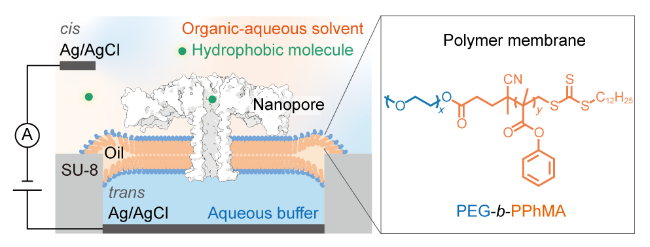
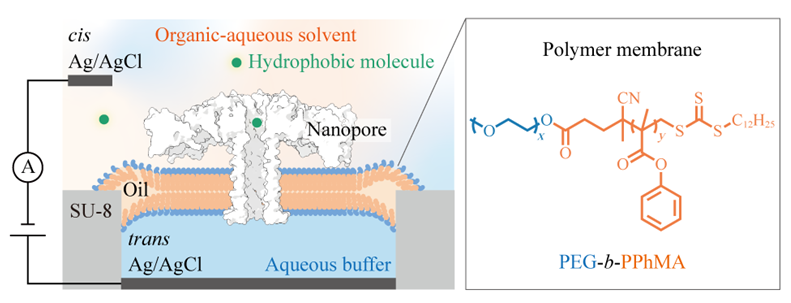
图1 用于水-有机溶剂体系单分子测量的聚合物膜-蛋白质纳米孔道系统. 通过将Aerolysin纳米孔道嵌入PEG-b-PPhMA两嵌段聚合物双层膜, 构建了可以在水-有机体系中维持稳定的单分子传感体系, 能够对疏水有机小分子进行灵敏检测Figure 1 Schematic illustration of the single-molecule sensing platform based on a PEG-b-PPhMA polymer membrane. An Aerolysin nanopore embedded in the polymer membrane remains stable in organic-aqueous solvent mixtures, enabling highly sensitive detection of hydrophobic organic molecules |
表1 PEG-b-PPhMA聚合物膜与传统磷脂膜的性能对比Table 1 Performance comparison of PEG-b-PPhMA polymer versus traditional lipid membranes |
| Molecule | Molecular weight/kDa | Solvent a | Leakage current/pA b | Nanopore system c |
|---|---|---|---|---|
| DPhPC | 0.8 | decane | 1.6±0.8 | Y |
| PEG44-b-PPhMA52 | 8.7 | toluene | 29.5±1.9 | N |
| PEG44-b-PPhMA79 | 13.8 | toluene | 9.5±0.5 | N |
| PEG44-b-PPhMA135 | 20.3 | toluene Vtoluene/Vdecane=4 Vtoluene/Vdecane=1 Vtoluene/Voctane=1 | 16.2±0.1 10.4±2.7 2.5±0.4 1.9±1.0 | Y Y Y Y |
| PEG44-b-PPhMA170 | 30.5 | toluene | 4.5±0.5 | N |
a Oil solvent composition used to dissolve the lipid or polymer that mixtures are given as volume ratios; b Leakage baseline current at +100 mV from three independent measurements; c Feasibility of Aerolysin nanopore insertion into the membrane (Y, successful; N, unsuccessful). |
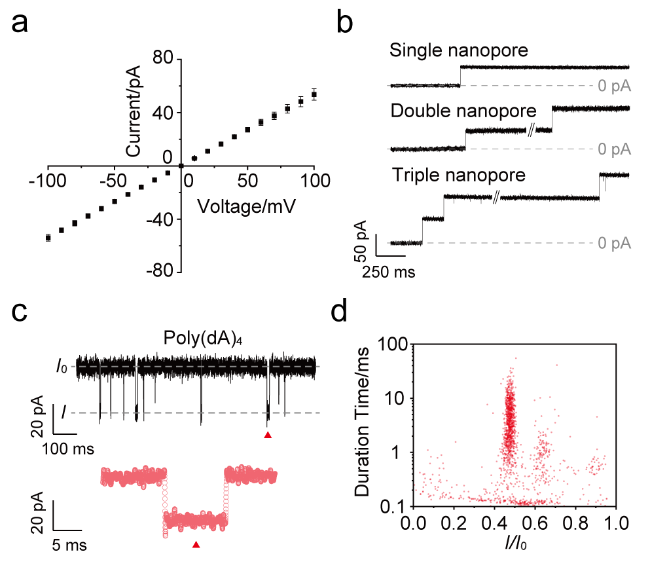
图2 PEG44-b-PPhMA135聚合物膜支撑的WT Aerolysin纳米孔道单分子测量. (a) WT Aerolysin的I-V曲线(n=3); (b) 不同数量的纳米孔道蛋白依次嵌入聚合物膜的电流-时间轨迹图; (c)使用WT Aerolysin检测2 μmol/L Poly(dA)4分子的电流轨迹和特征信号(红色箭头); (d) Poly(dA)4分子的阻断时间与残余电流程度(I/I0)分布散点图(统计事件数1500). 实验条件: 缓冲液为200 μL的1 mol/L Tris-KCl, pH 8.0, 施加电压为+100 mV, 采用20 mg/mL PEG44-b-PPhMA135/(V甲苯/V正辛烷=1)溶液成膜, 采样率为100 kHz, 低通滤波为5 kHz. 膜-孔体系基于MECA-16芯片构建, 电流信号通过Orbit 16仪器采集Figure 2 Single-molecule sensing using Aerolysin nanopore based on PEG44-b-PPhMA135 polymer membrane. (a) Current-voltage (I-V) curves of WT Aerolysin (n=3). (b) Current traces showing stepwise insertion of different numbers of nanopores into the polymer membrane. (c) Representative current traces of WT Aerolysin detecting 2 μmol/L Poly(dA)4, with characteristic blockade signals indicated by red arrows. (d) Scatter plot of duration time versus residual current depth (I/I0) for Poly(dA)4 with 1500 events. All experiments were performed in 200 μL of 1 mol/L Tris-KCl, pH 8.0, at +100 mV with 20 mg/mL PEG44-b-PPhMA135/(Vtoluene/Voctane=1). Data were acquired using an Orbit 16 system with MECA-16 chips at 100 kHz sampling rate and at 5 kHz low-pass filter |
2.2 聚合物膜支撑的纳米孔道疏水小分子传感
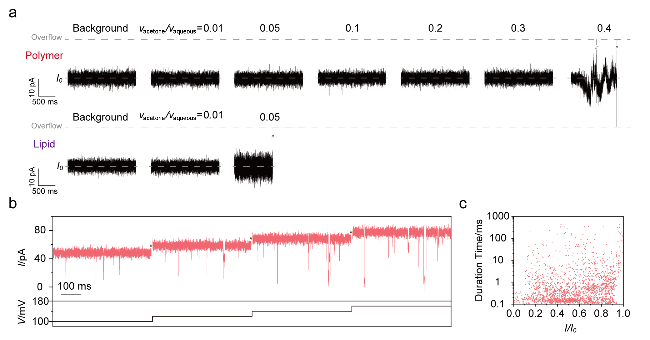


图3 聚合物膜支撑的Aerolysin纳米孔道在水-有机溶剂体系中对疏水有机小分子的检测. (a) 在不同丙酮含量下WT Aerolysin的开孔电流(I0)轨迹图. 上: PEG44-b-PPhMA135/(V甲苯/V正辛烷=1)聚合物膜. 下: DPhPC/正癸烷磷脂膜. V丙酮/V水分别为 0 (纯水相缓冲液)、0.01、0.05、0.1、0.2、0.3和0.4 (从左至右), 施加电压为+100 mV; (b) WT Aerolysin检测10 mmol/L N,N'-间苯撑双马来酰亚胺有机小分子的电流轨迹图. 施加电压依次为+100 mV, +120 mV, +140 mV和+160 mV (从左至右); (c) WT Aerolysin检测N,N'-间苯撑双马来酰亚胺的阻断时间-残余电流程度分布散点图, 施加电压为+100 mV, 统计事件数2000. 终体系V丙酮/V水=0.1. 实验条件: 缓冲液为1 mol/L Tris-KCl, pH 8.0, 采样率为100 kHz, 低通滤波为5 kHz, 膜-孔体系基于MECA-16芯片构建, 电流信号通过Orbit 16仪器采集Figure 3 Hydrophobic organic small molecule sensing using WT Aerolysin nanopore supported by polymer membranes in organic-aqueous solvent systems. (a) Open-pore current (I0) traces of WT Aerolysin inserted into the PEG44-b-PPhMA135/(Vtoluene/Voctane=1) membrane (top) and the DPhPC lipid membrane dissolved in decane (bottom). Measurements were performed in acetone-aqueous solvent systems, including pure aqueous buffer (Vacetone/Vaqueous=0, background) and mixtures with acetone-to-aqueous volume ratios of 0.01, 0.05, 0.1, 0.2, 0.3, and 0.4 (from left to right) at +100 mV; (b) Current traces of 10 mmol/L N,N'-1,3-phenylenedimaleimide detection with WT Aerolysin at +100 mV, +120 mV, +140 mV, and +160 mV, respectively; (c) Scatter plot of duration time versus I/I0 for N,N'-1,3-phenylenedimaleimide sensing. Statistics were collected in Vacetone/Vaqueous=0.1 system at +100 mV with 2000 events. All experiments were performed in 1 mol/L Tris-KCl, pH 8.0 as aqueous buffer solution with a sampling rate of 100 kHz and a 5 kHz low-pass filter using a MECA-16 chip and Orbit 16 instrument |