Communication

Chiral Phosphonic Acid-Catalyzed Enantioselective Ring-Opening/ Electrophilic Reaction to Access α,α-Bisindole Triarylmethanes

  • Teng Liu , a, * ,
  • Yijiang Guo a ,
  • Bingqian Tian a ,
  • Jianping Wu a ,
  • Jiangbo He , b, *
Expand
  • a Yunnan Key Laboratory of Crystalline Porous Organic Functional Materials, Qujing Normal University, Qujing 655011, China
  • b Kunming Key Laboratory of Respiratory Disease, Kunming University, Kunming 650214, China
* E-mail: ;

Received date: 2026-04-02

  Online published: 2026-06-10

Supported by

Yunnan Fundamental Research Projects(202501AT070398)

Special Basic Cooperative Research Innovation Programs of Qujing Science and Technology Bureau & Qujing Normal University(KJLH2024ZD01)

Yunnan Key Laboratory of Crystalline Porous Organic Functional Materials(202449CE340024)

and the Visiting Scholar Program of the China Scholarship Council.

Abstract

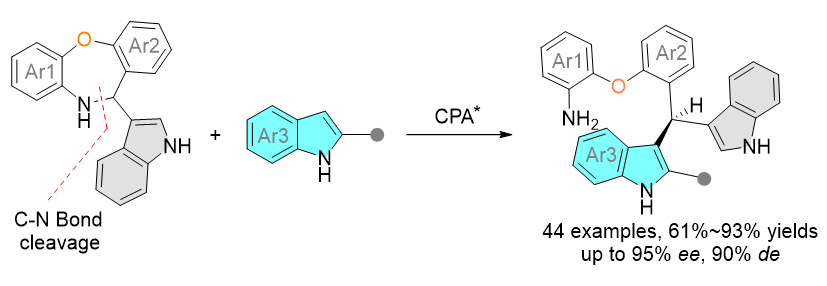
Chiral triarylmethanes have a significant application in the field of pharmaceuticals and materials science, and exhibit diverse functional properties and biological activities, such as fluorescent probe, polymer materials, organic dyes, rapid cell division inhibitor, aromatic enzyme inhibitor, hormone-dependeng breast cancer agent, anti-bacterial and anticancer drug, etc. Due to their importance, the synthesis of heteroaryl-containing triarylmethane derivatives has attracted continuous attention from organic chemists in recent years. Among them, chiral α,α-bisindole triarylmethanes, as a relatively unique member of this family, has also drawn considerable interests in asymmetric catalytic synthesis. At present, the construction of chiral α,α-bisindole triarylmethanes mainly relies on leaving groups bearing in reactants (such as -OH, -OTMS, -NHR, etc.), and the asymmetric synthetic routes, reaction atom economy, and stereoselectivities still face certain limitations. In this text, a type of readily available and promising seven-membered heterocyclic 3-indolyl[1,4]oxazepines as precursors undergo an asymmetric catalytic ring-opening reaction process involving the cleavage of C—N bond that are subsequently trapped by electron-donating or electron-withdrawing modified nucleophilic indoles catalyzed by chiral phosphonic acid. Notably, the reactions harness the ability of 3-indolyl[1,4]oxazepines to generate the key intermediate indole imine methides (IIMs) catalyzed by chiral phosphonic acid via a ring-opening reaction process which proved to be an excellent electrophilic species. This protocol provided a concise route to the synthesis of a series of structurally diverse chiral α,α-bisindole triarylmethanes (44 examples) in excellent enantiomeric excess, diastereomeric excess, and yields (up to 95% ee, 90% de, 61%~93% yields) and 100% atom economy. The biological activity tests indicated that the chiral α,α-bisindole triarylmethanes have obvious inhibitory effect on HeLa (IC50: 22.73±3.03~54.3±2.94 µmol/L), Sy5Y (IC50: 30.3±3.28~61.0±3.10 µmol/L), and Panc-1 cancer cells (IC50: 43.93±2.72~63.35±3.39 µmol/L), exhibiting good and diversified anticancer activities. Therefore, these preliminary evaluation results of these anticancer activities imply that chiral α,α-bisindole triarylmethanes have potential applications in medicinal chemistry.

Cite this article

Teng Liu , Yijiang Guo , Bingqian Tian , Jianping Wu , Jiangbo He . Chiral Phosphonic Acid-Catalyzed Enantioselective Ring-Opening/ Electrophilic Reaction to Access α,α-Bisindole Triarylmethanes[J]. Acta Chimica Sinica, 2026 , 84(7) : 1025 -1032 . DOI: 10.6023/A26040098

1 引言

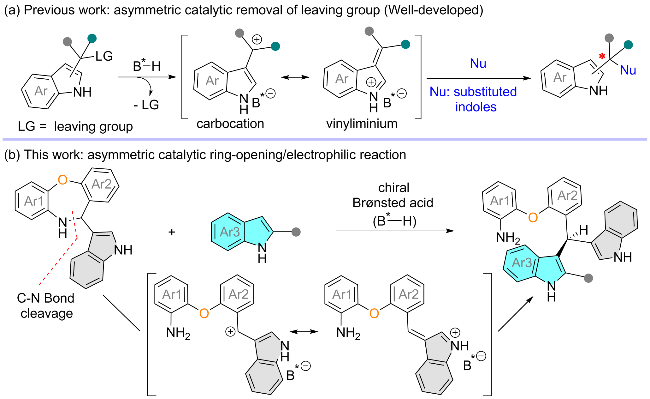
三芳基甲烷结构单元广泛存在于天然产物、活性药物及有机材料分子中[1]. 其中, 在这类分子中含杂芳基三芳基甲烷骨架多存在于活性药物分子中, 通常展现出抗癌[2]、抗菌[3]和抗结核[4]等生物活性(图1). 手性α,α-双吲哚三芳基甲烷作为手性三芳基甲烷家族[5]中一类较为特殊的结构, 近年来受到有机合成化学家们的持续关注. 目前, 多位化学家利用官能团化的吲哚甲醇平台分子发展了手性Brønsted酸催化活化吲哚甲醇脱水, 通过非环C—O键断键形成亲电物种中间体再与亲核吲哚发生不对称亲电反应[6] (图2a). 除此之外, 张锁秦等[7]发展了四甲基硅氧基(-OTMS)作为离去基团, 在手性膦酸催化下非环C—O键断键, 实现与取代吲哚催化不对称Friedel-Crafts烷基化反应, 高对映选择性合成手性α,α-双吲哚三芳基甲烷(图2a). 游书力等[8]发展了手性膦酸催化非环C—N键断键脱除对甲基苯磺酰胺基(-NHTs)离去基团, 以中等对映选择性(45%~68% ee)合成目标产物 (图2a). 鉴于目前合成路线主要依赖底物中的离去基团, 致使反应原子经济性受限明显. 因此, 开发可替代且原子经济性的合成路线, 高立体选择性合成结构多样化的手性α,α-双吲哚三芳基甲烷是十分有必要的.
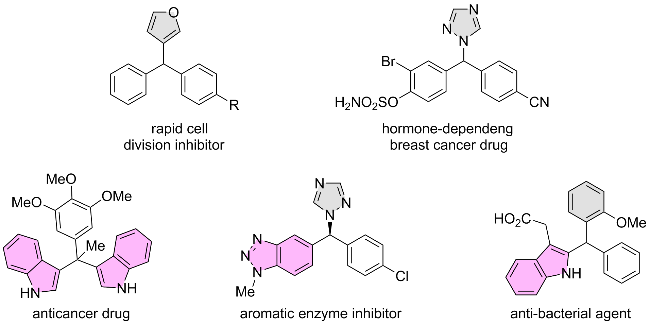
图1 具有生物活性的代表性化合物

Figure 1 Biological activities of representative molecules

图2 手性α,α-双吲哚三芳基甲烷不对称合成策略

Figure 2 Asymmetric synthesis strategy of chiral α,α-bisindole triarylmethanes

鉴于上述非环C—O键和C—N键断键脱除离去基团参与不对称催化反应的启发, 我们设想在不需要离去原子或基团情况下, 不对称反应仍能进行, 从而实现反应的原子经济性和高立体选择性构建手性α,α-双吲哚三芳基甲烷. 基于本课题组[9]长期对杂环化学的研究兴趣, 发现一类易得且具有合成应用潜力的七元环氧氮杂䓬, 该类分子在Brønsted酸催化下能够发生C—N键断键, 并形成具有亲电性的活性中间体, 进而与亲核试剂发生反应. 在本工作中, 发展了手性螺环膦酸催化七元环氧氮杂䓬C—N键断键与取代吲哚不对称开环/亲电串联反应, 以优秀的立体选择性、产率以及100%原子经济性合成一系列结构多样的α,α-双吲哚三芳基甲烷. 而且, 生物活性测试表明所合成产物对人类宫颈癌细胞(HeLa)、人骨髓神经母细胞瘤细胞(Sy5Y)及胰腺癌细胞(Panc-1)生长均表现出明显抑制效果, 展现出良好的抗癌活性(图2b).

2 结果与讨论

2.1 反应条件优化

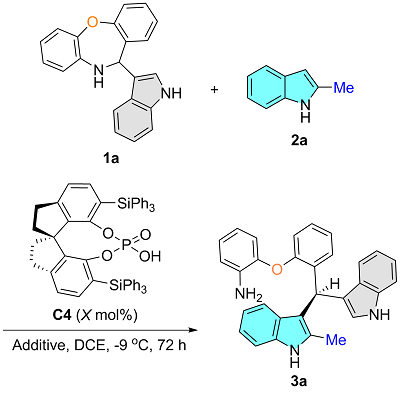
最初, 为了便于开展研究, 选择3-吲哚基七元环氧氮杂䓬1a和2-甲基吲哚2a作为不对称开环/亲电串联反应的反应物. 首先, 对手性膦酸催化剂(A1~A8, B1~B2, C1~C4)进行考察, 包括BINOL衍生的手性膦酸和螺环手性膦酸催化剂(具体见支持信息表S1). 在上述手性膦酸催化下反应均能够顺利进行, 并均以优秀的收率生成化合物3a. 遗憾的是, 产物的对映选择性并不理想(12%~61% ee). 催化剂筛选结果表明, 螺环手性膦酸催化剂C4催化效果较好, 以61% ee和84%产率得到产物3a. 随后, 我们进一步对其它反应条件进行了细致筛选和优化, 包括反应温度、溶剂、添加剂、手性催化剂负载量、反应物比例及浓度(见支持信息表S2, S3). 实验结果表明, 反应温度和反应溶剂对该反应立体选择性影响明显, 反应添加剂对该反应转化产生不利影响. 最终, 反应的最优条件得以确定, 螺环手性膦酸C4 (10 mol%)作为手性催化剂, 1,2-二氯乙烷(DCE)作为反应溶剂, 在-9 ℃条件下以90%收率和91% ee合成目标分子3a (表1, Entry 3).
表1 反应条件优化a

Table 1 Optimization of reaction conditions

Entry Solvent (mL) Additive X (mol%) Yieldb/% eec/%
1 DCE (0.1) — 10 85 87
2 DCE (0.2) — 10 88 88
3 DCE (0.3) — 10 90 91
4 DCE (0.4) — 10 90 88
5 DCE (0.5) — 10 88 89
6 DCE (0.8) — 10 86 84
7d DCE (0.3) 3 Å MS 10 83 62
8d DCE (0.3) 4 Å MS 10 84 65
9d DCE (0.3) 5 Å MS 10 84 60
10d DCE (0.3) Na2SO4 10 85 88
11d DCE (0.3) MgSO4 10 85 87
12 DCE (0.3) — 5 80 89
13 DCE (0.3) — 15 90 90
14 DCE (0.3) — 20 90 90

a Conditions: the reaction was carried out in 1a (0.033 mmol) and 2a (0.363 mmol) catalyzed by C4 (10 mol%) in DCE. b Isolated yield based on 1a. c The ee value was determined by HPLC. d The loading of additive in the reaction was carried out with 50 mg. DCE=1,2-dichloroethane.

2.2 底物范围考察

在建立最优反应条件后, 我们进一步考察该反应的底物普适性(图3). 首先, 针对亲核吲哚C2位点取代基位阻和共轭效应的差异, 我们分别考察了乙基、异丙基以及叔丁基、苯基和2-吡啶基对反应立体选择性的影响. 结果表明, 亲核吲哚C2位点取代基位阻对反应有显著影响, 位阻越大, 产物的转化率及立体选择性明显降低(3c~3d). 取代基共轭效应对反应立体选择性有明显不利影响, 仅以11%~34% ee合成产物3e~3f. 在上述反应中, 吲哚C2位点甲基取代被证明是合适大小的取代基团. 随后, 对吲哚苯环上不同位置的供电子取代基(Me、OMe)和拉电子取代基(F、Cl、Br)对反应影响分别进行考察. 反应均能顺利进行, 以81%~94% ee和80%~93%收率合成相应的α,α-双吲哚三芳基甲烷3g~3q. 此外, 该合成方法还成功应用于各种C2位无取代基的吲哚. 一般情况下, 在吲哚苯环上不同位置具有富电子取代基(Me, OMe)能更好地适应此反应, 以80%~85% ee和86%~92%产率合成产物3r~3w, 尽管具有拉电子效应的取代基团(Br, I)以稍低的对映选择性(61%~70% ee)合成相应的产物3x~3y. 值得注意的是, 当吲哚7位取代时, 仅以38%~50% ee合成产物3z~3aa. 另外, 吡咯作为一类传统的杂环碳亲核试剂也可以兼容该反应, 以88%收率和74% ee合成产物3bb. 而且, 该反应能以优异的收率和对映选择性合成相应的含硫醚键化合物3cc, 产物的绝对构型为S-构型[10-11].
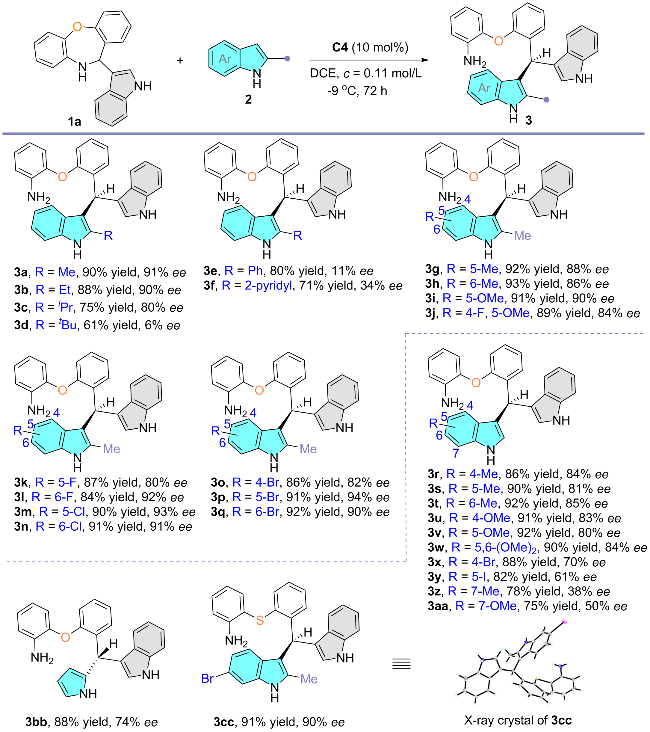
图3 取代吲哚底物范围

Figure 3 Substrate scope of substituted indoles

为了进一步证明已建立合成方法的实用性, 多个结构复杂含活性药物分子片段的吲哚衍生物被考察(图4). 令人印象深刻的是, 天然产物(+)-薄荷醇和活性药物分子非诺贝特酸、吲哚美辛酸和苯达甲酸衍生化的反应物均很好地参与此反应, 并分别以90% de, 89%~95% ee以及82%~85%的收率合成相应产物4a~4d, 上述反应进一步说明反应兼容性强, 底物普适性广.
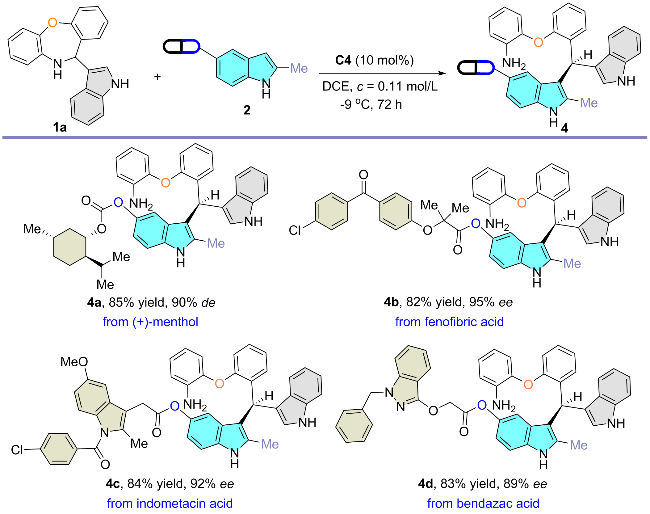
图4 生物活性分子衍生物吲哚底物范围

Figure 4 Indole substrate scope of bioactive molecule derivatives

随后, 对含各种取代基的3-吲哚基七元环氧氮杂䓬1底物范围进行考察(图5). 结果表明, 在芳环上(Ar1和Ar2)不同位置进行取代的供电子基团(Me, OMe)或吸电子基团(F, Cl, Br)都能很好地与吲哚2a顺利发生反应, 以82%~92%产率和81%~93% ee合成相应的α,α-双吲哚三芳基甲烷5a~5i.
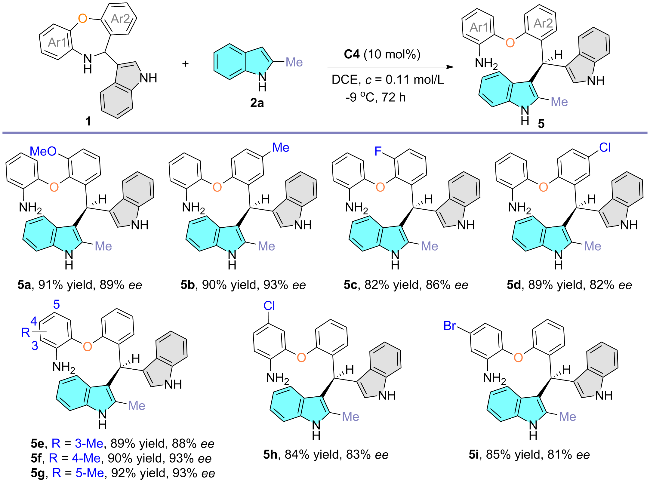
图5 3-吲哚基七元环氧氮杂䓬底物范围

Figure 5 Substrate scope of 3-indolyl[1,4]oxazepines

另外, 为了考察手性产物的生物活性, 我们尝试测试部分手性产物(3a, 3bb, 5b, 5d, 5h)对人类宫颈癌细胞(HeLa)、人骨髓神经母细胞瘤细胞(Sy5Y)以及胰腺癌细胞(Panc-1)的细胞毒性来研究其抗癌生物活性(图6). 初步测试结果表明这些产物对HeLa、Sy5Y和Panc-1癌症细胞均表现出良好的抑制效果. 其中, 对HeLa癌细胞的IC50值范围为22.73±3.03至54.3±2.94 µmol/L, 对Sy5Y癌细胞的IC50值范围为30.3±3.28至61.0±3.10 µmol/L, 对Panc-1癌细胞的IC50值范围为43.93±2.72至63.35±3.39 µmol/L (具体见支持信息表S5, S6). 因此, 抗癌活性初步测试表明, 所合成的手性产物在药物化学中具有潜在的应用价值.
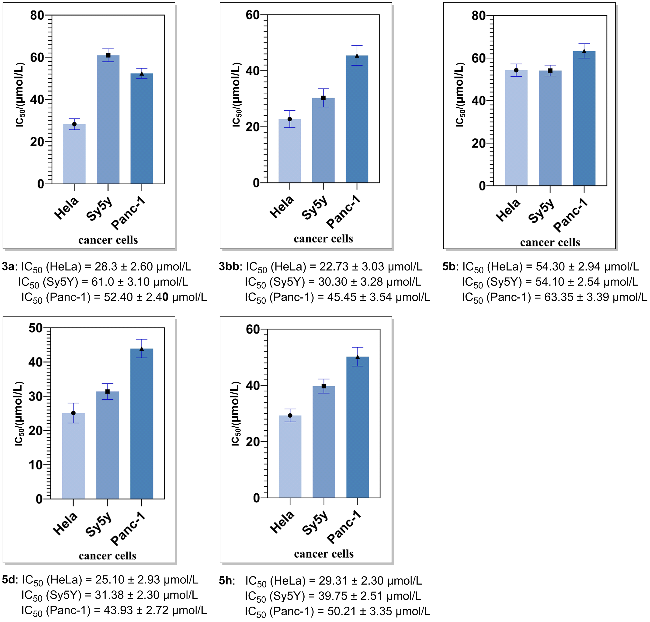
图6 部分手性产物抗癌活性测试

Figure 6 Anticancer activity testing of partial chiral products

为了进一步阐明该不对称催化反应过程, 我们进行了一些控制实验(图7). 在标准反应条件下, N-甲基衍生的反应物1l无法与2-甲基吲哚2a发生该不对称反应. 而且, 在此反应中N-甲基吲哚2b也被证明是不合适的反应底物. 实验结果表明, 反应物中游离的NH部分在此催化不对称反应中起着重要作用, 与反应催化模式相关联. 另外, 将反应物1a替换为1k和1n分别与取代吲哚2f和2a发生反应, 以5% ee和80%产率合成产物6, 以79% ee和82%产率得到产物7. 由此可知, 3-亚甲基亚胺中间体的顺利形成对反应的立体选择性影响较大.
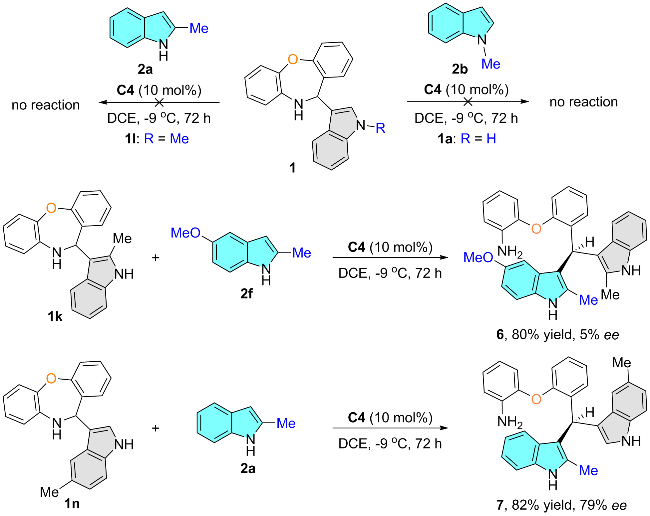
图7 控制实验

Figure 7 Control experiments

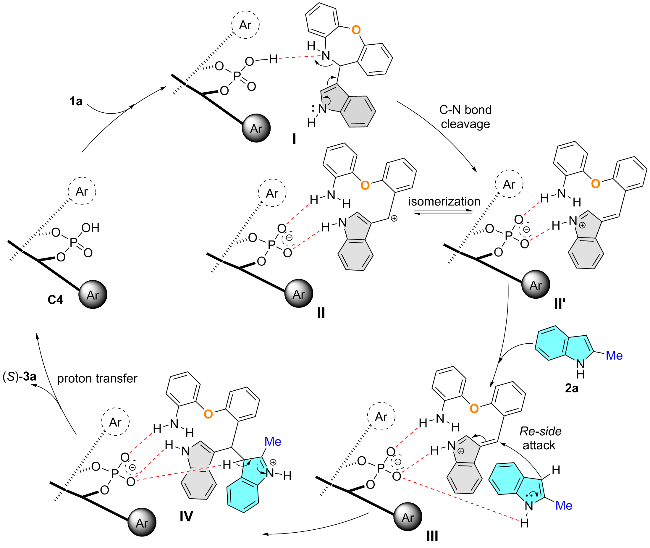
根据上述控制实验结果和已知文献报道[12], 我们提出了一个可能的反应机制过程(图8). 在反应过程中, 手性膦酸C4作为Brønsted酸催化剂首先通过N—H氢键相互作用活化反应物1a, 促使反应物1a中C—N键断裂, 进而由中间体I形成碳阳离子II (与II'互变异构)中间体. 在这种情况下, 反应物中游离的NH能够与催化剂形成多重氢键以促进随后的亲电反应. 2-甲基吲哚2a从Re侧进攻亲电亚甲基位点, 形成新的C—C键, 产生中间体IV. 最后, 中间体IV经历质子转移并与催化剂解离, 最终合成目标产物3a.
图8 可能的反应机理

Figure 8 A plausible mechanism

3 结论

综上所述, 本研究工作发展了一种螺环手性膦酸催化环状3-吲哚基七元环氧氮杂䓬与取代吲哚间对映选择性开环/亲电反应方法, 以高收率、高对映选择性、非对映选择性合成一系列结构多样的手性α,α-双吲哚三芳基甲烷. 该合成策略未借助离去基团, 实现反应的100%原子经济性. 而且, 所合成的α,α-双吲哚三芳基甲烷对人类宫颈癌细胞(HeLa)、人骨髓神经母细胞瘤细胞(Sy5Y)以及胰腺癌细胞(Panc-1)均表现出良好的抗癌生物活性.
(Cheng, B.)
[1]
(a) Chen, X.-Q.; Pradhan, T.; Wang, F.; Kim, J. S.; Yoon, J. Chem. Rev. 2012, 112, 1910.

DOI

(b) Wulff, H.; Zhorov, B. S. Chem. Rev. 2008, 108, 1744.

DOI

(c) Liu, S.; Liu, Z.; Li, M. Acta Chim. Sinica 1995, 53, 1185 (in Chinese).

(刘绍璞, 刘忠芳, 李明, 化学学报, 1995, 53, 1185.)

(d) Liu, D.; Xu, H.; Hang, Y.; Lu, H. Chin. J. Org. Chem. 2022, 42, 796 (in Chinese).

DOI

(刘冬兰, 许海燕, 杭懿, 陆鸿飞, 有机化学, 2022, 42, 796.) .

DOI

(e) Li, Z.; Wang, J.; Zhao, J.; Zhao, C.; Liu, X.; Yu, X. Chin. J. Org. Chem. 2014, 34, 485 (in Chinese).

(李中贤, 王俊伟, 赵俊宏, 赵灿方, 刘小培, 余学军, 有机化学, 2014, 34, 485.)

DOI

(f) Lin, J.; Sun, W. Chin. J. Org. Chem. 2020, 40, 4367 (in Chinese).

DOI

(林进, 孙伟, 有机化学, 2020, 40, 4367.)

DOI

[2]
(a) Lewis, M. R.; Goland, P. P. Cancer Res. 1953, 12, 130.

(b) Nair, V.; Thomas, S.; Mathew, S. C.; Abhilash, K. G. Tetrahedron 2006, 62, 6731.

DOI

(c) Parai, M. K.; Panda, G.; Chaturvedi, V.; Manju, Y. K.; Sinha, S. Bioorg. Med. Chem. Lett. 2008, 18, 289.

DOI

(d) Mondal, S.; Panda, G. RSC Adv. 2014, 4, 28317.

DOI

[3]
Whitehead, C. W.; Whitesitt, C. A. J. Med. Chem. 1974, 17, 1298.

DOI PMID

[4]
Panda, G.; Shagufta; Mishra, J. K.; Chaturvedi, V.; Srivastava, A. K.; Srivastava, R.; Srivastava, B. S. Bioorg. Med. Chem. 2004, 12, 5269.

DOI

[5]
Selected recent examples: (a) Zhu, S.; Xiao, B.; Huang, M.; Wu, Y.; Sun, T.-Y.; Yang, J.; Wu, Y.-D.; Zhang, J. J. Am. Chem. Soc. 2025, 147, 45210.

DOI

(b) Jiang, C.; Meng, Y.; Huang, Y.; Liu, C.; Yin, Y.; Zhao, X.; Cao, S.; Jiang, Z. J. Am. Chem. Soc. 2025, 147, 5320.

DOI

(c) Wang, J.; Fu, C.; Chen, X.; Wan, L.; Jiang, J.; Zheng, J.; Shi, J.; Liu, X.-H.; Lou, Y. Org. Lett. 2025, 27, 7081.

DOI

(d) Kang, B.; Xu, M.-H. ACS Catal. 2025, 15, 13030.

DOI

(e) Zhao, S.-N.; Song, H.-Q.; Hu, Y.; Gao, F.; He, Y.; Zhao, X.-J. Org. Biomol. Chem. 2026, 24, 805.

DOI

(f) Min, Y.; Shen, H.; Huang, S.; Gu, H.; Lin, X. Org. Biomol. Chem. 2025, 23, 5359.

DOI

[6]
(a) Zhang, J.-Y.; Chen, J.-Y.; Gao, C.-H.; Yu, L.; Ni, S.-F.; Tan, W.; Shi, F. Angew. Chem. Int. Ed. 2023, 62, e202305450.

DOI

(b) Rui, K.; Gu, H.; Woldegiorgis, A. G.; Lin, X. Org. Lett. 2023, 25, 6654.

DOI

(c) Zhu, W.-R.; Su, Q.; Deng, X.-Y.; Liu, J.-S.; Zhong, T.; Meng, S.-S.; Yi, J.-T.; Weng, J.; Lu, G. Chem. Sci. 2022, 13, 170.

DOI

(d) Qi, S.; Liu, C.-Y.; Ding, J.-Y.; Han, F.-S. Chem. Commun. 2014, 50, 8605.

DOI

(e) Han, Z.; Wang, W.; Zhuang, H.; Wang, J.; Wang, C.; Wang, J.; Huang, H.; Sun, J. Org. Lett. 2023, 25, 477.

DOI

(f) Wu, P.; Wu, J.; Wang, J.; Mei, G. Chin. J. Org. Chem. 2018, 38, 1251 (in Chinese).

DOI

(伍平, 吴迦勒, 王静怡, 梅光建, 有机化学, 2018, 38, 1251.)

DOI

[7]
Zhuo, M.-H.; Jiang, Y.-J.; Fan, Y.-S.; Gao, Y.; Liu, S.; Zhang, S. Org. Lett. 2014, 16, 1096.

DOI

[8]
Sun, F.-L.; Zheng, X.-J.; Gu, Q.; He, Q.-L.; You, S.-L. Eur. J. Org. Chem. 2010, 2010, 47.

DOI

[9]
(a) Wen, Y.; Liu, T.; Huang, S.; Zeng, G.; Zhang, Z.; Ye, Y.; Huang, C. Org. Lett. 2025, 27, 1935.

DOI

(b) Wen, Y.-M.; Liu, T.; Zeng, G.-Y.; Li, J.-J.; Yao, Z.-H.; He, C.-X.; Huang, C. Eur. J. Org. Chem. 2025, 28, e202401287.

DOI

(c) Liu, T.; Li, Y.; Cheng, F.; Shen, X.; Liu, J.; Lin, J. Green Chem. 2019, 21, 3536.

DOI

(d) Guo, Y.-J.; Fu, Z.-Y.; She, A.-R.; Wang, F.; He, C.-X.; Liu, T. Asian J. Org. Chem. 2025, 14, e00614.

DOI

[10]
CCDC 2441272 of compound 3cc contains the supplementary crystallographic data for this paper.

[11]
Liu, T.; She, A.; Wang, F.; Liu, K.; Cheng, F. Mol. Divers. 2026, 10.1007/s11030-026-11617-z.

[12]
(a) Fan, T.; Zhang, H.-H.; Li, C.; Shen, Y.; Shi, F. Adv. Synth. Catal. 2016, 358, 2017.

DOI

(b) Kim, Y.; Lee, J.; Jung, J.; Kim, S.-G. Tetrahedron Lett. 2019, 60, 1625.

(c) Li, L.; He, Z.; Liu, M.; He, Y.; Loh, T.-P. Adv. Synth. Catal. 2026, 368, e70366.

DOI

Outlines

/

〈 〉