


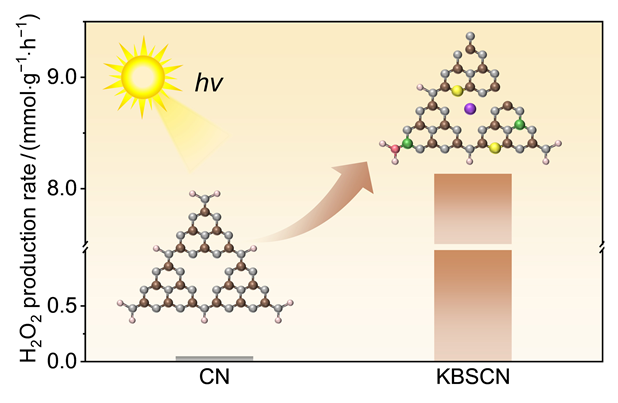
1 引言
2 结果与讨论
2.1 催化剂合成与基本物化性质
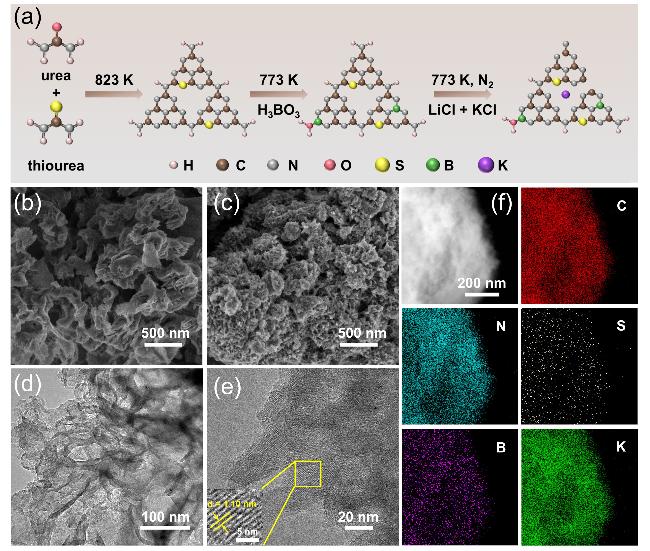
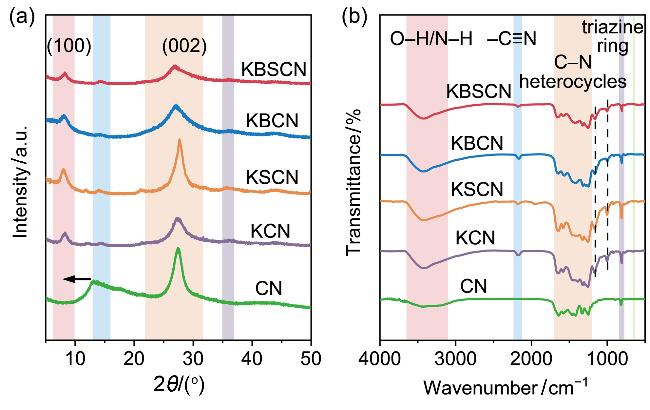
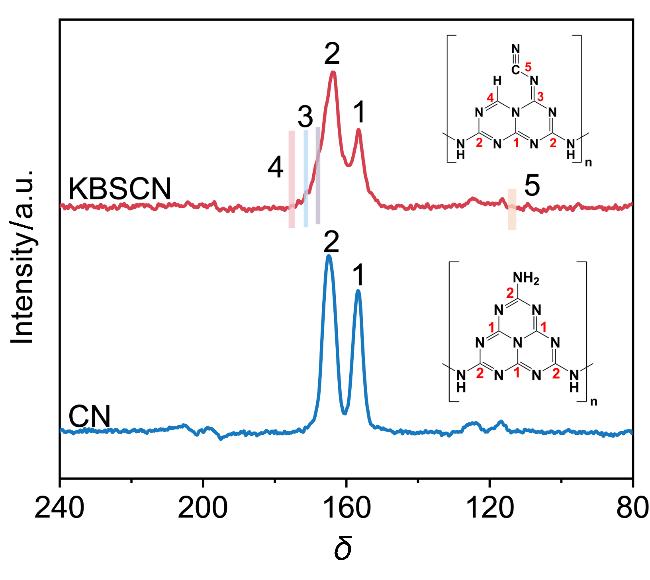
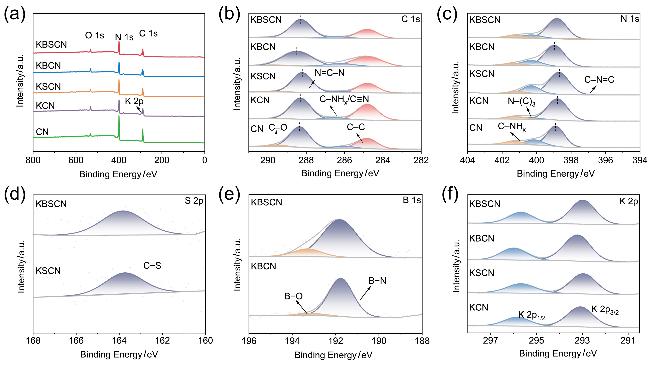
图4 CN和KxCN的(a) XPS全谱、(b) C 1s谱和(c) N 1s谱; (d) KSCN和KBSCN的S 2p谱; (e) KBCN和KBSCN的B 1s谱; (f) KxCN的K 2p谱Figure 4 (a) Survey XPS spectra, (b) C 1s spectra, and (c) N 1s spectra of CN and KxCN. (d) S 2p spectra of KSCN and KBSCN. (e) B 1s spectra of KBCN and KBSCN. (f) K 2p spectra of KxCN |
2.2 光催化O2还原合成H2O2性能
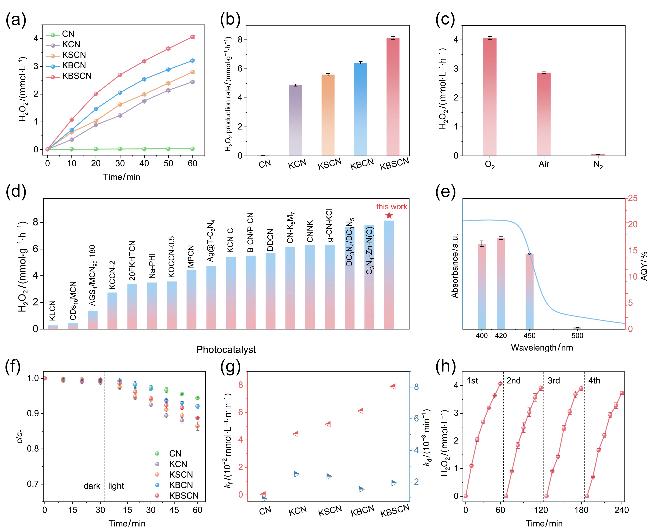
图5 CN和KxCN上(a) H2O2的生成浓度随时间的变化和(b)光催化O2还原合成H2O2生成速率的比较; (c)不同气氛(O2、air、N2)下KBSCN上光催化O2还原合成H2O2的生成速率对比; (d) KBSCN与已报道的氮化碳基催化剂的H2O2生成速率对比; (e)不同入射光波长(400、420、450和500 nm)下获得的AQY与KBSCN的紫外−可见漫反射光谱的对比; (f) N2气氛下CN和KxCN对H2O2 (c0=5 mmol•L−1)的光催化分解性能; (g)光催化O2还原生成H2O2过程中CN和KxCN对应的kf与kd; (h) KBSCN在光催化O2还原合成H2O2反应中的循环套用稳定性; 所有光催化性能数据均为3次独立重复实验的平均值, 图中误差棒代表3次平行实验的标准偏差Figure 5 (a) Time-dependent production of H2O2 and (b) comparison of the H2O2 production rate in photocatalytic O2 reduction over CN and KxCN. (c) H2O2 production rate over KBSCN in different atmospheres (O2, air, or N2). (d) Comparison of the H2O2 production rate between KBSCN and reported carbon nitride-based catalysts. (e) AQY obtained at different incident light wavelengths (400, 420, 450, and 500 nm) versus UV-vis DRS of KBSCN. (f) Photocatalytic decomposition of H2O2 (c0=5 mmol•L−1) over CN and KxCN under N2 atmosphere. (g) kf and kd for H2O2 production over CN and KxCN in photocatalytic reduction of O2 to H2O2. (h) Recyclability of KBSCN in photocatalytic O2 reduction to H2O2. All photocatalytic performance data are presented as the average of three independent replicate experiments, and the error bars in the figures represent the standard deviation of three parallel experiments |
2.3 光电性质表征
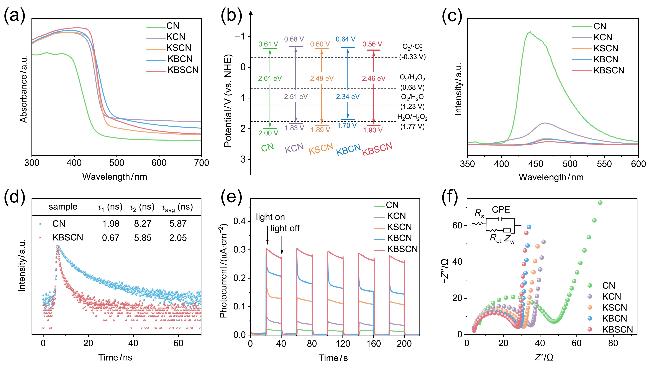
图6 CN和KxCN的(a) UV-vis DRS光谱和(b)能带结构及H2O2生成对应的氧化还原电位; (c) CN和KxCN的PL光谱; (d) CN和KBSCN的TRPL光谱; CN和KxCN的(e)瞬态光电流响应和(f) Nyquist图(插图为拟合EIS所采用的等效电路)Figure 6 (a) UV-vis DRS spectra and (b) energy band structure and redox potential for photocatalytic production of H2O2 of CN and KxCN. (c) PL spectra of CN and KxCN. (d) TRPL spectra of CN and KBSCN. (e) Photocurrent response curves and (f) EIS Nyquist plots of CN and KxCN (the inset represents the equivalent circuit for fitting EIS) |
2.4 光催化反应机理
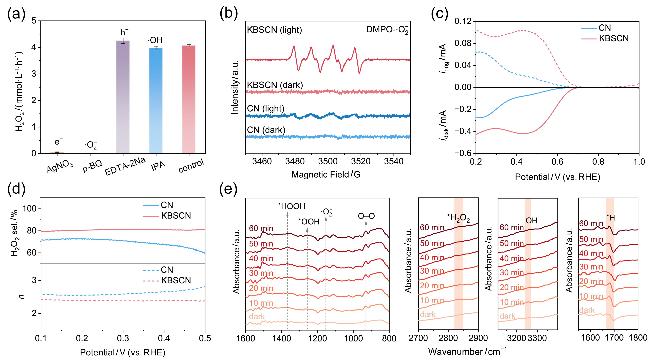
图7 (a)不同捕获剂对KBSCN上H2O2生成速率的影响(所有光催化性能数据均为3次独立重复实验的平均值, 图中误差棒代表3次平行实验的标准偏差); (b)黑暗和光照条件下CN和KBSCN的DMPO-•O2− EPR谱; (c)在O2饱和的0.1 mol•L−1 KOH溶液(pH=13)中, 以1600 r•min−1的转速测试CN和KBSCN的LSV曲线; (d)由LSV测试结果计算得到CN和KBSCN的H2O2选择性和电子转移数; (e)不同光照时间间隔下KBSCN上的in situ DRIFT谱(测试条件: 可见光照射, O2-水蒸汽气氛)Figure 7 (a) H2O2 production rate in the presence of different scavengers over KBSCN (All photocatalytic performance data are presented as the average of three independent replicate experiments, and the error bars in the figure represent the standard deviation of three parallel experiments). (b) EPR signals of DMPO-•O2− generated on CN and KBSCN under dark or visible light irradiation situation. (c) The LSV curves of CN and KBSCN measured at 1600 r•min−1 in O2-saturated 0.1 mol•L−1 KOH solution (pH=13); (d) Selectivity of H2O2 production and electron transfer number derived from LSV test. (e) In situ DRIFT spectra detected on KBSCN upon visible light irradiation at different time intervals (Experimental conditions: visible light irradiation and O2-water vapor atmosphere) |
2.5 密度泛函理论计算
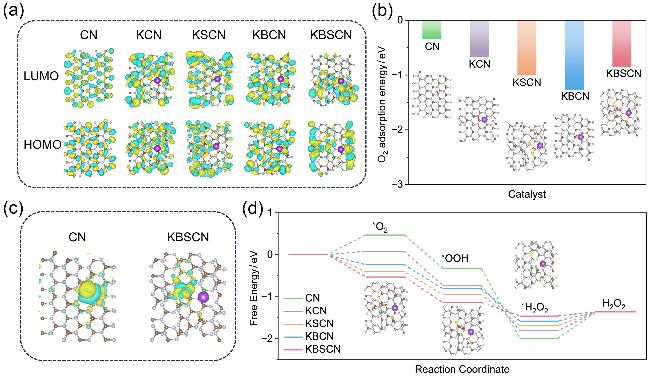


图8 (a) CN和KxCN的LUMO和HOMO分布图; (b) CN和KxCN上的O2吸附能; (c) CN和KBSCN活性位点上O2的差分电荷密度(黄色与青色区域分别代表电子富集与电子缺失); (d) CN和KxCN上光催化ORR的自由能变化曲线(插图为KBSCN表面发生的ORR过程); 粉色、棕色、灰色、红色、黄色、绿色、紫色分别代表氢、碳、氮、氧、硫、硼、钾原子Figure 8 (a) LUMO and HOMO distributions for CN and KxCN. (b) Adsorption energy of O2 on CN and KxCN. (c) Differential charge density of O2 on the active site of CN and KBSCN (The yellow and the cyan regions represent electron accumulation and depletion, respectively). (d) Free energy profiles for photocatalytic ORR over CN and KxCN (The insets show the ORR process occurring on KBSCN). The pink, brown, gray, red, yellow, green, and purple colors represent hydrogen, carbon, nitrogen, oxygen, sulfur, boron, and potassium, respectively |