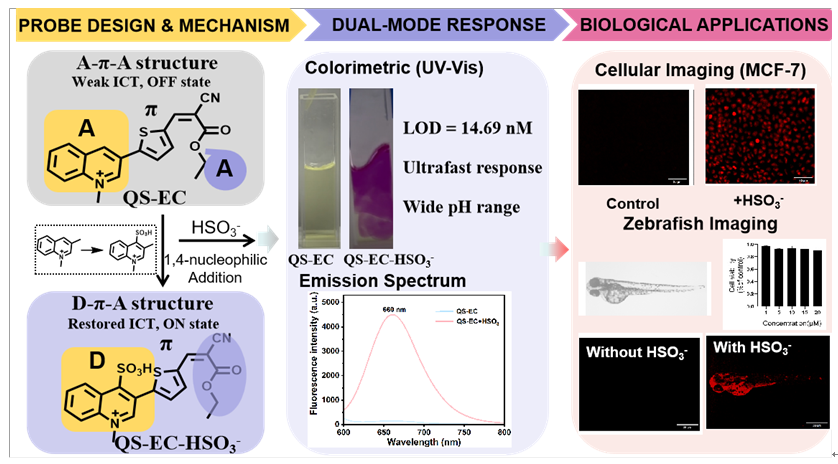
SO2 is an important gaseous signaling molecule in living organisms, and its abnormal concentration is closely associated with various physiological and pathological processes, including respiratory and central nervous system diseases. SO2 exists mainly as HSO3⁻ in aqueous solution, making the development of highly specific and high-contrast detection methods for HSO3⁻ crucial for studying the physiological functions of SO2 and the early diagnosis of related diseases. In this study, a quinoline-based near-infrared fluorescent probe, QS-EC, with an A-π-A structure was designed and synthesized. The probe initially exists in a fluorescent "dark state." Upon specific 1,4-nucleophilic addition with HSO3⁻, its structure transforms into a D-π-A configuration, restoring the intramolecular charge transfer (ICT) effect and resulting in a dual-mode response of solution color deepening and fluorescence turn-on. The optical performance of QS-EC was systematically evaluated using UV-Vis and fluorescence spectroscopy. Spectroscopic results showed that the QS-EC responded to HSO3- within 3 s, with a detection limit of 14.69 nmol/L, and remains stable within a pH range of 6-13. Competitive experiments demonstrated that QS-EC exhibits high selectivity for HSO3⁻ without interference from other anions or biothiols. It is worth emphasizing that QS-EC enables efficient detection of HSO3⁻, which not only simplifies the detection process but also significantly enhances the probe's practicality and biocompatibility. Furthermore, MTT assays were used to evaluate its biocompatibility, revealing that cell viability remained above 80% after incubation with 0-20 μM of QS-EC for 24 hours, confirming its low cytotoxicity. For cellular imaging, QS-EC successfully enabled dynamic monitoring of both exogenous and endogenous HSO3⁻ in live cells. Further in vivo imaging experiments in zebrafish model showed a high signal-to-noise ratio red fluorescence turn-on signal, with fluorescence intensity increasing as the HSO3⁻ concentration rose. This indicates that QS-EC is capable of visually tracking HSO3⁻ distribution in complex living environments. Through systematic evaluation from molecular design and spectral performance to cellular and in vivo applications, this study fully demonstrates the potential of QS-EC for early diagnosis research in SO2-related diseases.
Tian Mingyu
,
Meng Lingying
,
Zhong Keli
,
Tang Lijun
,
Song Fengling
. Construction of a Novel Near-Infrared Dual-Mode Probe Based on Quinoline for HSO3- and Its Imaging Applications[J]. Acta Chimica Sinica, 0
: 26040114
-26040114
.
DOI: 10.6023/A26040114
[1] Cao H.; Yu F.; Dou K.; Wang R.; Xing Y.; Luo X.; Yu F.Anal Chem. 2024, 96 (46), 18574-18583.
[2] Gao S.; Wang S.; Li M.; Zhang W.; Zhang W.; Yang L.; Li Z.; Yu M.Sensors and Actuators B: Chemical . 2026, 447,138873.
[3] Liang T.; Jiang Y.; Li Y.; Tian M.; Wu C.; Yan X.; Sun X.; Shen T.; Zhong K.; Tang L.Sensors and Actuators B: Chemical. 2026, 446, 138694.
[4] Tamima U.; Santra M.; Song C. W.; Reo Y. J.; Ahn K. H.Anal Chem. 2019, 91 (16), 10779-10785.
[5] Yang L.-N.; Zhou, N. Chin. Appl. Chem.2026, 43(04),481-497(in Chinese).(杨乐妮, 周娜. 应用化学, 2026, 43 (04):481-497.)
[6] Wan Q.; Chen S.; Shi W.; Li L.; Ma H.Angew Chem Int Ed Engl. 2014, 126 (41): 11096-11100.
[7] Ren R.; Tian M.; Li J.; Yan X.; Liang T.; Wu C.; Li Y.; Tang L.; Zhong K.Dyes and Pigments. 2026, 245,113191.
[8] Wang S.; Zheng H.; Ma L.; Yang L.; Song Q.; Yu M.; Li Z.Sensors and Actuators B: Chemical. 2024, 417, 136113.
[9] Li K.; Li L.-L.; Zhou Q.; Yu K.-K.; Kim J. S.; Yu X.-Q.Coordination Chemistry Reviews. 2019, 388, 310-333.
[10] Lu Y.; Li H.; Yao Q.; Sun W.; Fan J.; Du J.; Wang J.; Peng X.Dyes and Pigments. 2020, 180, 108440.
[11] Xu Y.-L.; Chen H.; Xu B.-S.; Li D.; Sun J.-Q.; Zhou L.; Cai F.-Z.; Wang H. Anal. Sci.2021, 37(2), 234-238 (in Chinese).(徐永玲, 陈浩, 许丙嵩, 李迪, 孙建强, 周乐, 蔡丰泽, 王慧. 分析科学学报, 2021, 37(02): 234-238.)
[12] Koch M.; Koppen R.; Siegel D.; Witt A.; Nehls I.J Agric Food Chem. 2010, 58 (17), 9463-7.
[13] Stipanuk M. H.; Ueki I.J Inherit Metab Dis. 2011, 34 (1), 17-32.
[14] Kalimuthu P.; Tkac J.; Kappler U.; Davis J. J.; Bernhardt P. V.Anal Chem 2010, 82 (17), 7374-9.
[15] Su T.; Song X.; Tu D.; Wang R.; Xing Y.; Yu F.; Luo X.Anal Chem. 2025, 97 (39), 21679-21687.
[16] Li C.-C.; Meng Y.-L.; Niu J.-T.; Liu C.; Wang L.; Liang T.; Jia X.-J.; Liu X.-Y.; Kang Y.-F.Sensors and Actuators B: Chemical. 2026, 447, 138736.
[17] Ouyang J.; Sun L.; Pan J.; Zeng Z.; Zeng C.; Zeng F.; Tian M.; Wu S.Small. 2021, 17 (42): e2102598
[18] Willmann J. K.; van Bruggen, N.; Dinkelborg, L. M.; Gambhir, S. S.Nat Rev Drug Discov. 2008, 7 (7), 591-607.
[19] Huang J.; Li J.; Lyu Y.; Miao Q.; Pu K.Nat Mater.2019, 18 (10), 1133-1143.
[20] Jiang Y.; Wang L.; Hu B.; Nong C.; Shen X. C.; Chen H.Adv Healthc Mater. 2024, 13 (32), e2402828.
[21] Wang F.; Jiang X.; Xiang H.; Wang N.; Zhang Y.; Yao X.; Wang P.; Pan H.; Yu L.; Cheng Y.; Hu Y.; Lin W.; Li X.Biosens Bioelectron. 2021, 172, 112756.
[22] Ma X.; Han R.; Wang J.; Zhang B.; Ruan M.; Zhao W.; Zhang J.Spectrochim Acta A Mol Biomol Spectrosc . 2025, 328, 125497.
[23] Yin H. Y.; Song B.; Chen W. L.; Xiong X. Q.; Wang J. Y.; Song F. L.Chem. Commun. 2020, 56, 10549-10551.
[24] Zhang Q.; Hu X.; Dai X.; Sun J.; Gao F.J Mater Chem B. 2021, 9(16), 3554-3562.
[25] Singh G.; Sharma S.; Singh A.; Jyoti; Pawan; Kaur, J. D.; Kaur, H.; Mohan, B.; Rana, S. Materials Chemistry and Physics 2024, 319, 129347.
[26] Wang Y.; Gao, W.-Y. J. Shanxi Univ., Nat. Sci. Ed.2022, 45(3), 807-815(in Chinese). (王煜, 高文英. 山西大学学报(自然科学版), 2022, 45 (03): 807-815.)
[27] Singh G.; Stanzin J.; Devi A.; Sharma S.; Sharma D.; Mithun; Singh Gill, B.; Vikas; Mohan, B.Inorganica Chimica Acta 2024, 569,122148.
[28] Singh G.; Stanzin J.; Khurana S.; Devi S.; Vikas; Singh, G.; Singh, J.; Sabharwal, S.; Mohan, B.Spectrochim Acta A Mol Biomol Spectrosc. 2024, 316, 124319.
[29] Bian C.; Zhang S.; Fan J.; Chen S.; Yu M.; Li Z.,Dyes and Pigments. 2023, 216:111308.
[30] Wang C.; Wang X.; Zhong K.-L.; Hou S.-H.; Yan X.-M.; Bian Y.-J.; Tang, L.-J. Chin. Org. Chem.2021, 41(6), 2417-2423(in Chinese). (王超, 王鑫, 钟克利, 侯淑华, 燕小梅, 边延江, 汤立军.有机化学, 2021, 41 (06): 2417-2423.)
[31] Wu M. Y.; Wu J.; Wang Y.; Liu Y. H.; Yu X. Q.Molecules. 2018, 23 (4), 871.
[32] Xu Z.; Chen Z.; Liu A.; Ji R.; Cao X.; Ge Y.RSC Adv. 2019, 9(16), 8943-8948.