


1 引言
2 结果与讨论
2.1 合成
2.2 理论计算
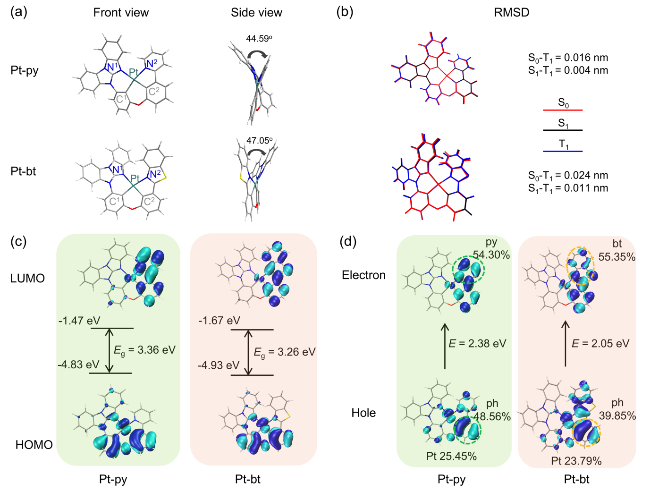
图2 Pt-py和Pt-bt配合物基态的(a)分子结构正视图和侧视图, (b) S0、S1和T1的几何比较和RMSD值, (c)前线轨道分布以及能量和(d) T1→S0态的自然跃迁轨道Figure 2 (a) Front and side views of the molecular structures in the ground states, (b) geometric comparison of S0, S1 and T1 and RMSD values, (c) distribution of frontier orbitals and energy and (d) natural transition orbitals of the T1→S0 state of the complexes Pt-py and Pt-bt |
2.3 光物理性质
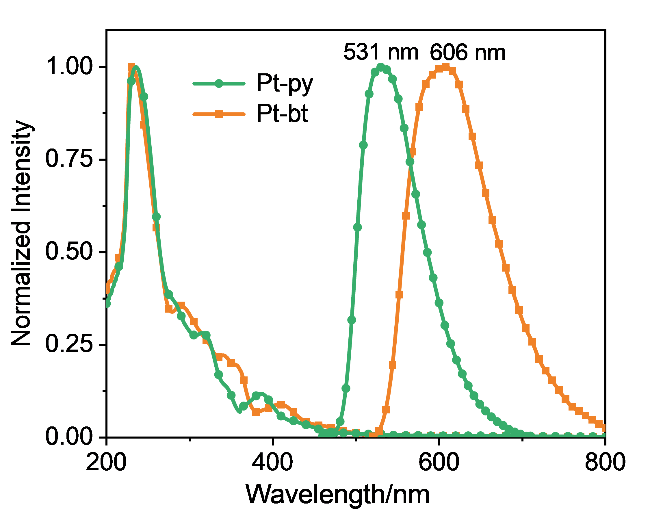
图3 配合物Pt-py与Pt-bt在二氯甲烷溶液中的归一化紫外-可见吸收光谱与光致发光光谱Figure 3 Normalized UV-Vis absorption spectra and photoluminescence spectra of the complexes Pt-py and Pt-bt in dichloromethane |
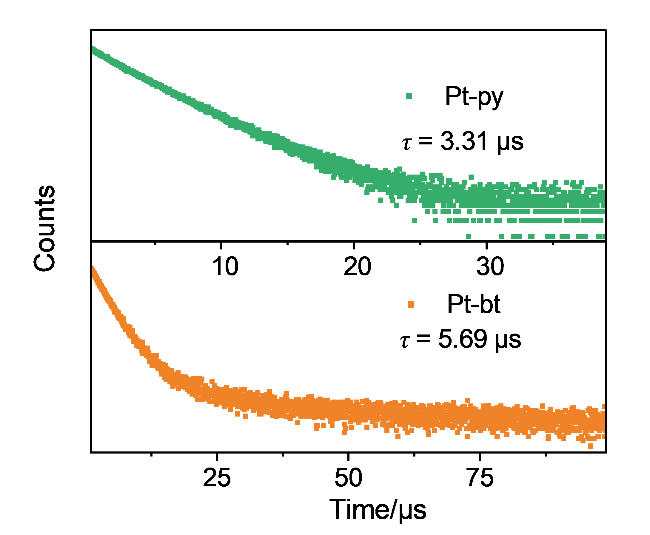
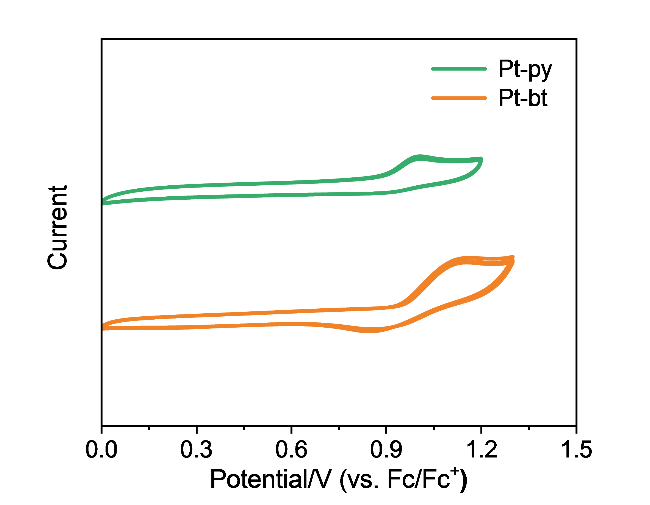
表1 Pt-py和Pt-bt的光物理性质、电化学与热力学性质Table 1 Photophysical, electrochemical and thermodynamic properties of the complexes Pt-py and Pt-bt |
| Complex | λabsa/nm | λema/nm | Eopt gb/eV | τc/µs | Фc/% | HOMOd/eV | HOMOe/eV | Td/℃ |
|---|---|---|---|---|---|---|---|---|
| Pt-py | 386 | 531 | 2.63 | 3.31 | 99.02 | -5.29 | -2.66 | 445.44 |
| Pt-bt | 409 | 606 | 2.44 | 5.69 | 57.24 | -5.35 | -2.91 | 389.51 |
a Measured in DCM (10−5 mol•L−1); b Determined by the onset of absorption spectra; c Measured in doped DMIC-TRZ film (w=5%) in Air; d Measured through cyclic voltammetry (CV), EHOMO=-(Eox onset+4.8); e Calculated by the Equation ELUMO=EHOMO+Eopt g. |
2.4 电化学性质
2.5 热力学性质
2.6 电致发光性能
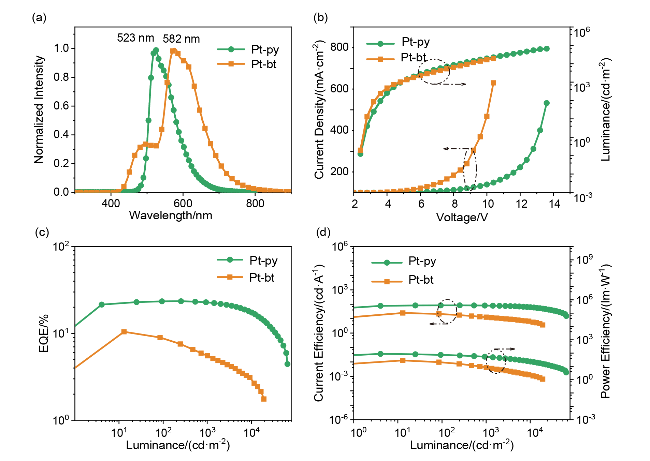


图6 基于Pt-py和Pt-bt的掺杂OLEDs电致发光性能. (a)归一化EL光谱; (b)电流密度-电压-亮度曲线; (c)外部量子效率-亮度曲线; (d)电流效率-亮度-功率效率曲线Figure 6 EL performance of doped OLEDs based on Pt-py and Pt-bt. (a) Normalized EL spectra; (b) Current density-voltage-luminance curves; (c) External quantum efficiency-luminance curves; (d) Current efficiency-luminance-power efficiency curves |
表2 基于Pt-py和Pt-bt掺杂OLEDs的电致发光性能Table 2 EL performance of Pt-py and Pt-bt based doped OLEDs |
| Complex | λELa/nm | Lmax/(cd•m−2) | Von/V | CEmax/(cd•A−1) | PEmax/(lm•W−1) | EQEmax/500/1000/% | CIE1931 coordinatesb |
|---|---|---|---|---|---|---|---|
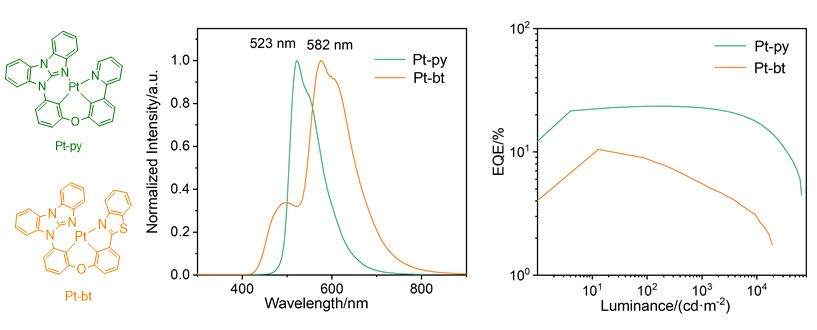
| Pt-py | 523 | 65782 | 2.8 | 83.3 | 86.5 | 23.4/23.3/22.3 | (0.35, 0.61) |
| Pt-bt | 582 | 19232 | 2.8 | 24.8 | 27.8 | 10.4/6.6/5.6 | (0.46, 0.44) |
a Turn-on voltage measured at the luminance of 1 cd•m−2; b Operating voltage: 6.4 V. |