


1 引言
2 结果与讨论
2.1 水凝胶的制备及性能表征
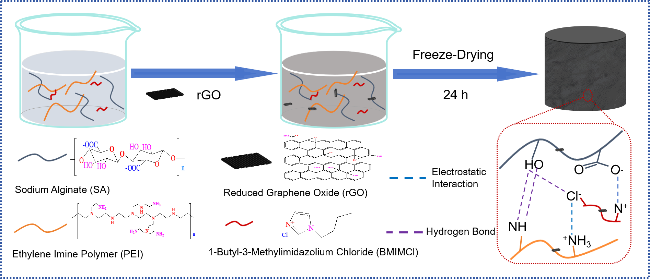
图式1 添加BMIMCl的BPS-Cl水凝胶制备过程示意图Scheme 1 Schematic illustration of the fabrication process of BPS-Cl hydrogel with addition of BMIMCl |
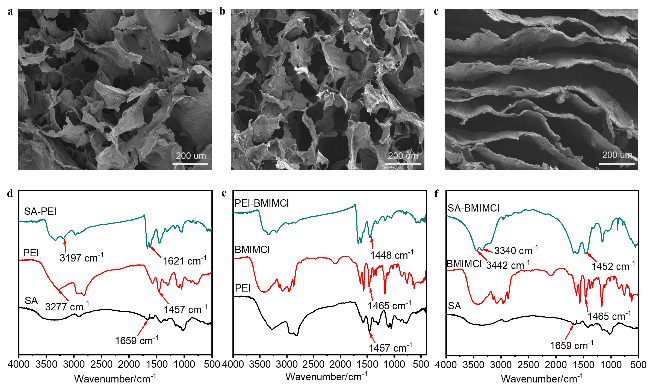
图1 (a) BPS-0干凝胶、(b) BPS-P干凝胶、(c) BPS-Cl干凝胶的扫描电镜图; (d) SA、PEI与SA-PEI、(e) PEI、BMIMCl与PEI-BMIMCl、(f) SA、BMIMCl与SA-BMIMCl的傅里叶变换红外光谱图Figure 1 SEM images of (a) BPS-0 xerogel; (b) BPS-P xerogel; (c) BPS-Cl xerogel; FTIR spectra of (d) SA, PEI and SA-PEI; (e) PEI, BMIMCl and PEI-BMIMCl; (f) SA, BMIMCl and SA-BMIMCl |
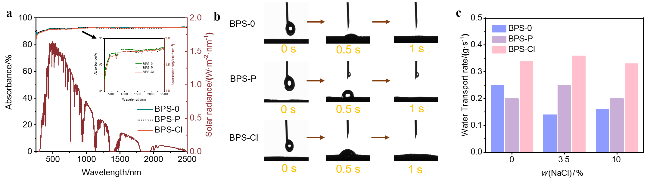
图2 (a)不同BPS样品紫外-可见-近红外吸收光谱及太阳光谱, 插图为对应波段下的局部放大图谱; (b)不同凝胶的水接触角照片; (c) BPS-0, BPS-P和BPS-Cl在不同质量分数NaCl溶液中的水传输速率Figure 2 (a) UV-Vis-NIR absorption spectra of different BPS samples and solar spectrum, the inset shows the partially enlarged view of the corresponding wavelength range; (b) The photos display the water contact angle of the different gels; (c) Water transport rates of BPS-0, BPS-P and BPS-Cl in different brine concentrations |
2.2 太阳能蒸发性能研究
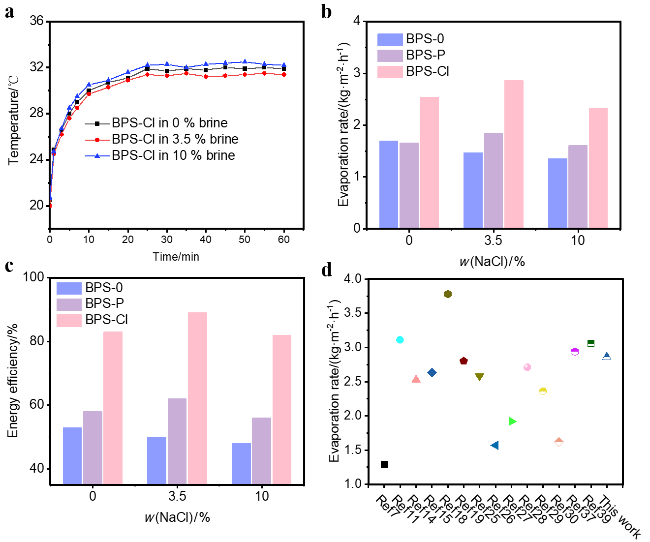
图3 (a)不同盐浓度下BPS-Cl的上表面温度; (b)不同蒸发器在不同盐浓度下的蒸发速率; (c)不同蒸发器在不同盐浓度下的能量效率; (d) BPS-Cl 与文献报道凝胶基蒸发器的蒸发速率对比Figure 3 (a) The upper surface temperature of BPS-Cl in different brine concentrations; (b) Evaporation rates of different evaporators in different brine concentrations; (c) The energy efficiency of different evaporators in different brine concentrations; (d) Evaporation rate comparison between BPS-Cl and reported gel-based evaporators |
表1 不同盐浓度下BPS-Cl的上表面温度Table 1 The upper surface temperature of BPS-Cl in different brine concentrations |
| Solution composition | Time for rapid heating /min | Upper surface temperature/℃ | Time to reach equilibrium/min | Upper surface temperature/℃ |
|---|---|---|---|---|
| pure water | 10 | 30.0 | 25 | 31.9 |
| w(NaCl)=3.5% | 10 | 29.7 | 25 | 31.4 |
| w(NaCl)=10% | 10 | 30.5 | 25 | 32.2 |
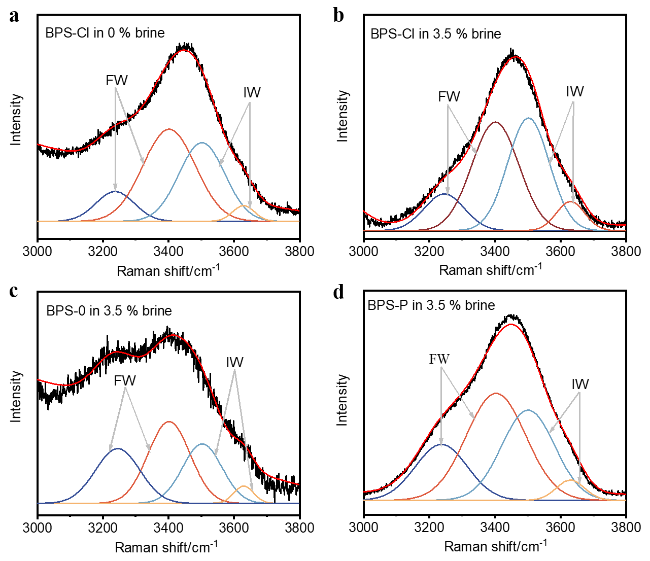
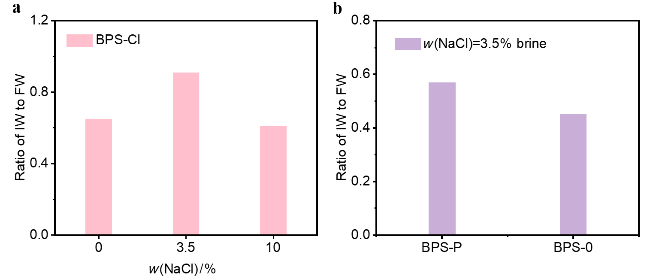
图4 不同样品中水的拉曼光谱分峰拟合图. (a) BPS-Cl纯水体系; (b) BPS-Cl, w(NaCl)=3.5%水溶液; (c) BPS-0, w(NaCl)=3.5%水溶液; (d) BPS-P, w(NaCl)=3.5%水溶液. 其中3245 cm⁻1和3401 cm⁻1处特征峰归属于强氢键结合的自由水(FW), 3502 cm⁻1和3630 cm⁻1处特征峰归属于弱氢键结合的中间水(IW)Figure 4 Deconvoluted Raman spectra of water for different samples. (a) BPS-Cl, pure water; (b) BPS-Cl, w(NaCl)=3.5% brine; (c) BPS-0, w(NaCl)=3.5% brine; (d) BPS-P, w(NaCl)=3.5% brine. Peaks at 3245 cm⁻1 and 3401 cm⁻1 are attributed to strongly hydrogen-bonded free water (FW), whereas peaks at 3502 cm⁻1 and 3630 cm⁻1 belong to weakly hydrogen-bonded intermediate water (IW) |
2.3 耐盐及自脱盐的性能研究
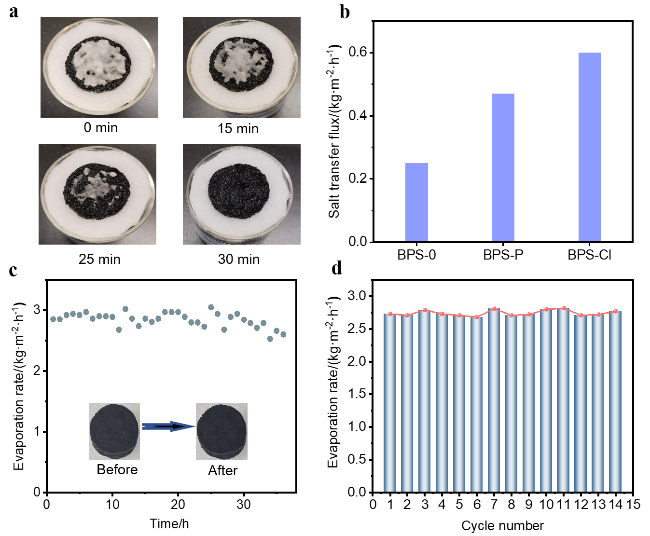
图6 (a)在BPS-Cl中加入1 g固体NaCl并将其漂浮于w(NaCl)=3.5%盐水中的盐溶解过程; (b) w(NaCl)=3.5%盐水中不同凝胶的盐通量; (c) 1倍太阳光照下BPS-Cl在w(NaCl)=3.5%盐水中的36 h连续蒸发测试, 插图为蒸发前后的凝胶表面形貌; (d) BPS-Cl在w(NaCl)=3.5%盐水中的循环稳定性Figure 6 (a) The process of salt dissolution in the BPS-Cl placed 1 g of solid NaCl and floated on the w(NaCl)=3.5% brine; (b) Salt flux of different gels in w(NaCl)=3.5% brine; (c) Continuous 36 hours evaporation test of BPS-Cl in w(NaCl)=3.5% brine under one sun irradiation. The illustration shows the gel surface before and after evaporation; (d) Cycling stability of BPS-Cl in w(NaCl)=3.5% brine |
2.4 太阳能室外蒸发实验研究
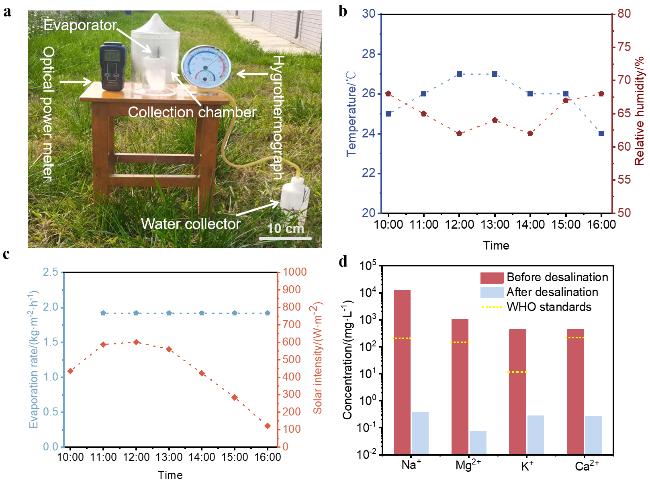


图7 (a)户外实验中界面太阳能蒸汽发生(ISSG)装置的实物照片; (b)户外测试中的环境温度与相对湿度; (c)户外测试中的太阳辐照强度与平均蒸发速率; (d)光热蒸发前后的离子浓度Figure 7 (a) Photos of ISSG device in outdoor experiment; (b) The ambient temperature and relative humidity in outdoor test; (c) The solar intensity and average evaporation rate in outdoor test; (d) Ion concentrations before and after solar-thermal evaporation |