


1 引言
Coniochaetone类天然产物来源于多种真菌(图式1A)[1], 其中coniochaetone A (1)和B (2)是该家族中最早被分离鉴定的成员, 由Gloer及其同事[1a]在1995年从粪生真菌Coniochaeta saccardoi (JS 223)液体培养物中分离并命名; Coniochaetone C (3)的分离则可追溯至2012年, Rukachaisirikul等[1b]从海柳共生真菌Penicillium citrinum PSU-F51中首次分离得到coniochaetone C (3); 其中氧化态更高的coniochaetone E (4)和coniochaetone F (5)是车永胜和李二伟等[1c]于2013年从冬虫夏草寄生真菌Fimetariella sp.固体培养物中分离得到; 最近, 杨献文课题组[1l]从深海来源真菌Penicillium citrinum W17中分离出多种coniochaetone类天然产物.
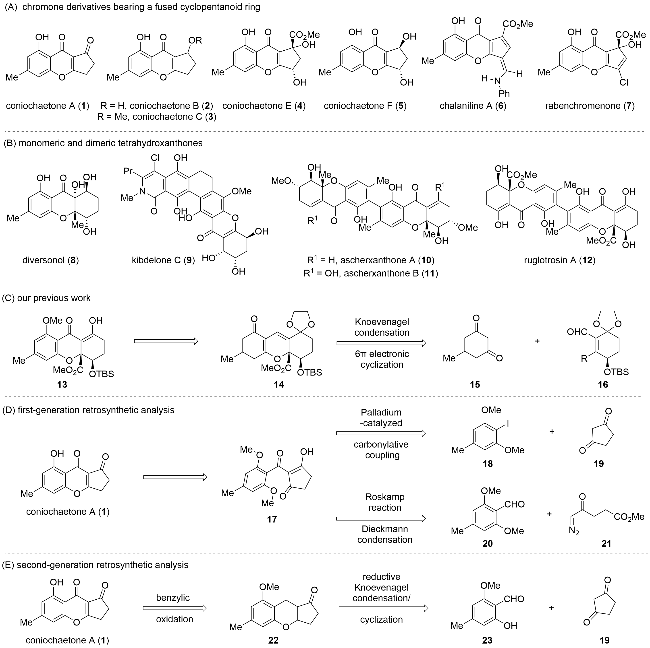
图式1 (A)含有稠合环戊烷环的色酮类天然产物; (B)四氢呫吨酮单体和二聚体; (C)我们之前的工作; (D)第一代逆合分析; (E)第二代逆合分析Scheme 1 (A) Chromone derivatives bearing a fused cyclopentanoid ring; (B) monomeric and dimeric tetrahydroxanthones; (C) our previous work; (D) first-generation retrosynthetic analysis; (E) second-generation retrosynthetic analysis |
Coniochaetone类天然产物是一类具有稠合环戊烷环的色酮类衍生物. 近年来, 多个结构新颖的该骨架天然产物相继被报道, 例如, 在2017年, Loesgen等[4]利用HDAC抑制剂伏立诺他诱导内生子囊菌Chalara sp. 6661产生了一种新型含苯胺结构单元的化合物chalaniline A (6); 在2021年, Masi等[5]从与伊朗橡树衰退病害密切相关的真菌Fimetariella rabenhorstii的培养滤液中, 分离得到了一种含氯的天然产物rabenchromenone (7). 在前期的工作中, 我们[6]通过一系列构建四氢呫吨酮骨架的策略完成了diversonol (8)、kibdelone C (9)、ascherxanthone A (10)和rugulotrosin A (12)等含有稠合环己烷环的四氢呫吨酮类天然产物的合成(图式1B). 其中, rugulotrosin A (12)的合成关键步骤为环己烷-1,3-二酮(15)与α,β-不饱和醛(16)经Knoevenagel缩合/6π-电环化/芳构化串联反应构建四氢呫吨酮骨架(图式1C)[6d].
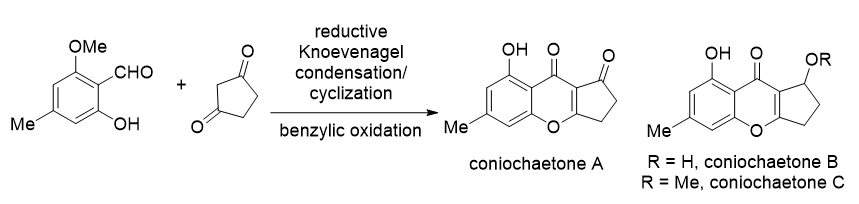
1998年, Mori等[7]以2-(甲亚磺酰基)苯乙酮与丁二醛的级联反应为关键策略, 成功构建了三环的苯并吡喃酮骨架, 并完成了coniochaetone A (1)和B (2)的首次合成. 在此, 我们开展了coniochaetone类天然产物的合成研究, 经过两代合成路线的探索, 最终成功实现了该类天然产物的全合成. 在第一代合成方案中, coniochaetone 类天然产物由中间体17拟经醚环关环得到, 而关键中间体17则期望通过钯催化的插羰偶联和Roskamp反应两条策略制备(图式1D). 第二代合成方案中, 目标分子拟由三环中间体22经苄位氧化及官能团转化获得, 其三环骨架的合成则是利用Ramachary发展的还原性Knoevenagel缩合/环化反应实现(图式1E)[8].
2 结果与讨论
2.1 第一代合成方案
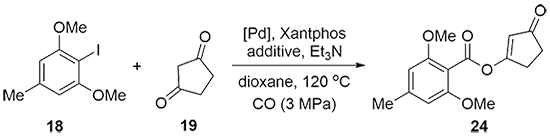
最初的设计方案中, 拟通过钯催化的插羰偶联反应, 由已知化合物18[9]和1,3-环戊二酮19制备三羰基化合物17. 钯催化芳基卤化物与1,3-二羰基底物的插羰偶联反应[10]已发展成为合成1,3-二酮及相关结构的重要方法, Lindhardt与Skrydstrup等[10a]对此进行了系统的研究. 该反应面临的主要问题在于1,3-二羰基底物亲核位点的选择性, 碳亲核进攻会生成三羰基化合物, 而氧亲核进攻则生成苯甲酸烯醇酯. 为解决该问题, Lindhardt与Skrydstrup通过加入氯化镁来活化1,3-二羰基底物, 调控其进行碳亲核进攻实现三羰基化合物. 此外, 三羰基化合物亦可由烯醇酯通过Fries型重排反应[11]获得.
首先, 采用Lindhardt和Skrydstrup等[10a]报道的方法, 以(1,5-环辛二烯)二氯化钯[PdCl2(cod)]作为钯源、氯化镁(MgCl2)为添加剂(表1, Entry 1), 以38%的收率得到了氧亲核进攻的产物24, 而非预期的碳亲核进攻产物17. 当将钯源更换为[1'-双(二苯基膦)二茂铁]二氯化钯二氯甲烷络合物[PdCl2(dppf)•CH2Cl2] (Entry 2)时, 仅得到少量的烯醇进攻产物24; 将添加剂更换为碳酸钾(K2CO3)时(Entry 3), 同样仅得到烯醇进攻产物24. 这些结果均表明, 在该体系下1,3-环戊二酮的氧亲核性更强, 从而选择性地生成烯醇酯24.
表1 钯催化的插羰偶联Table 1 Palladium-catalyzed carbonylative coupling |
| Entry | [Pd] | Additive | Result |
|---|---|---|---|
| 1 | PdCl2(cod) | MgCl2 | 38% |
| 2 | PdCl2(dppf)•CH2Cl2 | MgCl2 | trace |
| 3 | PdCl2(dppf)•CH2Cl2 | K2CO3 | 54% |
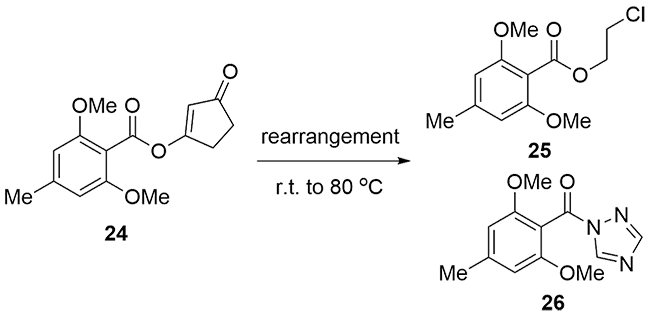
随后, 转而探索通过Fries型重排反应实现烯醇酯24向三羰基化合物17的转化(表2). 该类重排反应在1,3-环戊二酮烯醇酯底物上的报道较为有限, 现有文献主要涉及氰化物催化的重排过程[12]. 首先, 尝试了氰化物(Entries 1, 2)催化体系, 无论是三甲基氰硅烷(TMSCN)还是丙酮氰醇(acetone cyanohydrin), 均未促使该重排反应发生. 在4-二甲氨基吡啶(DMAP)和碳酸钾(K2CO3)条件下[13](Entry 3), 以75%的收率得到羧酸负离子与溶剂二氯乙烷(DCE)发生取代反应的产物25. 当将碱更换为氢氧化钠(NaOH)与15-冠醚-5 (15-crown-5)时, 主要是回收原料酯24. 随后, 计划通过1,2,4-三氮唑对酯24进行活化以促进碳亲核取代反应[14]. 采用不同碱与1,2,4-三氮唑(1,2,4-triazole)的组合时(Entries 5~7), 主要生成活性中间体26, 未观察到1,3-环戊二酮碳亲核进攻的重排产物17. 这表明1,3-环戊二酮的碳亲核性可能弱于其烯醇形式的亲核性, 难以有效进攻活性中间体以生成目标重排产物.
表2 Fries型重排Table 2 Fries-type rearrangement |
| Entry | Base | Additive | Solvent | Result |
|---|---|---|---|---|
| 1 | Et3N | TMSCN | CH3CN | NR |
| 2 | Et3N | acetone cyanohydrin | CH3CN | NR |
| 3 | K2CO3 | DMAP | DCE | 25 (75%) |
| 4 | NaOH | 15-crown-5 | DCE | 25 (7%, 88% brsm) |
| 5 | K2CO3 | 1,2,4-triazole | CH3CN | 26 (61%) |
| 6 | Li2CO3 | 1,2,4-triazole | CH3CN | 26 (10%, 77% brsm) |
| 7 | NaH | 1,2,4-triazole | CH3CN | 26 (66%) |
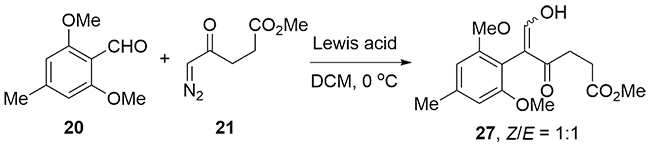
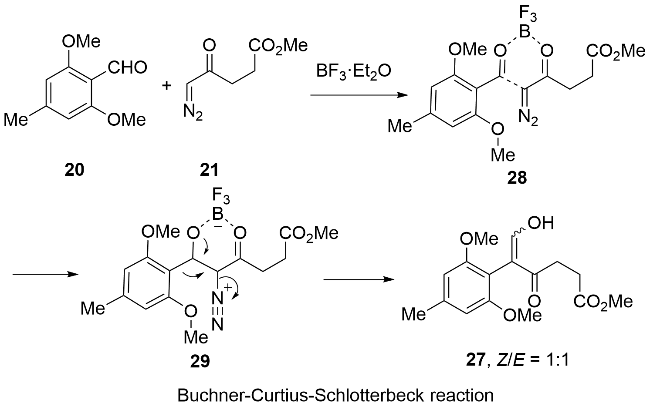
于是, 我们转而探索Roskamp反应[15]和Dieckmann缩合的合成策略, 以实现关键中间体17的合成. 以已知化合物20[16]和21[17]为原料, 首先对Roskamp反应进行了探索(表3), 考察了不同路易斯酸对该反应的影响. 当使用三氟化硼乙醚(BF3•Et2O)时(Entry 1), 以17%的收率得到重排产物27 (Z/E=1∶1), 而非预期的Roskamp反应的加成产物; 以四氯化锡(SnCl4)为路易斯酸时(Entry 2), 主要生成重排产物27, 并回收部分原料20; 而以三氟甲磺酸钪 [Sc(OTf)3] 为催化剂时(Entry 3), 则以88%收率得到重排产物27. 为此, 对重排产物的形成机理进行了推测(图式2): 在路易斯酸作用下, 化合物20和21经Buchner-Curtius-Schlotterbeck反应[18]生成中间体29, 后者经1,2-芳基迁移, 最终生成重排产物27.
2.2 第二代合成方案
鉴于第一代路线中关键中间体17难以通过有效合成策略获得, 合成路线调整为直接构建三环骨架, 以实现coniochaetone类天然产物的合成.
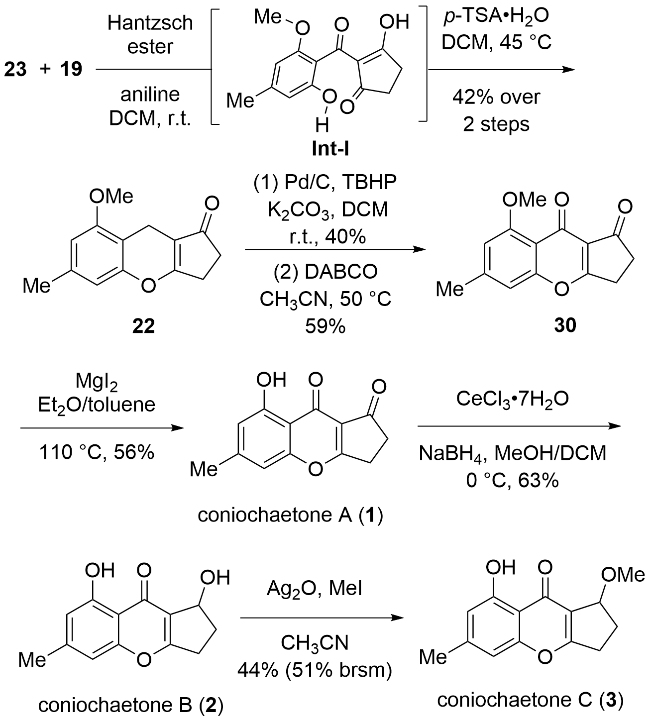
表4 苄位氧化Table 4 Benzylic oxidation |


| Entry | Reagent | Solvent | Temperature | Result |
|---|---|---|---|---|
| 1 | SeO2 | 1,4-dioxane H2O | 110 ℃ | NR |
| 2 | CrO3 | AcOH/H2O | r.t. | decomposed |
| 3 | NHPI tBuONO | CH3CN | 80 ℃ | decomposed |
| 4 | DDQ | DCM/H2O | r.t. | decomposed |
| 5 | O2, Et3N | CH3CN | 80 ℃ | trace 30 |
| 6 | Mn(OAc)3 TBHP | EA | r.t. | NR |
| 7 | Co(acac)2 TBHP | acetone | r.t. | trace 31 33 (25%) |
| 8 | Pd/C, TBHP K2CO3 | DCM | r.t. | trace 31, 32 33 (40%) |
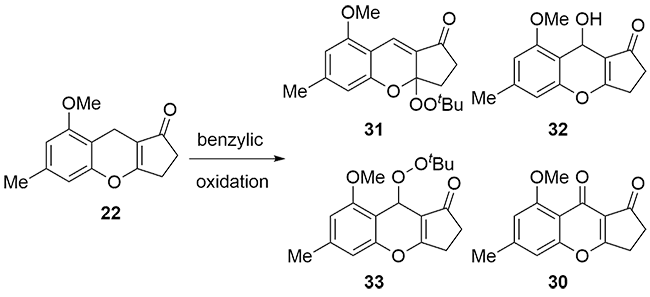
于是, 我们转而探索条件更为温和的氧化体系. 在氧气/三乙胺(Et3N)体系中(Entry 5), 仅以极低转化率得到少量的苄位氧化产物30. 随后考察了多种过渡金属催化的苄位氧化条件: 醋酸锰[Mn(OAc)3]与叔丁基过氧化氢(TBHP)的体系[26](Entry 6)未能引发反应; 而乙酰丙酮钴[Co(acac)2]和叔丁基过氧化氢(TBHP)体系[27](Entry 7)则以25%的收率得到苄位引入过氧叔丁基的产物33, 同时伴有少量的重排产物31. 据此推测, 该反应可能经历了烯丙基自由基中间体, 并被过氧叔丁基自由基捕获. 当采用钯碳(Pd/C)为催化剂时[28](Entry 8), 除了以40%的收率得到化合物33外, 还分离得到少量苄位羟基氧化产物32. 然而, 化合物32稳定性较差, 在分离或者储存过程中易分解; 尝试对其进一步氧化[29] (Supporting Information Table S1), 但多数条件均导致其分解. 因此, 选用稳定性更好的化合物33进行后续氧化研究. 在1,4-二氮杂二环[2.2.2]辛烷(DABCO)存在下, 化合物33经Kornblum-DeLaMare重排[30], 以59%的收率转化为酮30. 至此, 经过两步的苄位氧化, 成功实现了苄位羰基的引入.
得到酮30后, 我们开始了coniochaetone类天然产物的合成. 在碘化镁存在下高温回流, 以56%的收率实现了coniochaetone A (1)的合成. 对于coniochaetone B (2)的合成, 最初尝试通过CBS还原[31]实现其不对称合成. 该体系虽可获得目标产物, 但产率与对映选择性均不理想(Supporting Information Table S2). 因此, 改用Luche条件[32]对coniochaetone A (1)进行还原, 以63%的收率得到coniochaetone B (2). 随后, 对羟基选择性甲基化条件进行了筛选(Supporting Information Table S3). 结果表明, coniochaetone B (2)在强碱条件下不稳定, 最终确定以氧化银为碱[33], 实现了羟基的选择性甲基化, 以44%的产率完成了coniochaetone C (3)的合成. 最后, 对上述合成路线进行了优化, 成功实现了coniochaetone 类天然产物的克级规模制备(coniochaetone A: 2.1 g; coniochaetone B: 1.1 g; coniochaetone C: 1.2 g)[34], 为其后续的生物活性研究奠定了基础.
3 结论
我们针对coniochaetone类天然产物先后开展了两代合成路线的研究. 在第一代合成方案中, 设计通过关键中间体17经醚键环合实现coniochaetone类天然产物的合成, 然而, 所尝试的钯催化插羰偶联与Roskamp反应两条合成策略均未能有效获得该关键中间体. 鉴于此, 调整了合成策略. 在第二代方案中, 采用Ramachary发展的还原性Knoevenagel缩合/环化反应策略快速构建了三环核心骨架, 随后经苄位氧化及官能团转化, 成功完成了coniochaetone类天然产物的合成. 此外, 该合成路线已实现克级规模的放大制备, 为后续系统的生物活性评价奠定了坚实的物质基础.
4 实验部分
4.1 8-甲氧基-6-甲基-3,9-二氢环戊并[b]色满-1(2H)-酮(22)的合成
将1,3-环戊二酮19 (12.5 g, 128.0 mmol, 1.0 equiv.), 化合物23 (22.2 g, 134.0 mmol, 1.05 equiv.)和1,4-二氢-2,6-二甲基-3,5-吡啶二甲酸二甲酯(Hantzsch ester, 34.1 g, 151.5 mmol, 1.2 equiv.)置于1 L反应瓶中, 置换氮气三次, 在氮气氛围下加入600 mL二氯甲烷(DCM)溶解, 随后再加入苯胺(aniline, 12.2 mL, 134.0 mmol, 1.0 equiv.), 反应24 h后, TLC检测原料消耗完毕, 将反应液浓缩, 残余物经(40%~100%乙酸乙酯/石油醚)柱层析快速分离得到其粗产物(反应体系复杂, 难以纯化干净). 将粗产物(35.0 g, 141.1 mmol, 1.0 equiv.) 置于1 L反应瓶中, 加入500 mL二氯甲烷(DCM)溶解, 再加入对甲苯磺酸一水合物(p-TSA•H2O, 27.0 g, 141.1 mmol, 1.0 equiv.), 再将体系缓慢升至45 ℃, 反应约10 h, TLC检测原料消耗完毕, 冷却至室温, 加入150 mL水淬灭反应, 二氯甲烷(200 mL×3)萃取, 合并有机相, 150 mL饱和氯化钠洗涤, 无水硫酸钠干燥过滤浓缩, 残余物经(20%~30%乙酸乙酯/石油醚)柱层析分离得到化合物22 (黄白色固体, 16.8 g, 两步产率为42%), Rf=0.7 (30%乙酸乙酯/石油醚). 1H NMR (500 MHz, CDCl3) δ: 6.46 (s, 1H), 6.42 (s, 1H), 3.78 (s, 3H), 3.26 (s, 2H), 2.69~2.63 (m, 2H), 2.52~2.46 (m, 2H), 2.30 (s, 3H); 13C NMR (125 MHz, CDCl3) δ: 203.8, 179.2, 158.2, 151.3, 138.4, 114.6, 109.7, 107.5, 106.3, 55.7, 33.4, 25.8, 21.6, 16.5. IR νmax: 2924, 2853, 1703, 1659, 1578, 1501, 1435, 1396, 1331, 1288, 1261, 1250, 1233, 1184, 1130, 1101, 1084, 1009, 988, 974, 868, 783, 691, 652, 575 cm-1; HRMS-ESI (m/z): [M+H]+ calcd for C14H15O3+ 231.1016, found 231.1007.
4.2 化合物33和化合物31的合成
将化合物22 (18.5 g, 80.4 mmol, 1.0 equiv.)置于1 L反应瓶中, 再加入溶于500 mL二氯甲烷(DCM)溶解, 再依次加入过氧叔丁醇[TBHP (70% solution in water), 33.5 mL, 258.3 mmol, 3.2 equiv.], 钯/碳 (10% Pd/C, 12.7 g)和碳酸钾(K2CO3, 28.5 g, 207.1 mmol, 2.6 equiv.), 反应约24 h, TLC检测原料消耗完毕, 硅藻土过滤, 再将滤液浓缩, 残余物经(20%~30%乙酸乙酯/石油醚)柱层析分离得到化合物33 (黄白色固体, 10.2 g, 40%)和少量的化合物31.
9-(叔丁基过氧基)-8-甲氧基-6-甲基-3,9-二氢环戊并[b]色满-1(2H)-酮(33): Rf=0.72 (30%乙酸乙酯/石油醚); 1H NMR (500 MHz, acetone-d6) δ: 6.74 (s, 1H), 6.71 (s, 1H), 5.88 (s, 1H), 3.90 (s, 3H), 2.92 (ddd, J=17.8, 7.6, 2.8 Hz, 1H), 2.82~2.75 (m, 1H), 2.53 (ddd, J=17.9, 7.6, 2.9 Hz, 1H), 2.45 (ddd, J=17.9, 7.3, 2.9 Hz, 1H), 2.37 (s, 3H), 0.98 (s, 9H); 13C NMR (125 MHz, acetone-d6) δ: 201.4, 182.6, 159.9, 154.9, 141.7, 116.0, 110.2, 109.0, 108.1, 79.8, 64.6, 56.4, 34.4, 26.7 (3C), 26.0, 21.8. IR νmax: 3728, 3597, 2976, 2928, 1709, 1659, 1580, 1404, 1360, 1290, 1254, 1233, 1136, 1092, 1013, 989, 826 cm-1; HRMS-ESI (m/z): [M+Na]+ calcd for C18H22O5Na+ 341.1359, found 341.1350.
3a-(叔丁基过氧基)-8-甲氧基-6-甲基-3,3a-二氢环戊并[b]色满-1(2H)-酮(31): Rf=0.9 (30%乙酸乙酯/石油醚); 1H NMR (400 MHz, CDCl3) δ: 7.88 (s, 1H), 6.53 (s, 1H), 6.33 (s, 1H), 3.85 (s, 3H), 3.05 (ddd, J=13.1, 8.7, 1.2 Hz, 1H), 2.56 (ddd, J=18.2, 11.5, 8.7 Hz, 1H), 2.46~2.32 (m, 1H), 2.35 (s, 3H), 2.15 (ddd, J=13.2, 11.5, 8.9 Hz, 1H), 1.08 (s, 9H); 13C NMR (100 MHz, CDCl3) δ: 201.4, 158.5, 155.0, 144.5, 126.5, 124.7, 110.2, 108.3, 105.4, 104.9, 80.6, 55.9, 36.0, 30.6, 26.6 (3C), 22.7. IR νmax: 2305, 2249, 2232, 1628, 1466, 1423, 1265, 1105, 910, 816, 810, 804, 793, 741, 706 cm-1; HRMS-ESI (m/z): [M+H]+ calcd for C18H23O5+ 319.1533, found 319.1540.
4.3 8-甲氧基-6-甲基-2,3-二氢环戊并[b]色烯-1,9-二酮(30)的合成
将化合物33 (6.0 g, 18.9 mmol, 1.0 equiv.)和三乙烯二胺 (DABCO, 10.5g, 94.2 mmol, 5.0 equiv.)置于250 mL反应瓶中, 置换氮气3次, 加入94 mL溶于乙腈(CH3CN)溶解, 再将体系缓慢升至50 ℃, 反应约5 h, TLC检测原料消耗完毕, 冷却至室温, 将反应液浓缩至10 mL, 将剩余的反应液经(0%~5%甲醇/二氯甲烷)柱层析分离得到化合物30 (褐色固体, 2.7 g, 59%), Rf=0.15 (乙酸乙酯). 1H NMR (500 MHz, CDCl3) δ: 6.83 (s, 1H), 6.65 (s, 1H), 3.91 (d, J=1.6 Hz, 3H), 3.01~2.95 (m, 2H), 2.66~2.60 (m, 2H), 2.42 (s, 3H); 13C NMR (125 MHz, CDCl3) δ: 198.1, 187.4, 172.2, 160.9, 158.3, 146.1, 120.0, 113.1, 110.3, 109.7, 56.6, 34.0, 25.4, 22.3. IR νmax: 3728, 3557, 2918, 2849, 1719, 1624, 1483, 1441, 1425, 1410, 1315, 1296, 1238, 1192, 1163, 1090, 1045, 829, 750, 727, 669, 654, 592, 517 cm-1; HRMS-ESI (m/z): [M+H]+ calcd for C14H13O4+ 245.0808, found 245.0800.
4.4 coniochaetone A (1)的合成
将化合物30 (4.0 g, 16.4 mmol, 1.0 equiv.)置于500 mL反应瓶中, 置换氮气3次, 溶于112 mL甲苯(toluene)加入新鲜制备的160 mL碘化镁(36.2 mmol, 2.2 equiv.) 溶液, 再将体系缓慢升至110 ℃, 反应约4 h, TLC检测原料消耗完毕, 冷却至室温, 加入50 mL 1 mol/L盐酸淬灭反应, 乙酸乙酯(50 mL×3)萃取, 合并有机相, 50 mL饱和氯化钠洗涤, 无水硫酸钠干燥过滤浓缩, 残余物经(0%~30%乙酸乙酯/二氯甲烷)柱层析分离得到coniochaetone A (1) (黄色固体, 2.1 g, 56%), Rf=0.7 (二氯甲烷). 碘化镁的制备: 将镁屑(1.1 g, 47.1 mmol, 2.9 equiv.)置于500 mL反应瓶中, 置换氮气3次, 再加入60 mL乙醚(Et2O)和100 mL甲苯(toluene), 在氮气氛围下向体系中分3批加入碘(I2, 9.2 g, 36.2 mmol, 2.2 equiv.), 反应约4 h至碘的颜色褪去, 即可得到碘化镁溶液. 1H NMR (500 MHz, CDCl3) δ: 12.20 (s, 1H, OH), 6.77 (s, 1H), 6.67 (s, 1H), 3.11~3.05 (m, 2H), 2.73~2.67 (m, 2H), 2.41 (s, 3H); 13C NMR (125 MHz, CDCl3) δ: 197.6, 189.9, 178.1, 161.9, 156.4, 148.4, 118.0, 114.3, 108.7, 108.2, 33.9, 26.2, 22.5. IR νmax: 3051, 2928, 1719, 1653, 1611, 1493, 1460, 1423, 1368, 1312, 1296, 1275, 1261, 1204, 1146, 1078, 1067, 847, 826, 810, 764, 750, 700 cm-1; HRMS-ESI (m/z): [M+H]+ calcd for C13H11O4+ 231.0652, found 231.0644.
4.5 coniochaetone B (2)的合成
将coniochaetone A (1) (1.74 g, 7.6 mmol, 1.0 equiv.)置于250 mL反应瓶中, 依次加入75 mL甲醇(MeOH)和75 mL二氯甲烷(DCM)将其充分溶解, 在0 ℃下加入七水合三氯化铈(CeCl3•7H2O, 6.8 g, 18.2 mmol, 2.4 equiv.), 搅拌30 min后, 再加入硼氢化钠(NaBH4, 518.0 mg, 13.6 mmol, 1.8 equiv.), 反应1 h, TLC检测原料消耗完毕, 加入50 mL水淬灭反应, 用二氯甲烷(50 mL×5)萃取, 合并有机相, 50 mL饱和氯化钠洗涤, 无水硫酸钠干燥过滤浓缩, 残余物经(10%~30%乙酸乙酯/二氯甲烷)柱层析分离得到coniochaetone B (2) (黄褐色固体, 1.1 g, 63%), Rf=0.65 (50%乙酸乙酯/石油醚). 1H NMR (400 MHz, CDCl3) δ: 12.25 (s, 1H, OH), 6.66 (s, 1H), 6.58 (s, 1H), 5.37 (d, J=7.4 Hz, 1H), 3.36 (s, 1H, OH), 3.09 (ddd, J=18.1, 9.4, 5.4 Hz, 1H), 2.78 (ddd, J=17.6, 8.5, 4.0 Hz, 1H), 2.53~2.41 (m, 1H), 2.36 (s, 3H), 2.06~1.94 (m, 1H); 13C NMR (125 MHz, CDCl3) δ: 181.4, 172.4, 160.8, 157.7, 146.9, 121.2, 112.7, 109.0, 107.9, 71.0, 30.0, 29.6, 22.4. IR νmax: 3421, 2951, 1655, 1622, 1599, 1491, 1458, 1425, 1366, 1296, 1246, 1207, 1144, 1078, 1047, 966, 868, 827, 702, 513 cm-1; HRMS-ESI (m/z): [M+Na]+ calcd for C13H12O4Na+ 255.0628, found 255.0619.
4.6 coniochaetone C (3)和化合物34的合成
将coniochaetone B (2) (2.65 g, 11.4 mmol, 1.0 equiv.)和氧化银(Ag2O, 6.6 g, 28.5 mmol, 2.5 equiv.)溶于115 mL乙腈(CH3CN), 随后加入碘甲烷(MeI, 1.6 mL, 25.1 mmol, 2.2 equiv.), 反应24 h后, 结束反应. 硅藻土过滤, 再将滤液浓缩, 残余物经(25%~75%乙酸乙酯/石油醚)柱层析分离得到coniochaetone C (3) (黄白色固体, 1.2 g, 44%), 化合物34 (黄白色固体, 318 mg, 11%)和回收coniochaetone B (2) (341 mg, 13%).
Coniochaetone C (3): Rf=0.65 (30%乙酸乙酯/石油醚); 1H NMR (500 MHz, CDCl3) δ: 12.53 (s, 1H, OH), 6.68 (s, 1H), 6.61 (s, 1H), 4.92 (dt, J=6.9, 1.5 Hz, 1H), 3.48 (s, 3H), 3.15 (dddd, J=17.3, 8.6, 7.3, 1.3 Hz, 1H), 2.76 (ddd, J=18.0, 9.4, 2.7 Hz, 1H), 2.38 (s, 3H), 2.34~2.25 (m, 1H), 2.17~2.08 (m, 1H); 13C NMR (125 MHz, CDCl3) δ: 181.2, 173.9, 161.1, 157.4, 146.8, 120.0, 112.7, 109.1, 107.7, 79.5, 57.4, 30.3, 27.7, 22.4. IR νmax: 2926, 2826, 1653, 1622, 1601, 1493, 1452, 1425, 1366, 1296, 1248, 1207, 1144, 1090, 1078, 1061, 1040, 980, 874, 827, 791, 702, 656, 679, 569, 513 cm-1; HRMS-ESI (m/z): [M+Na]+ calcd for C14H14O4Na+ 269.0784, found 269.0775.
1,8-二甲氧基-6-甲基-2,3-二氢环戊并[b]色烯-9(1H)-酮(34): Rf=0.2 (30%乙酸乙酯/石油醚); 1H NMR (500 MHz, CDCl3) δ: 6.80 (s, 1H), 6.61 (d, J=1.5 Hz, 1H), 4.90 (dt, J=7.0, 1.4 Hz, 1H), 3.94 (s, 3H), 3.51 (s, 3H), 3.16~3.08 (m, 1H), 2.68 (ddd, J=17.6, 9.4, 2.4 Hz, 1H), 2.42 (s, 3H), 2.34~2.22 (m, 1H), 2.07 (dddd, J=13.9, 8.4, 2.5, 1.5 Hz, 1H); 13C NMR (125 MHz, CDCl3) δ: 176.0, 170.2, 160.2, 159.3, 144.7, 122.8, 113.2, 110.4, 108.2, 80.0, 58.0, 56.5, 29.9, 28.5, 22.3. IR νmax: 1657, 1647, 1620, 1449, 1265, 1221, 1016, 910, 741, 706, 532 cm-1; HRMS-ESI (m/z): [M+H]+ calcd for C15H17O4+ 261.1121, found 261.1113.
(Cheng, B.)