


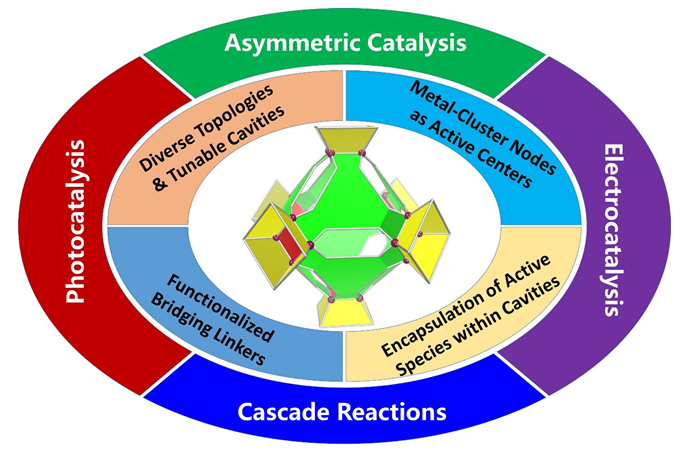
1 引言
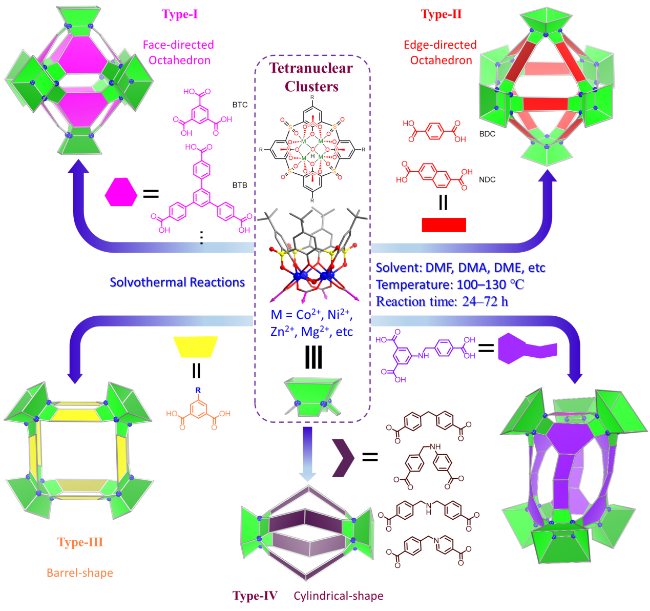
2 配位分子笼的催化功能实现机制
3 硫代/磺酰基杯[4]芳烃基配位分子笼的催化反应研究进展
表1 基于磺酰基杯[4]芳烃的配位分子笼代表性催化性能对比Table 1 Comprehensive comparison of representative catalytic performance of sulfonylcalix[4]arene-based coordination cages |
| 催化体系 | 催化活性中心来源 | 核心结构/策略 | 催化应用 | 关键性能指标 | 文献 |
|---|---|---|---|---|---|
| MOSC-1, MOSC-2 | 金属簇节点: Brønsted酸性μ4-H2O | 空腔限域 静电别构调控 | Knoevenagel缩合 | 底物选择性: 1-芘甲醛, 产率67% vs 2-萘甲醛, 产率5% | [35-36] |
| 1-Co, 1-Ni | 金属簇节点: M4TBSC, M=Co, Ni; 配体功能化: 吡啶鎓功能化 | 骨架离子化 静电微环境调控 | 电化学析氧反应(OER) | 过电位: 0.290 V @10 mA•cm-2 (1-Co); Tafel斜率: 75 mV•dec-1; 稳定性: 48 h连续电解无显著衰减 | [37] |
| Cu4TBSC基分子笼 | 金属簇节点: 配位不饱和Cu(II)位点) | 结构缺陷 开放金属位点 | 伯醇选择性氧化(醇→羧酸) | 底物选择性: 4-甲氧基苄醇99%产率(4 h)、4-硝基苄醇仅得19%羧酸+74%醛(中间体); 循环性: 4次循环后活性保持>90% | [38] |
| {M20V8} (M=Fe, Co, Ni)方锥纳米笼 | 金属簇节点: M20V8簇 | 金属替换 能带调控 | 可见光光热催化硫醚氧化脱硫 | 光热转换效率: Fe20V8 85.87%; 催化转化率: Fe20V8>99%; 性能排序: Fe20V8>>Co20V8>Ni20V8 | [39] |
| Co-PYDC | 金属簇节点: 开放Co(II)位点+Brønsted酸性μ3-H2O | 缺陷工程 双活性区域(外腔/内腔) | 串联催化: 烯烃→β-氨基醇 | 一锅法转化率: 苯乙烯衍生物) 96%; 区域选择性: 仅生成β-位开环产物 | [40] |
| 延长型八面体笼 | 配体功能化: -CH2NH- Brønsted碱 金属簇节点: Brønsted酸性μ4-H2O | 几何操纵(空腔拉伸) 酸碱双功能协同 | Knoevenagel缩合 | 底物1-芘甲醛, 产率89% | [43] |
| 手性Mn(salen)笼 | 配体功能化: 手性Mn(salen)活性中心 | 骨架隔离 空腔限域 | 氧化动力学拆分 (仲醇)/烯烃环氧化 | 对映选择性(ee): 1-苯乙醇>99% (拆分产物); 选择性因子(krel): 最高35.0 (vs游离Mn(salen) 10.3~26.9); | [44] |
| ImBDC-Co, ImBDC-Ni | 配体功能化: 咪唑鎓Lewis酸/卤素抗衡离子 | 离子型功能化配体 均相/异相结合 | CO2环加成反应 | 产物选择性:>99% (环氧氯丙烷); 底物范围: 脂肪族环氧化物产率>97%, 芳香族环氧化物>80%; 循环性: 3次循环无明显活性损失 | [45] |
| 蒽醌基光催化笼 | 配体功能化: 蒽醌光敏剂 | 光活性骨架 空腔预组织 | 光催化[2+2]环加成(查尔酮) | 非对映选择性(dr): syn-HH∶anti-HT=13∶1; 转化率: 96% (12 h) | [46] |
| PCC-15/16/17 | 配体功能化: -NH2- Brønsted碱) 金属簇节点: Brønsted酸性μ4-H2O | 活性位点间距精确调控: 调节-NH2-与μ4-H2O距离(从5.6 Å至12.4 Å) | Knoevenagel缩合 | 间距-活性关系: PCC-17 (5.6 Å) 96%产率>PCC-16 (12.4 Å) 21% 产率>PCC-15 (无-NH2)<5%产率; 底物范围: 多种芳香醛产率>95% | [47] |
| Pt@CIAC-121 | 封装客体: Pt纳米簇 | S-锚点(化学) 空腔限域(物理) | 电解水析氢反应(HER) | 起始电位: -0.24 V (vs Ag/AgCl, 略正于Pt/C); 电流密度: 在-0.60 V时, Pt@CIAC-121为 20 mA•cm-2•µg-1 (Pt/C的2倍) | [50] |
| Ru NPs@PCC-2a | 封装客体: Ru纳米颗粒 | 高负电荷笼(-30) 静电排斥/空间限域 | 氨硼烷甲醇解脱氢 | TOF: 304.4 min-1 (当时金属基催化剂最高值); 反应时间: 4.5 min内完成[n(H2)∶n(AB)=3.0∶1] | [51] |
| Co NCs@PCC-2a, Co NCs@PCC-2b | 封装客体: Co 纳米簇 | 高负电荷笼(-30, PCC-2a) vs 低负电荷笼(-6, PCC-2b) (对比论证电荷效应关键作用) | 氨硼烷水解 | TOF (PCC-2a): 90.1 min-1 (第一过渡系金属最高); TOF (PCC-2b): 22.5 min-1 (严重聚集) | [52] |
| Ru(bpy)3@PCC-2a | 封装客体(Ru(bpy)32+ 分子催化剂 | 共封装(催化剂+底物) | 光催化降解亚甲基蓝(MB) | 降解率(4 h): 94.9% (Ru(bpy)3@PCC-2a) vs 19.8% (游离Ru(bpy)32+); 循环性: 5次循环后活性保持>90% | [53] |
3.1 基于金属簇节点与开放金属位点的催化
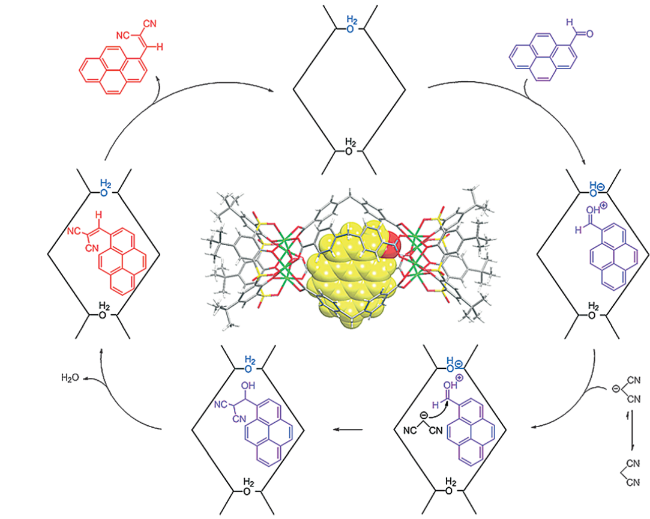
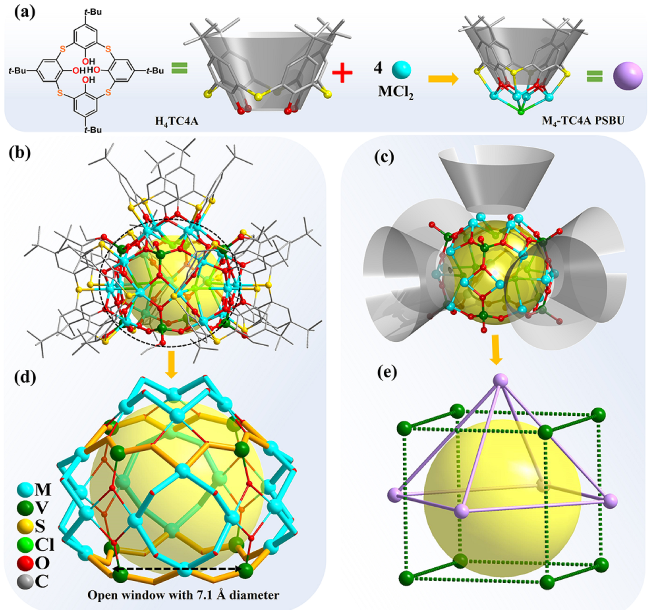
图3 M20V8 (M=Fe、Co、Ni)配位分子笼的合成及四方锥结构示意图: (a) H4TC4A配体与M4-TC4A次级构筑单元(PSBUs); (b)和(c) M20V8配位分子笼的分子结构示意图; (d) M20V8配位分子笼的十六元环窗口示意图; (e)五个M4-TC4A次级构筑单元与八个{VO4}基团的排布方式. 经参考文献[39]许可转载, 版权2025, Royal Society of ChemistryFigure 3 Schematic illustration of the synthesis and square pyramid structure of the M20V8 (M=Fe, Co, and Ni) cages. (a) The H4TC4A ligand and the M4-TC4A PSBUs. (b) and (c) Representation of the molecular structure of the M20V8 cages. (d) Illustration of the 16-membered ring window of the M20V8 cages. (e) Arrangement of five M4-TC4A PSBUs and eight {VO4} groups. Reprinted with permission from ref. [39], Copyright 2025 Royal Society of Chemistry |
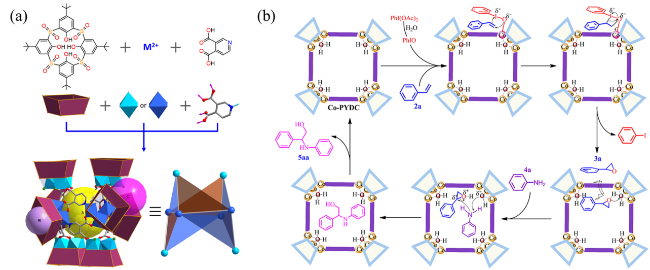
图4 配位分子笼Co-PYDC的(a)自组装过程和(b)催化串联反应合成β-氨基醇的反应机理. 经参考文献[40]许可转载, 版权2026, Springer NatureFigure 4 (a) Self-assembly of the coordination cage Co-PYDC; (b) Proposed mechanism for the synthesis of β-amino alcohols through tandem reactions catalyzed by cage Co-PYDC. Reprinted with permission from ref. [40], Copyright 2026 Springer Nature |
3.2 基于有机配体功能基团的催化
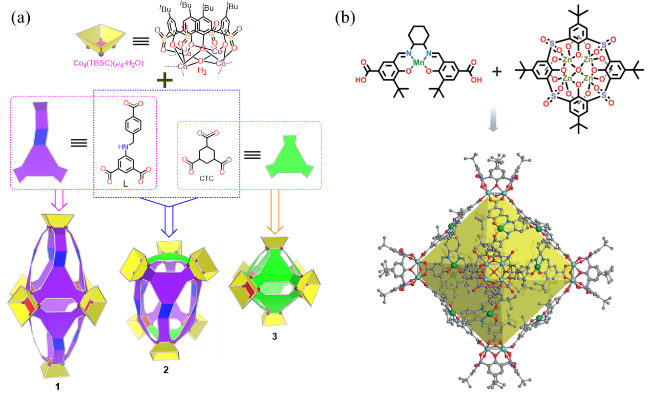
图5 (a)具有畸变八面体结构的配位分子笼设计; 经参考文献[43]许可转载, 版权2022, 作者; (b)手性Mn(salen)修饰的配位分子笼单晶结构示意图. 经参考文献[44]许可转载, 版权2018, Wiley-VCHFigure 5 (a) Design of coordination cage with distorted octahedral structures; Reprinted with permission from ref. [43], Copyright 2022 The Authors; (b) Single-crystal X-ray structure of the chiral Mn(salen)-functionalized coordination cage. Reprinted with permission from ref. [44], Copyright 2018 Wiley-VCH |
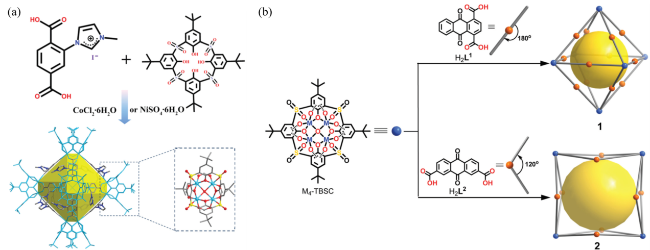
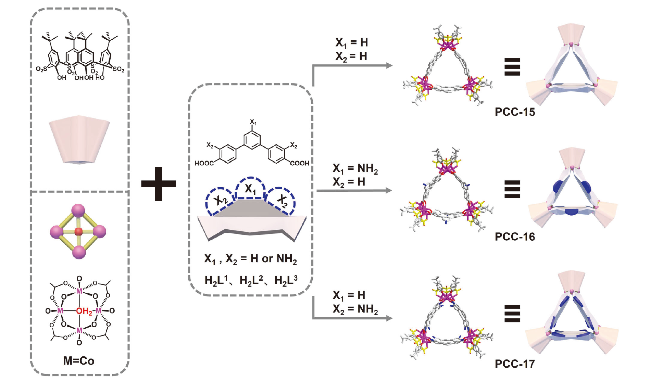
图7 通过配体工程精确调控活性位点间距的电性同构三棱柱状配位分子笼(PCC-15、PCC-16、PCC-17)的合成. 经参考文献[47]许可转载, 版权2026, 作者Figure 7 Synthesis of electrically isostructural trigonal-prismatic PCCs (PCC-15, PCC-16, PCC-17) with precisely tuned interactive site distances via ligand engineering. Reprinted with permission from ref. [47], Copyright 2026 The Authors |
3.3 基于限域空间内封装客体的催化
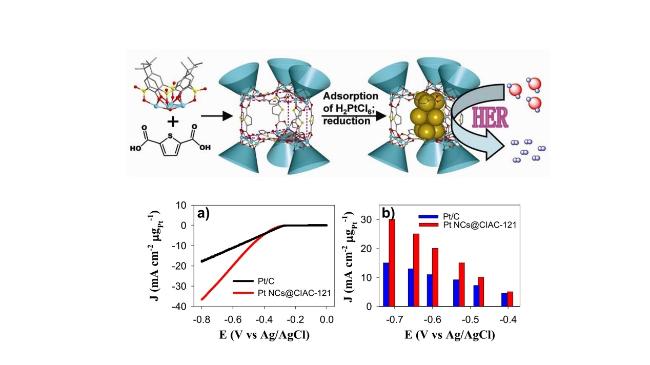
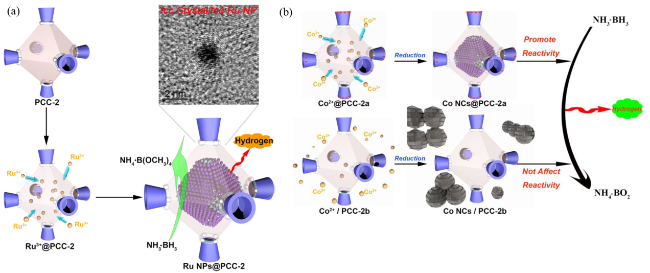


图9 配位分子笼封装(a)钌和(b)钴纳米粒子用于氨硼烷催化水解反应. 经参考文献[51]许可转载, 版权2018, 作者; 参考文献[52]许可转载, 版权2018, Wiley-VCHFigure 9 Coordination cages encapsulate (a) Ru and (b) Co nanoparticles for the catalytic reaction of hydrolysis of ammonia borane. Reprinted with permission from ref. [51], Copyright 2018 The Authors and ref. [52], Copyright 2018 Wiley-VCH |