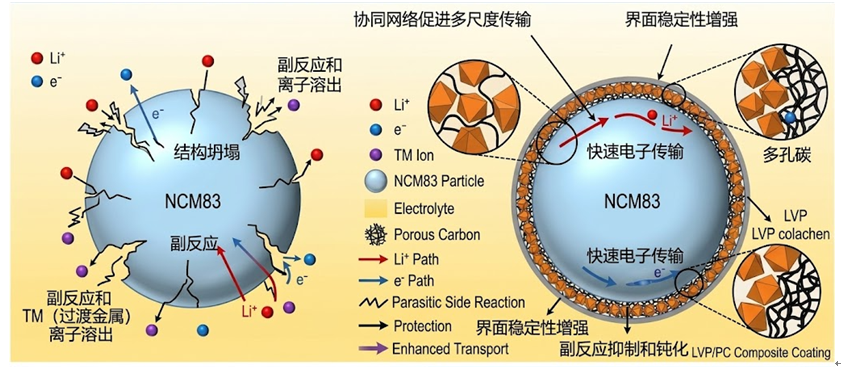
High-nickel ternary cathode materials, known for their high energy density, have become an important direction for the development of cathode materials in lithium-ion batteries. However, their high nickel content increases surface activity, leading to side reactions. Moreover, a series of issues such as cation mixing and microcrack generation also restrict the development of high-nickel cathode materials. To address these issues, this study employs a composite coating of bio-based porous carbon anchored with lithium vanadium phosphate (LVP@PC) to modify the high-nickel cathode material LiNi0.83Co0.12Mn0.05O2 (NCM83), thereby improving its interfacial stability. The results show that the stable three-dimensional olivine structure and high lithium-ion migration rate of lithium vanadium phosphate not only provide effective physical isolation, suppressing interfacial side reactions, but also offer fast channels for lithium-ion migration at the interface. Combined with the high electrical conductivity of porous carbon, the LVP@PC composite coating constructs an efficient hybrid conductive network for electrons and ions, significantly enhancing the kinetic performance of the electrode reaction. The results indicate that the electrochemical performance of the high-nickel cathode material is optimized through multiple synergistic effects. After 200 cycles at 1 C, the specific discharge capacity retention of the modified sample is increased by 12.3%. The charge-discharge platforms under different cycle numbers are more stable, and the voltage difference of the discharge median voltage is reduced, indicating weakened polarization. In rate capability tests, as the rate gradually increases from 0.1 C to 5 C, the specific discharge capacity still reaches approximately 180 mAh·g-1. Observation of the electrodes after galvanostatic charge-discharge cycling tests via scanning electron microscopy reveals that the surface of the NCM83 electrode modified with the lithium vanadium phosphate@porous carbon composite coating is smooth and exhibits tight connections, whereas the surface of the unmodified NCM83 electrode shows cracking textures. This demonstrates that the lithium vanadium phosphate@porous carbon composite coating can inhibit the generation of microcracks and slow their propagation.
Yang fan
,
Chen Xingjie
,
Liang shuo
,
Yu tao
,
Wu zhaoming
,
Lai Chunyan
. Study on Porous Carbon-Anchored Lithium Vanadium Phosphate Modified High-Nickel Cathode Materials[J]. Acta Chimica Sinica, 0
: 1
-1
.
DOI: 10.6023/A26050167
[1] Ding H.; Li S.; Cui X.; Wang P.; Li C.; Jiao S.; Song W.-L.; Zhang N.Chem. Eng. J. 2025, 512, 162287.
[2] He Z.; Su Y.; Luo M.; Wei X.; Cheng Y.; Li Y.; Zhang Z.; Yan R.; Zhao D.; Zhang M.; et al.ACS Appl. Mater.Interfaces. 2025, 17, 5c03449.
[3] Xiao X.; Yin Y.; Song Z.; Yu H.; Wang L.; He X.J. Power Sources. 2025, 652, 237691.
[4] Xie H.; Peng H.; Jiang D.; Xiao Z.; Liu X.; Liang H.; Wu M.; Liu D.; Li Y.; Sun Y.; et al.Chem. Eng. J. 2023, 470, 144051.
[5] Lv F.; Liu J.; Ye Y.; Wu Z.; Wang Q.; Sun Y.; Yuan S.Journal of Energy Storage. 2024, 97, 112828.
[6] Wang L.; Su Q.; Shi W.; Wang Y.; Wang G.; Han B.; Guo J.; Ye R.; Du G.; Zhang M.; et al.J. Power Sources. 2025, 642, 236907.
[7] Barbosa E. C.M.; Du, J.; Pal, A. S.; Kondrakov, A.; Brezesinski, T.Advanced Sustainable Systems. 2025, 9, 2400931.
[8] Wang S.-W.; Zhang J.-X.; Cheng Y.; Zhang L.-H.; Tian H.-J.; Li, B.-H. Acta Chim. Sinica2024, 82, 1134 (in Chinese).
(王舒玮, 张建勋, 成业, 章立寒, 田华军, 李宝华, 化学学报, 2024, 82, 1134.)
[9] Chen W.; Wang K.; He X.; Chen X.; Huang T.; Chen J.; Huang W.; Yang X.; Ren X.; Ouyang X.; et al.Nano Energy. 2025, 139, 110950.
[10] Liu S.; Zhou Z.; Jiang J.; Chen S.; Li X.; Yang X.-G.Journal of Energy Storage. 2025, 123, 116751.
[11] Wang Z.-C.; Liu L.; Zhu M.-Y.; Sun Y.; Zhao Q.; Ding Y.-Y.; Ye, F.-C. Acta Chim. Sinica2024, 82, 589 (in Chinese).
(王筑城, 刘磊, 朱梦媛, 孙悦, 赵晴, 丁玉寅, 叶付臣, 化学学报, 2024, 82, 589.)
[12] Teng T.; Xiao L.; Shen L.; Ran J.; Zheng J.; Zhu Y.; Chen H.Mater. Chem. Phys. 2023, 301, 127521.
[13] Chen Y.; Wang M.; Chen J.; Yang J.; Li Z.; Huang Y.; Chen Z.; Zou Y.; Zheng J.; Li X.Mater. Lett. 2020, 271, 127771.
[14] Ma L.; Liu G.; Wang Y.; Xi X. Molecules. 2023, 28, 5165.
[15] Ho V.-C.; Jeong S.; Yim T.; Mun J.J. Power Sources. 2020, 450, 227625.
[16] Zhao S.; Zhu Y.; Qian Y.; Wang N.; Zhao M.; Yao J.; Xu Y.Mater. Lett. 2020, 265, 127418.
[17] Yoon Y.; Shin S.; Shin M. W.ACS Applied Polymer Materials. 2023, 5, 2c01872.
[18] Chen T.; Han S.; Xu J.; Tian R.International Journal of Electrochemical Science. 2023, 18, 100151.
[19] Ma S.; Li Y.; Zhang Y.; Song Y.; Liu L.; Ma J.; Liu J.Energy Technology. 2022, 10, 2200843.
[20] Zhao Y.; Lu D.; Yun X.; Wang J.; Song W.; Xie W.; Zuo L.; Zheng C.; Xiao P.; Chen Y.Small Methods. 2025, 9, 2401221.
[21] Li K.; Chen W.; Duan M.; Liu Z.; Muhtar D.; Yang X.; Ning K.; Xie F.; Lu X.Small. 2025, 21, 2502152.
[22] Liu J.; Wang S.; He J.; Liang K.; Li J.; Huang X.; Ren Y.Journal of Industrial and Engineering Chemistry. 2024, 137, 023.
[23] Liu Y.; Qi C.; Cai D.; Tang X.; Li Y.; Li W.; Shao Q.; Zhang J.Ionics. 2023, 29, 049691.
[24] Lin T.; Ren K.; Liu H.; Li Q.; Lian C.; Li J.Chem. Eng. J. 2025, 515, 163628.
[25] Wang F.; Liang W.; Liu K.; Zhao Y.; Shi L.; Wang Z.; Lv Y.; Wang Y.; Zhang M.; Yuan S.Chem. Eng. J. 2024, 495, 153503.
[26] Zhang X.; Cao L.; Sun H.; Zhao C.; Tian S.; Song J.; Luo L.; Wu Y.J. Alloys Compd. 2025, 1039, 182817.
[27] Wang B.; Wang K.; Ren H.; Wang X.; Hu Z.; Haw S.-C.; Kuo C.-Y.; Chen C.-T.; Kao C.-W.; Chan T.-S.; et al.eScience. 2026, 6, 100509.
[28] Pan Q.; Qin Z.; Lei C.; Peng J.; He Z.; Li Y.; Huo G.; Cheng Y.J. Power Sources. 2026, 662, 238729.
[29] Guo X.; Wang X.; Cui J.; Wu H.; Zhao C.; Liu Z.; Qin Y.; Fang Z.; Li C.Electrochim. Acta. 2026, 549, 148028.
[30] Lin W.; Bao W.; Cai J.; Cai X.; Zhao H.; Zhang Y.; Deng Y.; Yang S.; Zhou Z.; Liu Z.; et al.Appl. Surf. Sci. 2023, 615, 156278.
[31] Yin H.; Zheng J.; Zheng F.; Wen Z.; Shi H.; Zhou Y.; Su M.; Li X.; Naveed A.; Wang H.; et al.Small. 2025, 21, e09808.
[32] Peng F.; Zhang L.; Yang G.; Li Y.; Pan Q.; Li Y.; Hu S.; Zheng F.; Wang H.; Li Q.Chem. Eng. J. 2023, 451, 138911.
[33] Wang J.; Wei J.; Liang D.; Hao L.; Zhang Q.; Zhang H.; Li X.Electrochim. Acta. 2026, 546, 147755.
[34] Bhanuse G. B.; Kumar S.; Fu Y.-P.J. Power Sources. 2026, 665, 239048.
[35] Lee S.; Kim T.; Kim K.; Song G.; Park J.; Lee M.; Jung H.; Park K.; Choi S. H.; Song J.; et al.Adv. Energy Mater. 2025, 15, 2405782.
[36] Zhao Y.; Li R.; Xiao H.; Li P.; Qiao D.; Wang Z.; Liu Y.; Huang Q.Journal of Electroanalytical Chemistry. 2025, 989, 119161.
[37] An L.; Li W.; Wang J.; Liu S.; Jiao K.; Fan L.; Liang J.; Liu Z.; Du Q.Applied Energy. 2024, 355, 122272.


