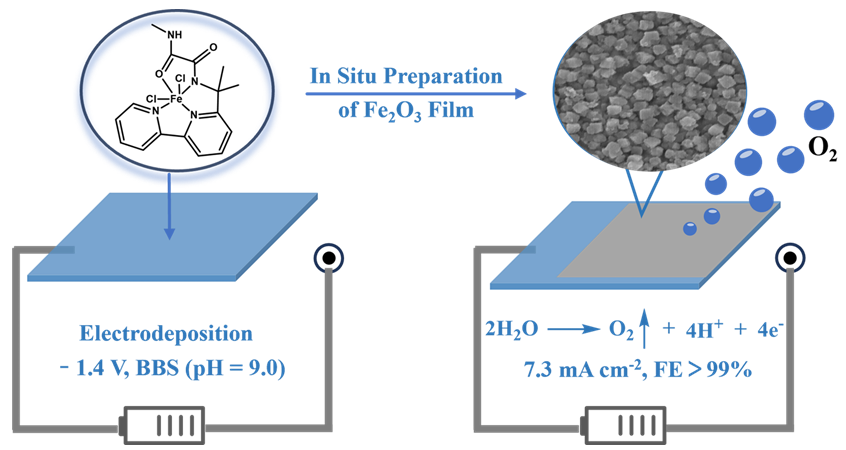
The depletion of petroleum reserves and imminent environmental problems has promoted the pursuit of clean and sustainable energy. Electrocatalytic water splitting to produce hydrogen represents a critical strategy in the field of new energy development. Water oxidation reaction is regarded as the bottleneck restricting the process due to the high energy demanding and slow kinetics process. Development of efficient and stable anode electrodes to enhance the efficiency of water splitting is essential. Here, Fe-based film electrode was in-situ prepared by electrodeposition directly from complex [Fe(bpy-pma)] (bpy-pma=N1-(2-([2,2'-bipyridin]-6-yl)propan-2-yl)-N2-methyloxalamide) in BBS (pH=9.0). The morphology, composition, structure and catalytic activity of the catalytic film were characterized using scanning electron microscopy (SEM), energy-dispersive X-ray spectroscopy (EDX), X-ray photoelectron spectroscopy (XPS) and electrochemical measurements. The results indicate that the surface of the Fe-cat electrode is covered with cubic Fe2O3 nanoparticles. Inductively coupled plasma (ICP) measurements showed that 1.8 μg cm-2 of Fe was deposited on the Fe-cat electrode. The catalytic film exhibits an overpotential of 540 mV at 1 mA cm-2 current density and a Tafel slop of 85 mV dec-1 for water oxidation in carbonate/bicarbonate solution (pH=9.75). A stable current density of 7.3 mA cm-2 over 10 h was observed during controlled potential electrocatalysis (CPE) with an applied potential of 1.3 V. No current attenuation occurred in the longer-term CPE for 24 h. The electrolysis products, H2 and O2, were detected using gas chromatography (GC), yielding a calculated Faradaic efficiency of 99%. During the electrodeposition process, the slow dissociation of ligands effectively suppresses Fe(OH)3 precipitation, yielding ultrathin nanomembranes with uniform density. Compared with FeCl3 as a precursor, ligand coordination not only markedly modulates the film morphology but also greatly enhances the iron loading and electrocatalytic activity. This strategy overcame the problems of poor quality, low efficiency and poor stability of film electrode caused by the precipitation of iron ions under neutral to alkaline conditions.
[1] Chow J.;Kopp R. J. and Portney, P. R. Science,2003, 302, 1528-1532.
[2] Lewis, N. S. and Nocera, D. G., Proc Natl Acad Sci., 2006, 103, 15729-15735.
[3] Chen X.;Li C.;Grätzel M.;Kostecki R. and Mao, S. S., Chem. Soc. Rev.,2012, 41, 7909-7937.
[4] Lubitz W.;Reijerse E. J. and Messinger, J., Energy Environ. Sci.,2008, 1, 15-31.
[5] Dr. Haruo Inoue;Dr. Tetsuya Shimada;Youki Kou;Dr. Yu Nabetani;Dr. Dai Masui;Dr. Shinsuke Takagi and Tachibana, D. H. ChemSusChem,2011, 4, 173-179.
[6] Prato M R. A.;Fransaer J. and Dominguez-Benetton, X., J. Mater. Chem. A,2023, 11, 20824-20838.
[7] Lin J.;Zhang Z.;Guo M.;Zhang H.;Gao M.;Deng R.;Xu C. and Zhang, Q., Sustain Energ Fuels,2026, 10, 99-118.
[8] Chen M.;Wu Y.;Han Y.;Lin X.;Sun J.;Zhang W. and Cao, R., ACS Appl. Mater. Interfaces,2015, 7, 21852-21859.
[9] Li F.;Bai L.;Li H.;Wang Y.;Yu F. and Sun, L. Chem. Commun.,2016, 52, 5753-5756.
[10] Najafpour, M. M. and Hosseini, S. M., Int. J. Hydrogen Energy, 2016, 41, 22635-22642.
[11] Pizzolato E.;Scaramuzza S.;Carraro F.;Sartori A.;Agnoli S.;Amendola V.;Bonchio M. and Sartorel, A., J. Energy Chem.,2016, 25, 246-250.
[12] Zhao Q.;Li D.;Gao G.;Yuan W.;Hao G. and Li, J., Int. J. Hydrogen Energy,2016, 41, 17193-17198.
[13] Kwong W. L.;Lee C. C.;Shchukarev A.;Björn E. and Messinger, J. J. Catal.,2018, 365, 29-35.
[14] Seabold, J. A. and Choi, K.-S.,J. Am. Chem. Soc., 2012, 134, 2186-2192.
[15] Zhu Y. B.;Hua C. Y.;Xie T. T.;Wang G. L. and Feng, P. Z., Chin. J. Inorg. Chem.,2023, 39, 1103‐1112(in Chinese). (朱亚波, 华承烨, 谢婷婷, 王广兰, 冯培忠, 无机化学学报, 2023, 39, 1103-1112.)
[16] Yang S.-H.;Gao N.-N. and Gong Y.-Q.,Chin. J. Inorg. Chem., 2025, 41, 2175-2185(in Chinese). (杨绍华, 高娜娜, 弓亚琼,无机化学学报, 2025, 41, 2175-2185.)
[17] Yang X.-T.;Geng Z.-B.;Kuang S.-L. and Feng, S.-H., Chem J Chinese U,2020, 41, 56-61(in Chinese). (杨小天, 耿智彬, 况思良, 冯守华, 高等学校化学学报, 2020, 41, 56-61.)
[18] Wu Y.;Chen M.;Han Y.;Luo H.;Su X.;Zhang M. T.;Lin X.;Sun J.;Wang L.;Deng L.;Zhang W. and Cao, R., Angew. Chem. Int. Ed. ,2015, 127, 4952-4957.
[19] Chowdhury D. R.;Spiccia L.;Amritphale S. S.;Paul A. and Singh, A., J. Mater. Chem. A. ,2016, 4, 3655-3660
[20] Xu X.;Wei X.-Z.;Liu Q.;Liao F.-J.;Ye C.;Tung C.-H. and Wu, L.-Z., Inorg. Chem. Front.,2025, 12, 6335-6341.
[21] Kamlesh;Mehra P.;Tavar D.;Prakash S.;Sharma R. K.;Srivastava A. K.;Paul A. and Singh, A. Langmuir,2023, 39, 6088-6101.


